TRANSMISSION // 2611.26733v1
NGC 1300’s X-ray sources flicker across the ULX threshold
Source published
Repeated X-ray observations reveal a changing population of ultraluminous sources in NGC 1300—and show why a single snapshot can mislead.
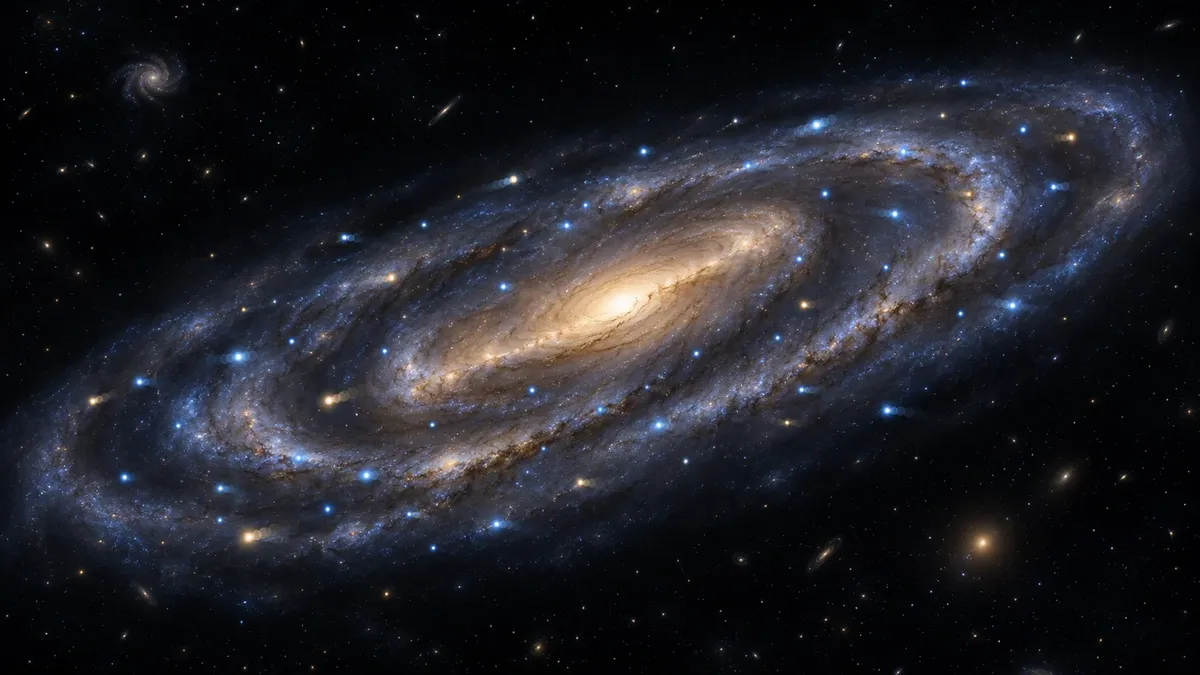
How many ultraluminous X-ray sources does a galaxy have? In NGC 1300, the answer depends partly on when astronomers look. Archival observations show that some sources reach the conventional brightness threshold during bright spells, while others remain luminous more steadily.
Ultraluminous X-ray sources, or ULXs, are exceptionally bright X-ray emitters outside a galaxy’s nucleus. Astronomers define them by an X-ray luminosity of at least 10³⁹ erg per second. Many are thought to be binary systems in which a compact object—a neutron star or black hole—pulls in matter from a companion star. But a source can cross the ULX threshold during a bright spell and fall below it later. That makes a galaxy’s apparent ULX count depend partly on when it is observed.
A team led by Sinan Allak examined whether this effect shapes the X-ray population of NGC 1300, a barred spiral galaxy about 20.7 megaparsecs away. The researchers analyzed 12 archival observations made with NASA’s Chandra X-ray Observatory between 2009 and 2025, and used Swift/XRT observations to add monitoring of selected sources. They searched for sources separately in each Chandra observation, matched detections by position, and estimated brightness in several X-ray energy bands. They tracked both detections and upper limits, then compared changes in luminosity and spectral hardness. They also built an X-ray luminosity function, which describes how many sources are brighter than different luminosity thresholds.
The study reports 42 X-ray sources within the galaxy’s optical extent, including one at its nucleus. Of the 41 sources away from the nucleus, six reached the ULX threshold in at least one observation. Another 13 were classed as candidates: their measured luminosities stayed below the threshold, but their upper uncertainty bounds reached or exceeded it in at least one epoch. These candidates are not confirmed threshold-crossing sources; their classification reflects measurement uncertainty.
The clearest example of dramatic change is X32. It reached a peak luminosity of about 1.5 × 10⁴⁰ erg per second—more than 715 times the minimum luminosity upper limit among observations in which it was not detected. In the team’s analysis, ten sources met its operational definition of a transient: a source had to be undetected in at least one epoch and have a peak luminosity at least ten times the lowest upper limit from its non-detections. Seven sources met a separate threshold for significant long-term variability, and four met both criteria. These definitions describe the measured data; they do not establish a shared physical cause for the changes.
The number of off-nuclear sources reaching the ULX threshold ranged from zero to four across individual Chandra observations. The authors interpret this changing count as evidence that long-term variability strongly affects the observed bright end of the population. Some systems may move above and below the classification threshold, so a single count is not a fixed inventory of equally bright sources. The study’s broader lesson is that repeated observations are needed for a more representative census.
The spectra also resist a simple, shared pattern. The team compared spectral hardness—the balance of higher- and lower-energy X-rays—with brightness. Luminous sources behaved differently from one another, with no common relationship between hardness and luminosity. X32 remained predominantly hard despite its large brightness changes. Its measured X-ray colors were consistent with the empirical region associated with high-mass X-ray binaries, but colors alone cannot identify the system uniquely. The observations also do not determine whether its compact object is a neutron star or a black hole.
Several limitations qualify the results. Many sources produced too few photons for detailed individual spectral fits, so the team estimated luminosities using a common assumed spectral model. Inferred intrinsic luminosities can depend on assumptions about absorption and spectral shape. The epoch-by-epoch luminosity functions were not corrected for incompleteness; apparent features, especially near the faint end, may therefore reflect uneven sensitivity rather than the population’s true structure. The authors also estimate substantial contamination by unrelated background active galaxies, particularly among faint sources. X-ray data alone cannot cleanly separate high-mass binaries associated with recent star formation from low-mass binaries associated with older stars.
The findings are presented in an arXiv manuscript whose text is marked “A&A proofs” and whose acknowledgments thank an anonymous referee for careful review and comments. This article relies on the supplied manuscript and does not independently verify its publication status. The central observational point is that, in NGC 1300, source variability makes the observed ULX census depend on the epoch. A single observation offers a snapshot, not the full picture.
- NGC 1300
- ultraluminous X-ray sources
- Chandra
- X-ray binaries
- X-ray variability
- astrophysics
Related reading
Automatically matched by shared topic keywords. These links do not imply that the sources agree or establish a consensus.