TRANSMISSION // 2611.26728v1
How Be-Star Disks Reveal Uneven Gas Patterns
Source published
CHARA observations from 2020 suggest strong disk asymmetries around two Be stars and weaker ones around two others. Limited coverage and a simplified model leave important uncertainties.
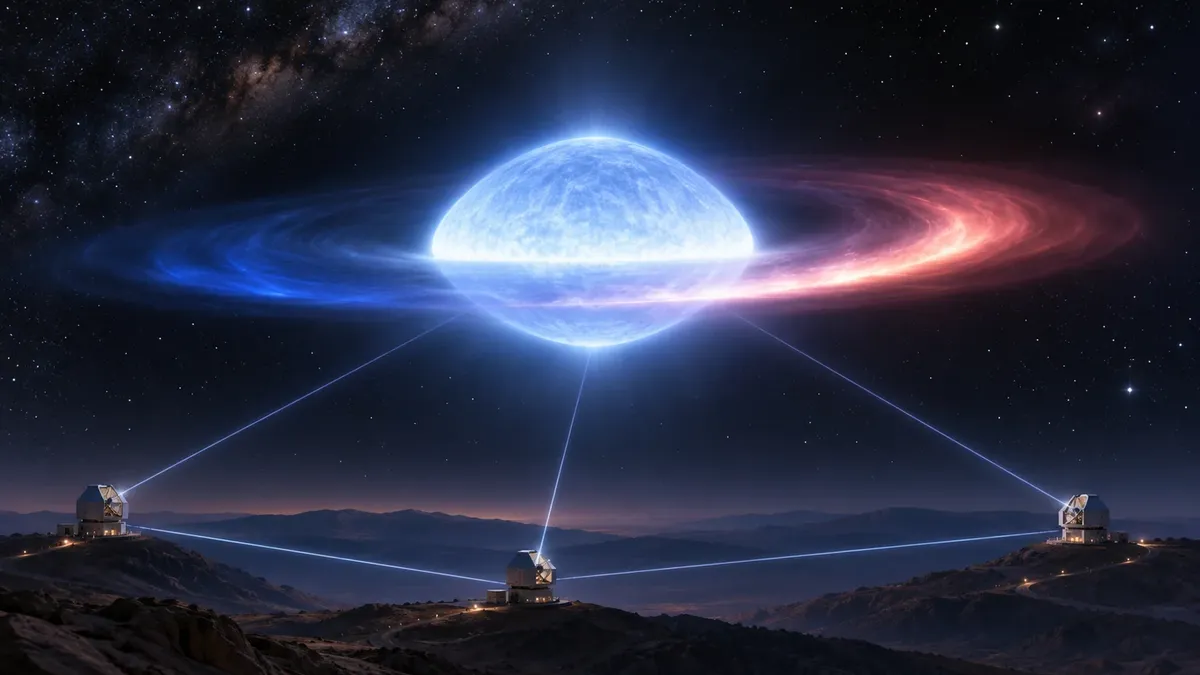
Be stars are fast-spinning stars surrounded by gas disks whose changing brightness may reflect large-scale patterns. Researchers combined H-alpha spectra and interferometry to examine four stars—but the 2020 observations are a snapshot, not a movie.
A changing pattern in starlight
Be stars are hot, rapidly rotating stars surrounded by disks of gas flowing outward from them. The gas emits a distinctive spectral feature: the H-alpha line. In many Be stars, this line has two peaks, one shifted toward blue wavelengths and one toward red. If the disk were evenly arranged, the peaks would tend to have similar strengths. When one is brighter, it can be a clue that the disk’s light is unevenly distributed.
One possible explanation is a global disk oscillation: a slowly changing pattern that creates regions of higher and lower gas density, often described as a one-armed spiral. As the pattern moves around the star, the blue and red peaks can change relative strength. But a spectrum alone does not show exactly where the emitting gas sits. The study asks whether measurements that track both wavelength and apparent position on the sky can reveal disk asymmetries.
Combining a spectrum with interferometry
The team studied four Be stars: γ Cas, φ Per, ζ Tau, and β CMi. Using the VEGA instrument at the CHARA Array, they measured how the stars’ H-alpha emission appeared across different wavelengths. The observations were made in November and December 2020, over several weeks, and sampled a limited set of telescope orientations and spatial frequencies.
The researchers considered three kinds of evidence together: the H-alpha line’s shape, changes in interferometric visibility amplitude, and changes in interferometric phase. In accessible terms, visibility amplitude gives information about how extended the light source appears, while phase indicates shifts in the light’s apparent center. Different wavelengths in the line correspond to gas moving at different speeds along our line of sight, so these measurements connect gas motion with its apparent position.
To interpret the observations, the authors built a model that calculates emission from the star and disk, then adds a simplified spiral density pattern. They adjusted disk and pattern parameters to fit the interferometric measurements and spectra taken near the same time. They also compared asymmetric-disk fits with a symmetric-disk reference. Some stellar and disk-orientation parameters were adopted from earlier studies rather than determined freely from these observations.
What the snapshot suggests
The model fits point to strong asymmetries in γ Cas and φ Per at the time of observation. Both stars then had particularly strong H-alpha emission. For ζ Tau and β CMi, the fits suggest weaker asymmetries, consistent with relatively modest line-peak variations reported around that period.
These are not equally clear, direct maps of four spirals. The data and models match only partly, and the interferometric coverage was limited. Only a few observations of γ Cas and φ Per had sufficient quality for comparison, restricting how much their disk structures could be diagnosed. The authors report mismatches between model predictions and observed line profiles or visibility curves. In γ Cas and φ Per, the model cannot reproduce an extra peak in the line profile; the paper discusses binary companions as one possible contributor to more complex structures in the outer disk.
The model is intentionally simple. Among other assumptions, it represents asymmetry with an idealized spiral pattern, does not include some changes in gas motion or structure away from the disk plane, and omits the disk’s continuum light near H-alpha. It also does not fully model the tidal effects of companion stars. In some fits to γ Cas and φ Per, the inferred density-enhancement parameter reaches the model’s upper limit. The authors caution that this is not a reliable physical measurement of the real density contrast; it may signal missing physics. They describe the fitted parameters as phenomenological: a way to summarize the data, not a complete account of the disks.
Why more observations matter
This study captures one period in the stars’ changing behavior, not the evolution of their disk patterns. A single observing epoch cannot establish how those patterns move, grow, or fade. The authors argue that repeated interferometric observations, with broader coverage and improved spectral detail, could test these changes and produce sharper images of gas at different wavelengths. More complete physical models will also be needed to distinguish oscillation patterns from other structures, including those shaped by companions.
The supplied manuscript identifies itself as submitted to the Astronomical Journal and says it was published on November 19, 2026. Its acknowledgments thank an anonymous referee for comments that led to improvements. Those comments do not, by themselves, establish the manuscript’s final journal publication or review outcome. The findings are the authors’ interpretation of a limited 2020 data set using a deliberately simplified model—not a definitive picture of how all Be-star disks behave.
- Be stars
- stellar disks
- optical interferometry
- H-alpha spectroscopy
- global disk oscillations
- CHARA Array
Reviewed cross-references
These connections were reviewed by a model, not independently fact-checked by a human. Similarity does not imply agreement; consult the original papers and the evidence below.
Could the Moon Become a Giant Optical Observatory?
Shared method: Both papers discuss optical long-baseline interferometry: the Be-star study uses CHARA/VEGA spectro-interferometry to measure H-alpha disk emission, while the lunar-observatory review identifies CHARA as an existing OLBI facility and discusses future interferometric arrays. The lunar concepts are prospective and differ in scale and design, so this is a methodological connection, not evidence that those facilities have observed Be-star disks.
Model review: · openai-codex/gpt-6-luna
Evidence and provenance
Selected excerpts, not complete papers. PDF extraction can omit figures or damage equations, tables and reading order; sources may be preprints.
2611.26728v1 — Original paper
Excerpt reference:
static/papers/2611.26728v1.md:115-152
Basis: Paper text
Source SHA-256:a98ab94042a5308634e9112f7ac028b6d9686be97c907710ebdcb31b284060d92611.05434v1 — Original paper
Excerpt reference:
static/papers/2611.05434v1.md:768-817
Basis: Paper text
Source SHA-256:9b409921dbb9c4e4e24f10a1b1a550e21cf7eac3156604536846c6f74ac043bf
Related reading
Automatically matched by shared topic keywords. These links do not imply that the sources agree or establish a consensus.
Measuring stars more directly sharpens the sizes of their planets
Source published
Shared keywords: chara array
Four stars put stellar models to the test
Source published
Shared keywords: chara array
Quantum sensing proposal aims to stop gravitational-wave signals cancelling out
Source published
Shared keywords: optical interferometry
Could the Moon Become a Giant Optical Observatory?
Source published
Shared keywords: optical interferometry