TRANSMISSION // 2611.26724v1
How Two Optical Cavities Could Switch Molecular Vibrations
Source published
A theoretical study predicts that linked plasmonic and Fabry–Pérot cavities could produce history-dependent optical and vibrational states, along with pulse-driven stepwise changes in collective molecular excitation.
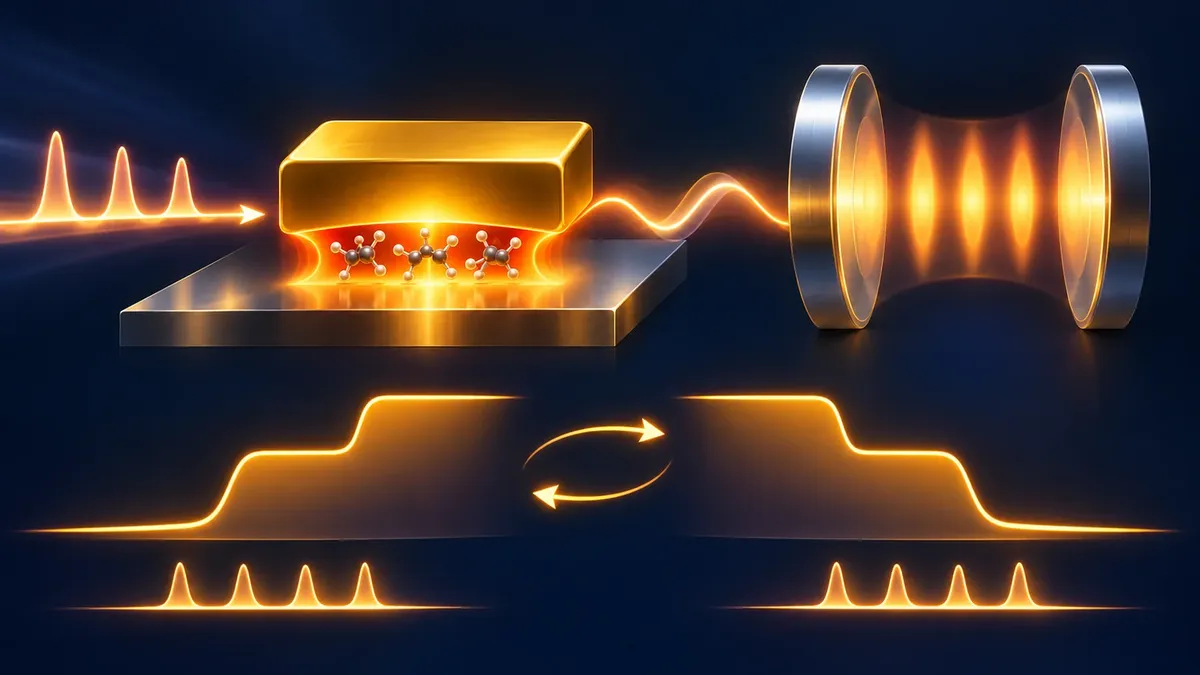
Can light make molecular vibrations respond differently depending on what happened before? A theoretical study explores this possibility in a system of molecules coupled to two linked optical cavities. Its calculations predict hysteresis and pulse-driven vibrational staircases, but do not demonstrate a molecular memory experimentally.
A switch usually has a clear setting: change the input, and it changes state. In some nonlinear systems, however, the response depends on the route taken to reach that input. This effect, called hysteresis, means that the same drive can produce different outputs depending on the system’s history. Hugo Molinares and colleagues investigate whether this kind of memory-like behavior could arise when light interacts with molecular vibrations.
Their proposed setup combines a plasmonic nanocavity, a Fabry–Pérot (FP) optical cavity, and an ensemble of vibrating molecules. The plasmonic cavity confines light where it interacts with the molecules. The FP cavity supports a second optical mode, coupled to the plasmonic one. The authors ask how this additional cavity changes the response to steady and pulsed light, and whether it can help control molecular vibration populations.
A model of coupled light and vibrations
The researchers describe the system with equations for the plasmonic field, the FP cavity field, and a collective molecular-vibration mode. They use a mean-field approximation: rather than tracking every fluctuation and correlation, they calculate average amplitudes and populations. For the steady-state analysis, they derive a relation between optical drive strength and plasmonic population, then examine when multiple steady solutions are possible and assess their stability.
They also simulate time-dependent protocols. To study hysteresis, they raise and then lower the drive while following the populations of both optical modes and the molecular vibrations. For the pulsed study, they apply sequences of pulses to the plasmonic mode and examine how the dynamics change when the FP mode is driven as well.
Two kinds of history-dependent response
In the simulations, increasing and decreasing the drive produce different paths through the system’s populations. At some drive values, the system can occupy a low- or high-population state depending on its earlier evolution. The authors identify this as dynamical hysteresis, associated with bistability: two stable steady states coexist over a range of conditions.
The FP cavity helps determine where that bistable behavior occurs. In the analytical treatment, its coupling to the plasmonic cavity changes the effective optical linewidth and detuning—the width and frequency offset that shape the optical response. Collective molecular interaction adds an effective nonlinearity. The calculations therefore predict that the bistable region can be adjusted by changing the cavity–plasmon coupling, optical detuning, or number of molecules.
Pulses produce another pattern. With the plasmonic mode driven, the simulated collective molecular-vibration population rises in steps, forming successive plateaus. Coupling to the FP cavity can bring higher population levels within reach earlier in the simulated dynamics, with the effect depending on cavity detuning. When both optical modes are driven, the calculations instead show a large initial vibrational excitation followed by stepwise decreases. The staircase’s direction thus depends on the driving configuration and the state left by previous pulses.
What the results do—and do not—show
This is a theoretical proposal, not an experimental demonstration of molecular switching or memory. The results come from deterministic mean-field simulations. Thermal fluctuation effects are not modeled in those dynamics, and the authors identify photothermal effects from absorption in the metallic nanocavity as outside the model.
The paper argues that the parameter ranges used in its calculations are compatible with scales reported for related molecular-optomechanical and hybrid-cavity platforms. That motivates exploring the proposal, but does not establish that the complete system or its predicted switching behavior has been built and verified.
If confirmed, control over distinct vibrational population levels could be relevant to nanoscale memory or multilevel information processing. For now, these are potential applications, not demonstrated capabilities. The study’s central contribution is a model showing how cavity design and driving sequences might shape history-dependent molecular dynamics.
The paper is a version 1 preprint on arXiv. Preprints may not yet have undergone peer review, so the findings should be treated as provisional.
- molecular optomechanics
- hysteresis
- plasmonic nanocavity
- Fabry–Pérot cavity
- molecular vibrations
- mean-field model
- optical switching
Related reading
Automatically matched by shared topic keywords. These links do not imply that the sources agree or establish a consensus.