TRANSMISSION // 2611.26710v1
Little Red Dots at Cosmic Noon: What Spectra Reveal
Source published
Spectra from Keck, the VLT and Magellan identify four likely Little Red Dots among six candidates with broad Hα. Many other targets remain ambiguous.
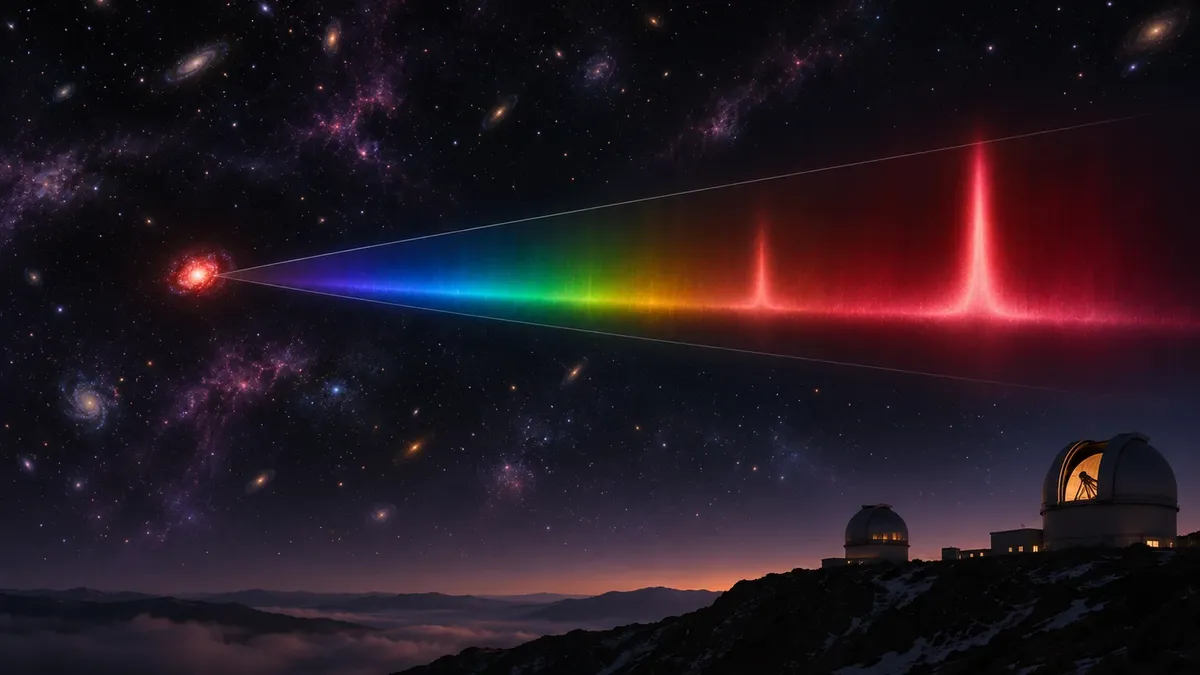
Little Red Dots are compact, unusually coloured objects often associated with accreting black holes. A study of candidates at a later cosmic era finds four with several characteristic spectral features—but its small, selectively observed sample leaves many candidates unresolved.
Little Red Dots (LRDs) are compact objects whose light often looks blue at ultraviolet wavelengths and red at optical wavelengths, producing a distinctive “V-shaped” spectrum. Many show broad hydrogen emission lines, which can indicate activity around a supermassive black hole. Most known LRDs are found at earlier cosmic times. This study asks whether objects selected as LRD candidates at “cosmic noon”—roughly the era when the universe was about 2–3 billion years old—share the same telltale properties.
The researchers began with 266 unresolved sources selected from deep ground-based imaging across 19.9 square degrees. Their colours were chosen to resemble the V-shaped appearance of LRDs. They obtained near-infrared spectra for 24 candidates using Keck/NIRES, the VLT’s X-shooter and Magellan/FIRE, looking especially for Hα, a hydrogen emission line that falls in the near-infrared for objects at these distances. They fitted different mathematical shapes and components to the lines, and compared the candidates’ colours and other measurements with published LRD and reddened-quasar samples. They also checked available archival Chandra X-ray data and, for one object, JWST spectroscopy.
Six of the 24 observed candidates showed broad Hα. Exponential profiles were preferred in the researchers’ comparisons of possible line models, though Gaussian alternatives were not ruled out for every source. Four of those objects also had several other features associated with JWST-selected LRDs: V-shaped continua, estimated Hα-to-Hβ ratios well above the standard expectation, and, in three cases, evidence of Balmer absorption. Hβ itself was not detected in any of the six. The ratios were therefore estimated by fitting Hβ using parameters from the Hα fits, rather than measured from a detected Hβ line, and carry substantial uncertainty. The four were not detected in X-rays where observations were available, though only two had usable Chandra coverage. Archival JWST imaging and spectroscopy independently confirmed one source as an LRD.
The other two broad-line objects appear less like canonical LRDs. One was detected in X-rays at a luminosity the authors describe as typical of ordinary active galactic nuclei; the other had a strong mid-infrared detection and did not meet the study’s continuum-slope criteria. The comparison also suggests that colour alone is not enough to distinguish LRDs from reddened quasars: some quasars meet the LRD-like colour criteria, and their spectra are needed to test the classification.
The non-detections are not a clean verdict. Of the 18 candidates without detected broad Hα, four have Lyα-based redshifts that put Hα outside the observed wavelength range for two. The remaining 14 have only photometric redshifts, so it is uncertain whether Hα fell within the spectra. If it did, the line could have been fainter than the study’s detection limit, or the estimated redshift or LRD classification could be wrong. The authors note that longer observations were given to targets after Hα was detected, so the six detections cannot be treated as a straightforward measure of how often the selection method succeeds.
The study therefore supports a measured conclusion: some candidates selected from ground-based imaging at cosmic noon have a combination of properties resembling LRDs found at earlier times. It does not establish how common these objects are, or determine what powers their unusual spectra. The high hydrogen-line ratios could reflect dense gas, obscuration, or other effects; the observations do not settle their relative roles. Likewise, black-hole masses and accretion rates inferred from standard active-galaxy formulas are highly uncertain because those formulas may not apply to LRDs.
These results come from a preprint submitted to a journal, not a final peer-reviewed publication. The small number of confirmed candidates, incomplete redshift information and uneven X-ray coverage limit how broadly the findings can be applied. Deeper spectroscopy and X-ray observations could help distinguish faint lines from incorrect redshifts or mistaken classifications, and clarify the physical conditions around these objects.
- Little Red Dots
- galaxy spectroscopy
- cosmic noon
- Hα emission
- active galactic nuclei
- early universe
Reviewed cross-references
These connections were reviewed by a model, not independently fact-checked by a human. Similarity does not imply agreement; consult the original papers and the evidence below.
Little Red Dots Thin Out, but Keep a Similar Brightness Profile
Shared method: Both papers use HSC-selected cosmic-noon LRD candidates and Keck, VLT, and Magellan spectroscopy to identify broad Hα; the abundance paper and the origin paper report overlapping follow-up results, so this is a methodological and sample connection, not independent confirmation.
Model review: · openai-codex/gpt-6-luna
Evidence and provenance
Selected excerpts, not complete papers. PDF extraction can omit figures or damage equations, tables and reading order; sources may be preprints.
2611.26710v1 — Original paper
Excerpt reference:
static/papers/2611.26710v1.md:56-105
Basis: Paper text
Source SHA-256:36e823e76d298c9b2542a778d75c5bdf9259a5854d1943cd9c2544722301657f2611.26685v1 — Original paper
Excerpt reference:
static/papers/2611.26685v1.md:57-120
Basis: Paper text
Source SHA-256:334d0a5d9d7a525559500840574db61ad24f837a53cdd4dadbd6bbf959cfbea5
Related reading
Automatically matched by shared topic keywords. These links do not imply that the sources agree or establish a consensus.
Little Red Dots Thin Out, but Keep a Similar Brightness Profile
Source published
Shared keywords: cosmic noon, early universe, little red dots
How JWST Could Trace the Seeds of the First Massive Black Holes
Source published
Shared keywords: early universe, little red dots
JWST counts faint galaxies to trace a busy era of star formation
Source published
Shared keywords: cosmic noon
Why early black holes may need a fast cosmic gas supply
Source published
Shared keywords: little red dots
Could Little Red Dots Help Explain IceCube’s Neutrinos?
Source published
Shared keywords: early universe, little red dots