TRANSMISSION // 2611.26708v1
A New Spectral Library for Astrophysical Shocks
Source published
A MAPPINGS V library models shock spectra with time-dependent precursor ionization, updating predictions used to interpret spectra from supernova remnants and galaxies.
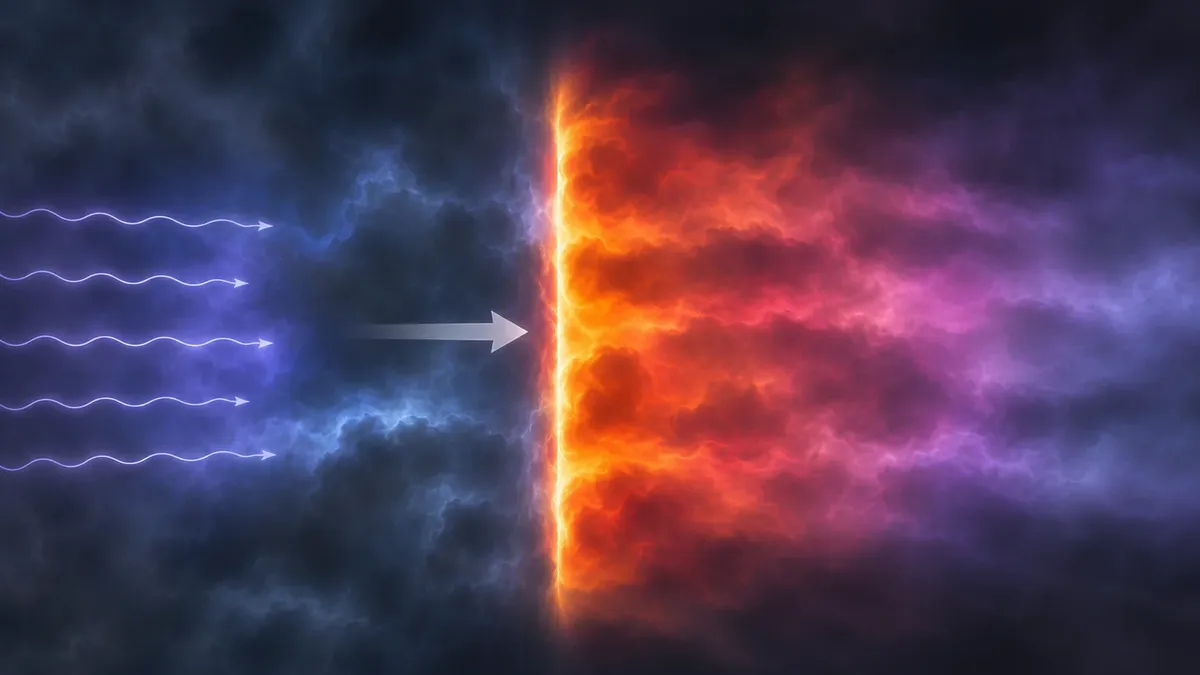
Shocks heat and compress gas, producing light that astronomers can study in spectra. A new model library updates predictions for that light by treating ionization in the gas ahead of a shock as a time-dependent process linked to the shocked flow.
When fast-moving gas plows into its surroundings, a shock forms: material heats up, compresses and radiates. Astronomers compare the resulting emission lines with models to help interpret spectra from places such as supernova remnants and galaxies with active galactic nuclei (AGN). But those comparisons depend on how the shock and surrounding gas are modeled. Yifei Jin and colleagues present a new library of simulated shock spectra made with the MAPPINGS V code.
The central question is how predictions change when models account for the gas just ahead of the shock, called the precursor. Radiation from hot gas behind the shock can travel upstream and ionize this material before it crosses the shock front. Earlier MAPPINGS III grids, including the widely used grid published by Allen and colleagues in 2008, treated the precursor as photoionized gas in equilibrium and calculated it separately from the shocked flow. That approximation may be unsuitable when gas passes through the precursor too quickly to reach an ionization-and-recombination balance.
The authors calculate the precursor consistently with the post-shock flow, including time-dependent and nonequilibrium ionization and the transfer of ionizing radiation across the shock front. This describes changes during the gas’s finite passage through the modeled precursor; it is not a claim that the library tracks an observed object changing over time. MAPPINGS V also uses updated atomic data, including the CHIANTI 10 database, and a more robust adaptive-mesh shock solver. The library covers shock speeds from 50 to 1,000 kilometres per second, preshock hydrogen-nucleus densities from 0.01 to 100 per cubic centimetre, a range of magnetic-field strengths, and several abundance choices. The library is available through Zenodo; the code version used for the calculations is also archived there, while MAPPINGS V is regularly updated on GitHub.
The time-dependent treatment matters because precursor gas may not have time to settle into equilibrium. In the paper’s example of a 150-kilometre-per-second shock, the modeled time-dependent precursor is shorter than the equilibrium version. The authors report that cooling is ineffective at the precursor’s leading edge during the finite time considered. Their comparisons also find that the older equilibrium method overestimates precursor emission in the models examined; this is not a claim about every possible shock condition. Differences in the precursor affect predicted emission-line ratios—the relative brightness of particular spectral lines—which researchers compare with observations.
The new and older grids show similar overall trends, but their predictions are not interchangeable. The MAPPINGS V shock grids are more compact on BPT diagnostic diagrams. Specific line-ratio differences depend on conditions: for example, in the MAPPINGS V models, total [O I]/H-alpha stays roughly flat above shock speeds of 400 kilometres per second, while it rises with speed in the MAPPINGS III comparison models. At those higher speeds, [S II]/H-alpha decreases in MAPPINGS V, whereas it increases slightly in MAPPINGS III. These examples show why changes between grids need to be considered line by line and in context.
The authors compare their models with galaxy spectra from the Sloan Digital Sky Survey. Shock-only and combined shock-plus-precursor grids agree with the AGN branch on BPT diagrams, but this agreement does not establish that shocks power any particular galaxy. The comparison also varies by diagram and abundance: on the [N II]/H-alpha diagram, low-metallicity shock models merge with the star-forming branch. The authors identify the [O I]/H-alpha diagram as a potentially useful way to separate shock-dominated sources from star-forming galaxies in their model comparison. It is not presented as a definitive diagnostic, and integrated galaxy spectra can mix shock emission with light from star-forming regions.
For candidate supernova remnants in M31 and M33, observed line ratios agree with model grids for shock speeds above about 85 kilometres per second. The best-fitting abundance grids are one solar for M31 and 0.4 solar for M33; these are model-grid matches, which the authors compare with estimates for the host galaxies. The contribution of a precursor in real remnants remains uncertain because it may not be fully developed.
These are model comparisons, not direct measurements of shock conditions in every object. Spectra depend on speed, density, magnetic field, abundance and effective shock age, so line ratios may not point to a unique physical setup. The library also assumes plane-parallel geometry; real shocks can be more complex, and the authors identify three-dimensional modeling as future work. The paper is posted as an arXiv preprint. ArXiv posting alone does not establish peer-review status, which readers should check separately.
- radiative shocks
- MAPPINGS V
- precursor ionization
- emission-line spectra
- supernova remnants
- AGN outflows
Related reading
Automatically matched by shared topic keywords. These links do not imply that the sources agree or establish a consensus.
W49B’s shocked clouds point to intense cosmic-ray ionization
Source published
Shared keywords: supernova remnants
Can cosmic rays gain a second boost behind a supernova shock?
Source published
Shared keywords: supernova remnants
Why Two Gamma-Ray Components Sometimes Form Separate Peaks
Source published
Shared keywords: supernova remnants