TRANSMISSION // 2611.26702v1
How SACP Handles Noisy Image Labels
Source published
SACP models how observed labels may arise from underlying image classes, retaining uncertainty as it adapts a vision-language model.
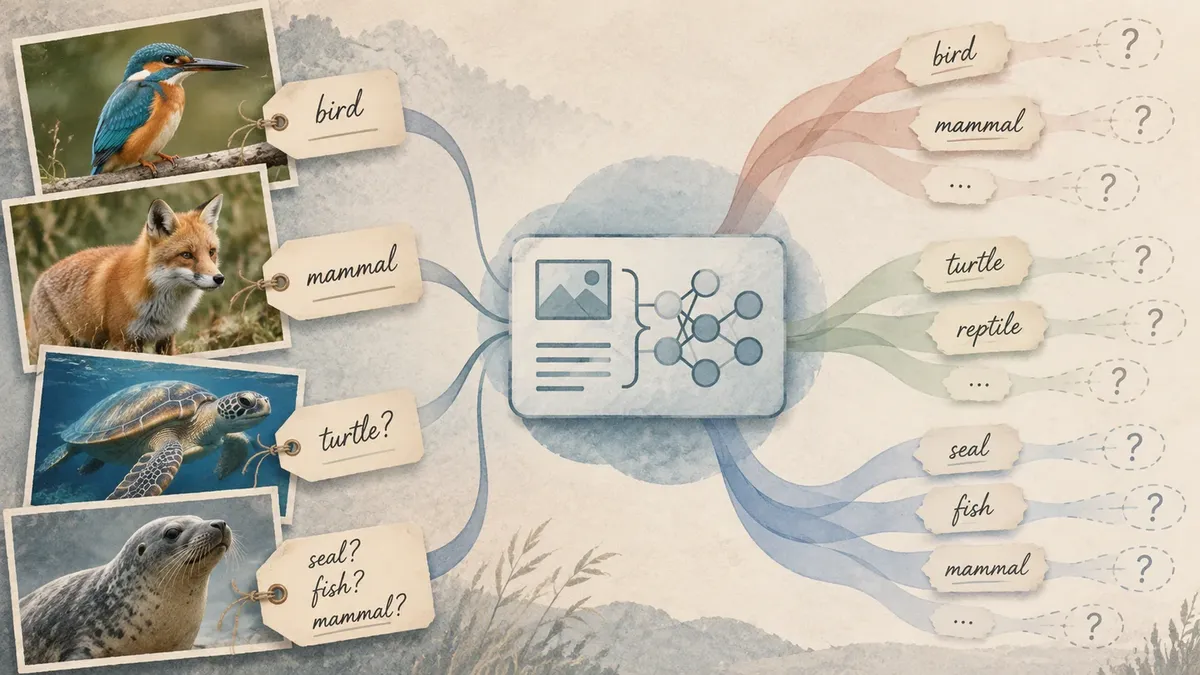
Image datasets can contain incorrect labels, a challenge for models trained from only a few examples. SACP is a proposed approach that estimates how an observed label could have arisen from an image’s underlying class, rather than simply accepting or discarding it.
A mislabeled image can be difficult to learn from, especially when training examples are scarce. The challenge is not only to spot questionable labels: errors may follow patterns, such as confusion between semantically related classes, and may vary from image to image. This paper asks whether prompt learning for vision-language models can be made more robust by modeling how observed annotations are generated.
The authors introduce SACP, short for Semantic-aware Annotation Channel-based Prompt learning. Prompt learning adapts a pretrained vision-language model by optimizing a small set of prompt tokens. In the experiments described here, the image and text encoders remain frozen while those tokens are learned.
Modeling the annotation process
SACP separates two questions: which class best fits the image, and how likely is the image’s underlying class to produce the label that was observed? The second question is represented by an “annotation channel”—a model of the relationship between a possible clean class and the recorded annotation.
The channel draws on semantic anchors from the pretrained model and image features. More specifically, the paper describes using the mismatch between an image feature and class anchors to model the chance of a label flip, anchor similarities to guide which incorrect classes might be assigned, shared low-dimensional projections to capture image-specific variation, and a uniform component for random corruption.
SACP combines the prompt classifier’s class predictions with the channel’s estimate of annotation likelihood. It then computes a probability distribution over possible clean labels. Rather than immediately replacing a questionable label with one certain answer, the method can preserve competing possibilities. A generalized expectation-maximization procedure uses these soft estimates to optimize the prompts and annotation channel. At inference, a memory stores image features alongside their inferred label distributions, allowing predictions to draw on this uncertainty-aware information.
What the experiments report
The paper evaluates SACP on five datasets with synthetically corrupted labels: Caltech101, DTD, Flowers102, OxfordPets and UCF101. It also tests Food101N, which contains real-world noisy labels. For the synthetic tests, the authors use symmetric noise, in which labels are replaced by other classes, and asymmetric noise, in which corruption favors semantically similar classes. The default setup uses 16 examples per class, and classification accuracy is measured on clean test sets. Reported results are averaged over three runs.
Compared with NA-MVP, the strongest comparison method identified by the authors, SACP’s average performance is reported as higher by 2.10 percentage points under symmetric noise and 4.28 percentage points under asymmetric noise. On OxfordPets at 50% asymmetric noise, the paper reports a 10.17-percentage-point improvement. On Food101N, SACP reports higher accuracy than the two listed comparison methods across the tested 4-, 8-, 16- and 32-shot settings. These are findings from the paper’s benchmarks and experimental setup, not guarantees for other datasets or uses.
The paper also reports an ablation on DTD at 50% symmetric and asymmetric noise. Removing the semantic channel, semantic constraints, generalized expectation-maximization, or posterior-aware memory is associated with lower scores in that specific test. This limited comparison does not establish that each component will help equally in other datasets or conditions.
Limits and uncertainty
Five of the six datasets use synthetic label corruption with specified patterns and rates; Food101N provides the real-world noisy-label test. The results therefore offer evidence across several benchmark settings, but they do not show how SACP will perform across all kinds of real-world annotation errors. The main experiments focus on few-shot classification using particular encoders and training choices.
The authors also warn that pretrained vision-language models may contain biases, which label refinement could carry forward. They recommend checking performance by class and maintaining human oversight in sensitive applications. This work is an arXiv preprint; the supplied source does not establish peer-review status. As with any proposed method, broader evidence would be needed to know how reliably results transfer beyond the reported experiments.
The paper’s central idea is to treat a noisy label as uncertain evidence: potentially informative, but not necessarily correct. SACP offers one way to model that uncertainty while adapting a vision-language model.
- vision-language models
- noisy labels
- prompt learning
- few-shot learning
- image classification
- machine learning
Related reading
Automatically matched by shared topic keywords. These links do not imply that the sources agree or establish a consensus.
Better AI training may start with where the data came from
Source published
Shared keywords: image classification
ACTOR uses delayed labels to improve later image classifications
Source published
Shared keywords: image classification, vision language models
A simple learning rule may help digit recognition withstand image corruption
Source published
Shared keywords: image classification, machine learning
AutoRefine adjusts AI code reviewers using software workflow outcomes
Source published
Shared keywords: noisy labels
When “Hyperbolic” AI Geometry Behaves Almost Euclidean
Source published
Shared keywords: machine learning, vision language models