TRANSMISSION // 2611.26701v1
Gaia data reveal a vast map of aging Milky Way stars
Source published
A machine-learning study classifies hundreds of thousands of oxygen-rich and carbon-rich AGB stars in Gaia data, then uses their positions to explore the Milky Way’s structure and history.
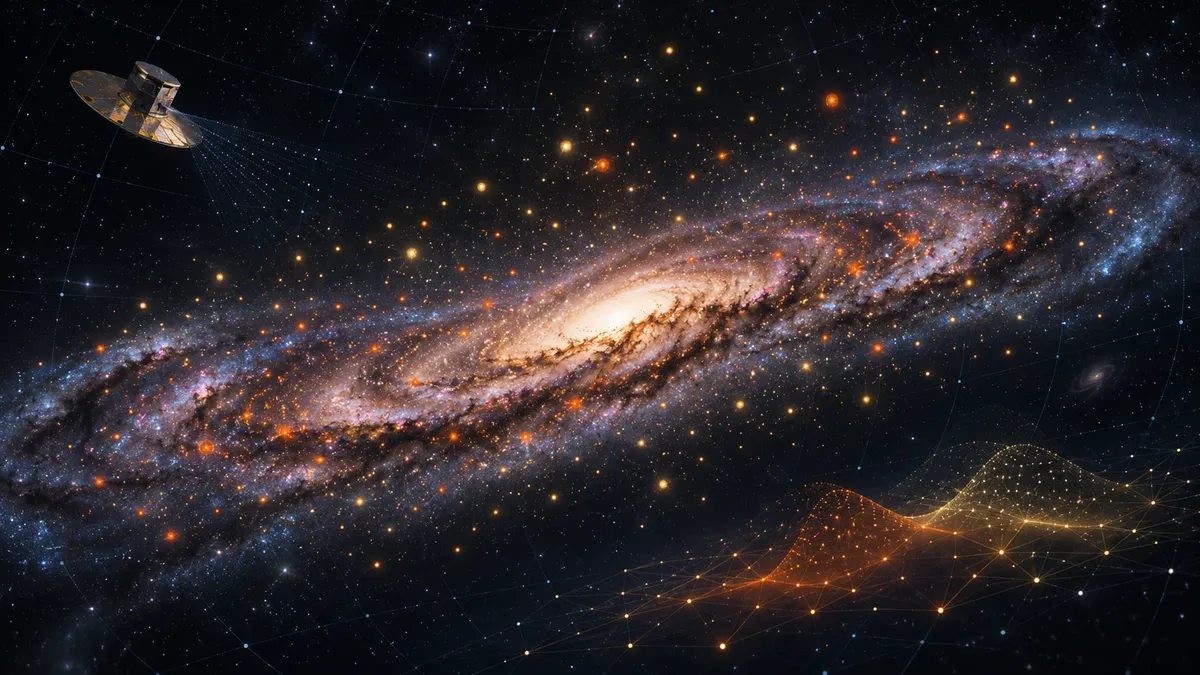
As stars age, many swell into giant stars and return material—including dust—to space. A new study uses machine learning to identify two chemically distinct kinds of these stars across Gaia’s enormous catalogue, and examines what their locations may reveal about the Galaxy.
Finding aging stars in a vast catalogue
Asymptotic Giant Branch (AGB) stars are late-life stars that can shed gas and dust into their surroundings. Their chemistry varies: some are carbon-rich, while others are oxygen-rich. Locating the two groups across the Milky Way can help astronomers study stellar evolution, dust sources and the Galaxy’s structure.
The challenge is scale. Gaia’s third data release contains measurements for a huge number of sources, and identifying AGB stars by hand is impractical. In this study, Tanya Kushwaha and colleagues use machine learning to classify Galactic AGB candidates in Gaia DR3.
A two-step classification
The researchers describe a two-step approach. First, they select sources based on similarity to known examples. Then an XGBoost machine-learning classifier combines colour information with spectroscopic features to assign classifications. The abstract says the method was designed to work on a dataset of roughly 140 million sources, while relying on a relatively small, high-quality training sample.
The resulting catalogue contains 304,090 oxygen-rich sources and 4,227 carbon-rich sources. These are machine-learning identifications, not a claim that every listed object has been confirmed individually through follow-up observations.
The team also examines where the classified stars fall in colour–magnitude diagrams and Gaia–2MASS diagrams. Using Gaia distances alongside stellar isochrones—models of how stars of different masses and ages evolve—they estimate properties including mass and age. They then study the stars’ positions across the Galaxy, including how their distribution changes with height above the Galactic mid-plane.
Different populations, different patterns
The abstract reports that the two classes occupy distinct regions in the diagrams. In their spatial analysis, oxygen-rich AGB stars are concentrated toward the inner Galaxy, while carbon-rich stars are more concentrated toward the Galactic anti-centre—the direction away from the Galactic centre.
The vertical distributions also differ. The authors report that massive oxygen-rich stars, estimated at 5–8 solar masses, remain close to the Galactic mid-plane. Carbon-rich stars, estimated at 2.3–2.5 solar masses, and lower-mass oxygen-rich stars, at 1–1.5 solar masses, extend farther above and below it. Across the samples discussed, scale heights increase as stellar mass decreases and estimated age increases.
The study further reports that carbon-rich stars of intermediate age, around one billion years, trace the Milky Way’s warp. The authors say the inferred warp amplitudes appear larger than those traced by Cepheids. Intermediate-mass oxygen-rich stars, with an estimated age of about 300 million years, show a tentative correspondence with some spiral-arm features. The carbon-rich distribution, by contrast, is described as too smooth for reliable identification with spiral arms in the current sample.
What the results can—and cannot—show
These patterns make the catalogue a potential tool for studying how stellar populations relate to Galactic structure and history. But the claims are not all equally firm: the spiral-arm correspondence is explicitly tentative, and the authors say the carbon-rich sample does not support a reliable arm identification. The reported mass and age ranges are estimates derived by comparing stars with isochrones, rather than direct measurements of each star’s history.
There is another important limit: the available evidence for this article is the paper’s abstract, not its full methods, tables or validation results. It does not provide enough detail to assess classification performance, contamination, selection effects, or uncertainties in the individual estimates. The paper is an arXiv preprint, and the supplied source does not establish whether it has undergone peer review. Its findings should therefore be read as the authors’ reported results, not as independently verified conclusions.
Even with those caveats, the work illustrates how combining large astronomical surveys with machine learning can produce candidate maps for further study. Follow-up checks and fuller methodological details will be important for determining how robustly these classifications and Galactic patterns hold up.
- Milky Way
- Gaia DR3
- AGB stars
- machine learning
- stellar populations
- Galactic structure
Related reading
Automatically matched by shared topic keywords. These links do not imply that the sources agree or establish a consensus.
A billion-star search maps the Milky Way’s nested structures
Source published
Shared keywords: gaia dr3, galactic structure, milky way
Measuring the Milky Way’s crowded bulge
Source published
Shared keywords: milky way, stellar populations
A Nearly All-Sky Dust Catalog for 87 Million Stars
Source published
Shared keywords: gaia dr3, milky way
Reading the dust around aging stars
Source published
Shared keywords: agb stars
Star Motions Reveal Clues to a Past Merger in NGC 253
Source published
Shared keywords: agb stars