TRANSMISSION // 2611.26696v1
Why repeating fast radio bursts may change their dispersion over time
Source published
A toy model of white-dwarf collapse shows how surrounding gas, its ionization and viewing angle could make a repeating fast radio burst’s dispersion measure rise, fall or reverse.
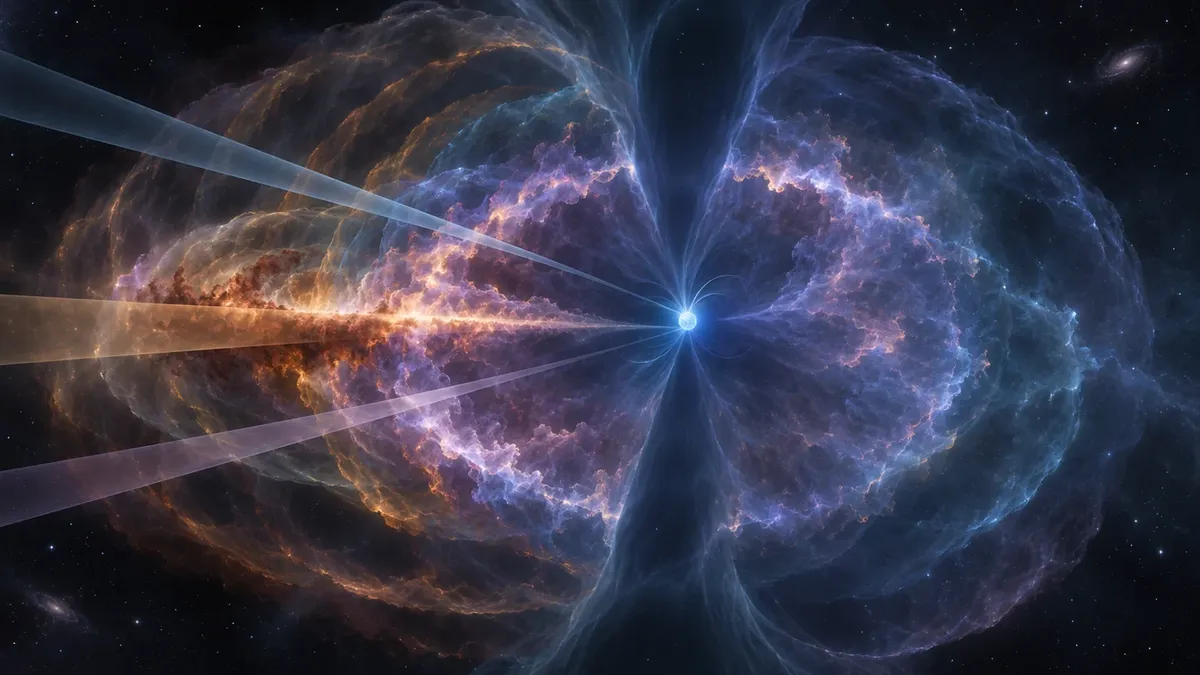
A repeating fast radio burst’s changing dispersion measure offers a clue to the plasma around its source—but does one measured slope tell us how old that source is? A new theoretical study says not necessarily. In a model where a white dwarf collapses inside gas shaped by an interacting binary, shocks and uneven surroundings can produce varied trends.
Fast radio bursts (FRBs) are brief, bright flashes of radio waves from beyond the Milky Way. As a burst travels through ionized gas, lower-frequency radio waves arrive later than higher-frequency ones. The size of this delay gives a measure called dispersion measure, or DM: roughly, the number of free electrons along the line of sight. If a repeating FRB’s DM changes over years, some of the changing plasma may be close to the source.
The new study asks whether that change could reflect not just expanding debris, but also the complicated surroundings left by a binary star system. The authors focus on accretion-induced collapse (AIC), in which a white dwarf collapses to form a neutron star. Before collapse, mass loss from an interacting binary could create a finite, lopsided environment: a wind, a bubble of shocked wind, a shell of swept-up material and, in some directions, a relatively empty polar channel. An FRB engine formed in this setting would not necessarily sit in a smooth, spherical cloud.
A structured environment in a toy model
Naoz and Kaspi calculate how expanding AIC ejecta and its shock would move through these different zones. Their model follows the electron column along a chosen viewing direction, separating contributions according to where the material came from. It compares two illustrative surroundings: a diffuse medium with a density of 1 particle per cubic centimetre extending to 10 parsecs, and a compact, denser cloud with 500 particles per cubic centimetre extending to 0.3 parsecs. These are example environments, not fits to particular FRBs.
The researchers also compare two simplified ionization cases. In one, the gas ahead of the shock is already ionized. In the other, that upstream gas starts neutral; the shock can then ionize it, adding free electrons to the measured DM. The model assumes an aspherical ejecta shape and an uneven wind, with separate calculations for polar and nonpolar sightlines.
At early times, the unshocked ejecta’s contribution falls approximately as time to the power of minus two: as the debris expands, its material spreads over a greater distance and its electron column thins. Later, the shock reaches boundaries between the pre-existing regions. Those crossings change how much material is swept up and where it sits, producing bends or breaks in the modeled DM history.
Why the DM can turn around
The ionization assumption can change the direction of the trend. If the gas ahead of the shock is already ionized, the shock mostly rearranges electrons that were already contributing to the column. In these models, DM generally declines or flattens. If the gas starts neutral, shock ionization can add electrons faster than expansion reduces their column. The total DM can then switch from falling to rising after roughly 10–20 years in the modeled cases, before turning over as the finite supply of material is processed.
Viewing direction matters too. A polar sightline can pass through the model’s evacuated channel, missing much of the wind and its surrounding structures. Another direction through the same system crosses more zones. The resulting histories can differ in timing, shape and even the sign of the change. The authors’ calculations span both positive and negative slopes, and approximately the range of rates reported for repeating FRBs, without fitting individual sources. This is a demonstration of possibility, not proof that AIC explains those sources.
The implication is that one snapshot of the DM slope is not a unique clock. A rising or falling DM might reflect the source’s age, but also the gas density, its ionization state and the observer’s direction. The authors suggest that population patterns—how often slopes are positive or negative, and how large they are—could help distinguish models. Sustained monitoring that captures a bend or reversal may also be more informative than a single slope measurement.
What remains uncertain
These results come from a deliberately simplified calculation, not a hydrodynamic simulation of a specific progenitor. The outflow is represented as a smooth, axisymmetric wind, and the ejecta as a prescribed expanding shape. The model treats different directions largely independently and does not resolve mixing or sideways flows between them. It brackets ionization with fixed cases rather than following heating, cooling and recombination in detail. The authors say the qualitative effects of boundaries and viewing angle are more robust than the precise transition times; those times depend on the adopted parameters.
The paper also notes that a shock-driven DM change differs from a photoionization scenario, in which changing high-energy output from the central source alters the ionized gas. In the proposed dynamical picture, the DM follows the shock and surrounding structure rather than the contemporaneous FRB burst rate. Other explanations, including motion through uneven plasma, are not ruled out by this model.
This is an arXiv preprint, a research manuscript that may not yet have undergone peer review. Its comparisons with observations are illustrative, and its conclusions should be read as predictions of a toy model rather than established explanations for FRB behavior.
- fast radio bursts
- dispersion measure
- accretion-induced collapse
- white dwarfs
- circumstellar gas
- ionization
- astrophysics
Related reading
Automatically matched by shared topic keywords. These links do not imply that the sources agree or establish a consensus.
Radio bursts offer tentative clues to gas around nearby galaxies
Source published
Shared keywords: dispersion measure, fast radio bursts
A radio burst’s crowded path reveals the challenge of tracing cosmic gas
Source published
Shared keywords: dispersion measure, fast radio bursts
A Cross-Signal Search for the Universe’s Missing Baryons
Source published
Shared keywords: fast radio bursts
Neutron star binaries may get their chance after a cluster’s black holes leave
Source published
Shared keywords: accretion induced collapse
A spinning white dwarf’s tidal response depends on how the star changes shape
Source published
Shared keywords: white dwarfs