TRANSMISSION // 2611.26695v1
How a tiny gauge-theory ladder approaches thermal equilibrium
Source published
Numerical simulations of a small D₃ gauge-theory ladder find several signs of ETH-like thermalization, while leaving open how the behavior scales to larger systems.
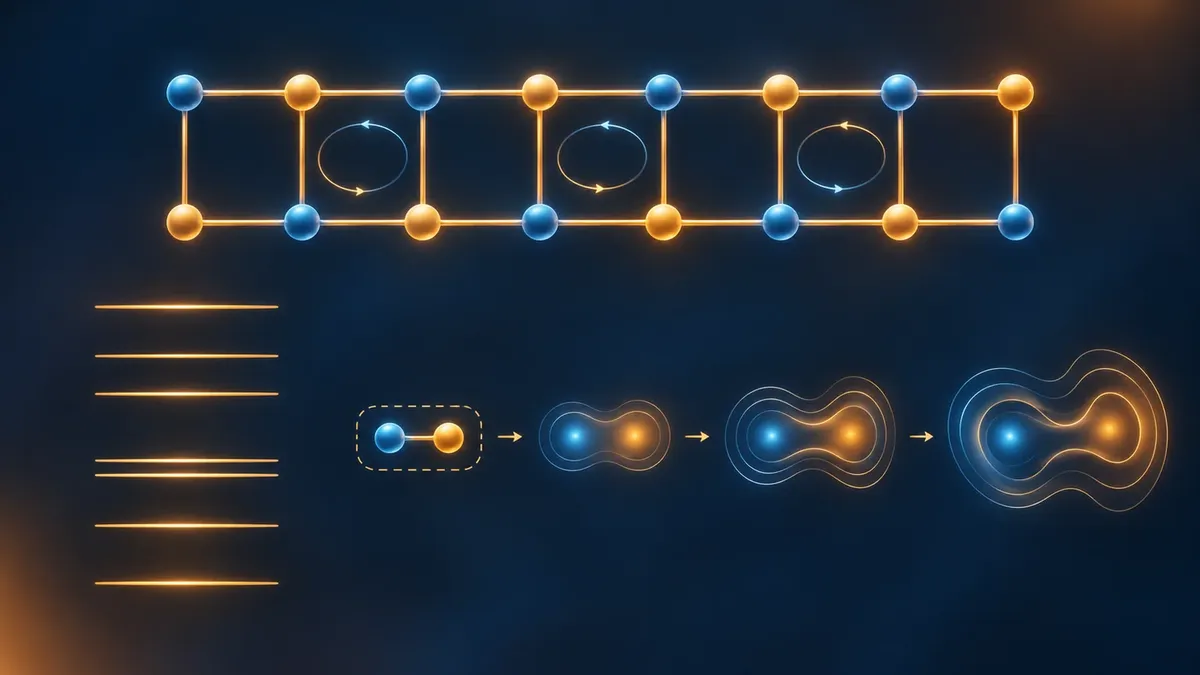
How can a system with strict gauge constraints still behave like a chaotic many-particle system? A numerical study of a simplified non-Abelian gauge theory finds signs of thermalization in a small ladder-shaped model—and emphasizes that its limited size makes broader conclusions uncertain.
Thermalization is familiar in everyday life: a hot drink cools as energy spreads around it. In an isolated quantum system, the question is subtler. The whole system evolves according to quantum mechanics, but measurements of a small part can come to resemble those of a system in thermal equilibrium. The Eigenstate Thermalization Hypothesis (ETH) offers one explanation: in suitable systems, nearby energy eigenstates give nearly the same values for local measurements.
Gauge theories add a complication. Their local constraints restrict which states are physically allowed, and symmetries can divide a system into distinct sectors. That makes it important to distinguish genuine departures from thermal behavior from effects caused by unresolved symmetries.
In this preprint, Marco Vaia and colleagues examine a simplified non-Abelian gauge theory based on the finite dihedral group D₃. It is a theoretical test case, not a direct model of quantum chromodynamics. The authors study a pure-gauge system on a short, ladder-shaped lattice. They use gauge fixing—a change of description that removes redundant degrees of freedom—to reduce the ladder to effective variables on its rungs. They then use exact diagonalization, a numerical method for calculating energy levels and eigenstates directly.
The calculations reach ladders of up to five rungs. The team examines several indicators: patterns in neighboring energy-level spacings; how local-operator measurements vary across energy eigenstates; entanglement in those eigenstates; and the changing spectrum of a subsystem’s reduced state during time evolution. Before comparing energy-level statistics with random-matrix predictions, the analysis resolves an exact spatial inversion symmetry.
Across much of the parameter range studied, the energy levels show statistics associated with the Gaussian orthogonal ensemble (GOE), a random-matrix benchmark for chaotic systems with the relevant symmetry. In these regions, local-observable measurements vary more smoothly with energy as the system grows from three to five rungs, consistent with ETH. The authors also report supporting patterns in matrix elements and eigenstate entanglement. In a separate time-evolution test, the subsystem’s entanglement-spectrum statistics move from a Poisson-like pattern toward one associated with the Gaussian unitary ensemble (GUE), after an initial period. This is a distinct diagnostic from the GOE-like statistics found in the Hamiltonian’s energy levels.
These findings do not mean that gauge constraints disappear or that every parameter choice thermalizes. The study finds a finite-size region where energy-level statistics depart from GOE expectations. There, local-observable data do not clearly show the smooth behavior seen in the more chaotic region, and off-diagonal matrix elements are less regular. The authors suggest this region may shrink in larger systems, but their calculations do not establish what happens in the thermodynamic limit—the idealized limit of infinitely many lattice sites.
The symmetry bookkeeping matters. The undeformed model has residual global symmetries that can produce degeneracies and complicate level-statistics tests. The researchers introduce a tunable deformation of the plaquette interaction that breaks those residual symmetries, then study how results vary with the deformation and the coupling. This helps expose a broad GOE-like region, but some results therefore concern a modified model, not only the undeformed gauge theory. The suggestion that chaotic behavior may persist at larger sizes is an interpretation of a numerical trend, not a finding directly demonstrated for large systems.
Exact diagonalization limits the study to small ladders. Larger lattices, other gauge groups, and systems with dynamical charges remain open questions identified by the authors. The calculations provide a controlled example of ETH-like behavior in a discrete non-Abelian gauge setting; they do not show that all non-Abelian gauge theories thermalize in the same way or establish consequences for early-universe physics or heavy-ion collisions.
This is a version-one arXiv preprint. A preprint is a research manuscript shared publicly before, or independently of, journal peer review; the source record does not establish that this version has been peer-reviewed. The results are best read as evidence from a specific numerical model, with questions about system size, generality, and experimental tests still open.
- quantum thermalization
- Eigenstate Thermalization Hypothesis
- quantum chaos
- lattice gauge theory
- non-Abelian gauge theory
- D₃
Reviewed cross-references
These connections were reviewed by a model, not independently fact-checked by a human. Similarity does not imply agreement; consult the original papers and the evidence below.
A geometric way to ask how chaotic a quantum system is
Shared method: Both studies use local-operator matrix elements or spectral response as a diagnostic related to quantum chaos: the D₃ gauge-theory study examines local-operator matrix elements in the energy basis, while Abdelshafy and Rodriguez-Nieva analyze local-operator spectral response within a geometric framework. The models and analyses differ, so this is a methodological overlap, not evidence that their findings agree.
Model review: · openai-codex/gpt-6-luna
Evidence and provenance
Selected excerpts, not complete papers. PDF extraction can omit figures or damage equations, tables and reading order; sources may be preprints.
2611.26695v1 — Original paper
Excerpt reference:
static/papers/2611.26695v1.md:65-120
Basis: Paper text
Source SHA-256:52672886f347bacb56e9e9adaa24abd38e08926f1b88cb69212e1f74910100c22611.13101v1 — Original paper
Excerpt reference:
static/papers/2611.13101v1.md:12-60
Basis: Paper text
Source SHA-256:c73803def514d8684afcfbc9d3fa6d1594a4a627202e929473c5b926ea2e8fae
Related reading
Automatically matched by shared topic keywords. These links do not imply that the sources agree or establish a consensus.
How quantum eigenstates encode entanglement growth
Source published
Shared keywords: quantum chaos
A quantum processor watches electric strings spread
Source published
Shared keywords: lattice gauge theory
How many electric-field levels does a quantum simulation need?
Source published
Shared keywords: lattice gauge theory
When quantum chaos helps atomic gases synchronize
Source published
Shared keywords: quantum chaos
A Julia toolkit for exploring quantum billiards
Source published
Shared keywords: quantum chaos