TRANSMISSION // 2611.26693v1
Can Partial Symmetry Protect Topological States?
Source published
A theoretical study proposes that a constraint on one sublattice can protect topological phases, including a zero-energy corner mode in a model honeycomb lattice.
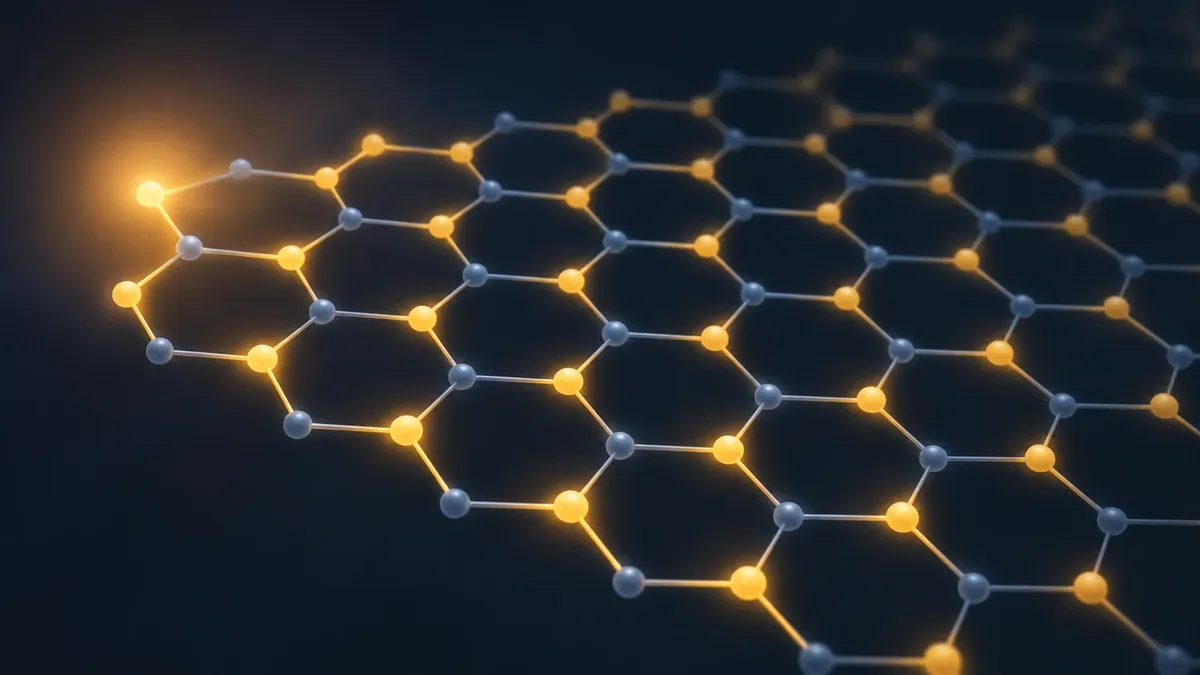
Topological phases can host unusual states at boundaries, but must the symmetry protecting them apply throughout a lattice? Chen-Shen Lee and Itamar Kimchi’s abstract proposes a partial answer: a constraint acting on one sublattice may protect topological modes. The reported results are theoretical, including a model with a zero-energy mode at one corner.
Topological phases are often associated with states at a system’s boundaries. In the Su–Schrieffer–Heeger (SSH) chain, chiral, or sublattice, symmetry constrains the Hamiltonian so that hopping between sites on the same sublattice—A-to-A or B-to-B—is forbidden. Chen-Shen Lee and Itamar Kimchi ask whether topological phases can also be protected when a related constraint applies to only one sublattice.
They call this proposed condition half-chiral symmetry. In the abstract, it is expressed as (PHP=0), where (P) projects onto one sublattice and (H) is the system’s Hamiltonian. The equation means that the Hamiltonian projected onto that sublattice vanishes. The abstract describes this as an algebraic constraint, contrasting it with conventional symmetry operators described by group theory.
The authors’ motivation includes systems with sublattice imbalance, such as graphene–hexagonal boron nitride, and systems with localized orbitals, such as zincblende. These are presented as contexts where the partial constraint may arise, not as demonstrations that the proposed phases occur in those materials.
Connecting bulk properties to boundary modes
According to the abstract, the authors develop a framework for using half-chiral symmetry to characterize topological protection. It identifies real-space bulk topological invariants—quantities meant to characterize the system as a whole—and corresponding boundary modes that remain at zero energy. This is a proposed link between bulk topology and boundary behavior.
For a two-dimensional example, the authors construct a half-chiral Kekulé honeycomb model. They report that its unusual higher-order topology protects a single zero-energy mode at a single corner. The abstract does not provide the model’s detailed construction or enough information to assess the derivation and conditions behind this result. In particular, the spatial shape of the mode and its response to particular perturbations cannot be determined from the abstract alone.
The result is a theoretical claim about a constructed model, not evidence in the supplied source that such a mode has been observed in a material. Nor does the abstract establish how readily the proposed constraint could be realized experimentally. Those are limits of the evidence available here, rather than conclusions about what the full paper or future work may show.
What can be concluded from the source?
This account is based on the abstract of the authors’ arXiv preprint, version 1. The abstract reports a framework, real-space invariants, boundary modes, and the honeycomb-model result; it does not provide the full methods, calculations, assumptions, or supporting evidence needed to examine those claims in depth. The supplied record also does not establish the work’s peer-review or publication status, or whether the proposed approach has independent confirmation.
The central idea is that a topological constraint need not take the conventional form applying across both sublattices: according to the authors’ abstract, a constraint on one sublattice can support protected topological modes. The single-corner result illustrates that proposal in one model. How broadly the framework applies, and how it might connect to physical systems, cannot be settled from the abstract alone.
- half-chiral symmetry
- topological phases
- sublattice symmetry
- boundary modes
- honeycomb lattice
- quantum physics
Related reading
Automatically matched by shared topic keywords. These links do not imply that the sources agree or establish a consensus.
Two imaging methods reveal microwave patterns in a superconducting lattice
Source published
Shared keywords: honeycomb lattice
How fast can Yang–Baxter circuits grow in complexity?
Source published
Shared keywords: quantum physics
Geometry as a shield for logical quantum information
Source published
Shared keywords: quantum physics
A quantum bound-breaking claim hinges on time evolution
Source published
Shared keywords: quantum physics
When two atoms scatter light as a pair
Source published
Shared keywords: quantum physics