TRANSMISSION // 2611.26689v1
How Gas and Radio Structures Relate in 3C Galaxies
Source published
MUSE observations of 26 radio galaxies reveal varied gas shapes and motions, with some features associated with radio structures and others uncertain in origin.
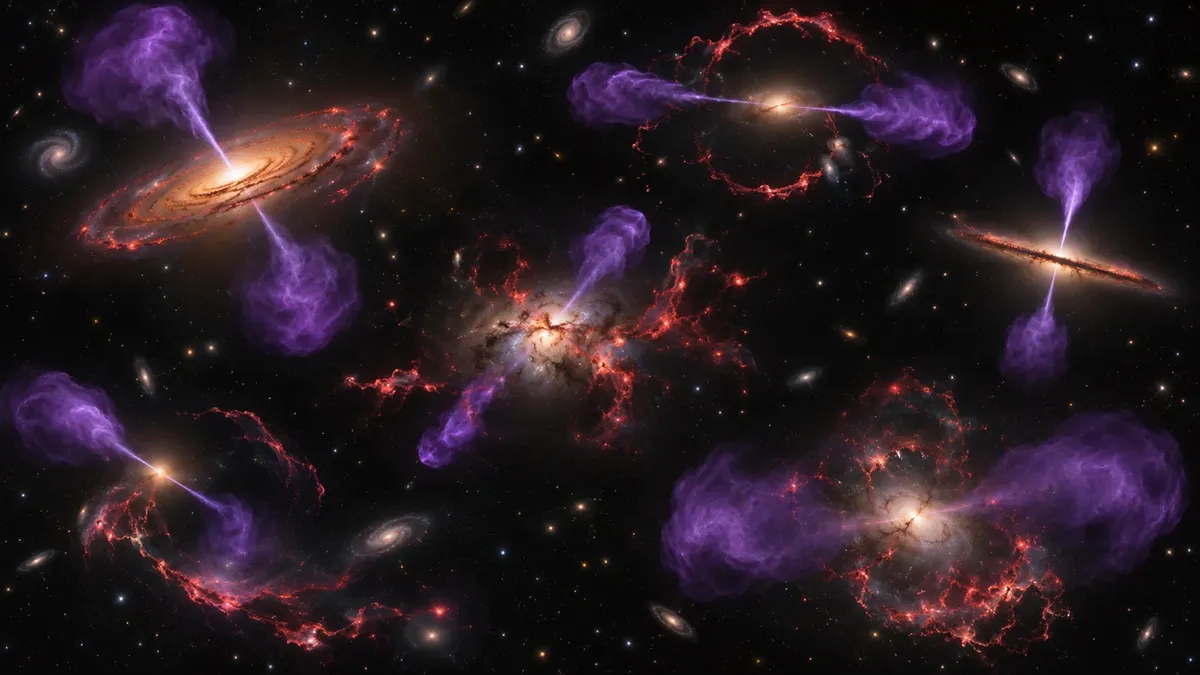
Radio galaxies host jets that can stretch far beyond their central regions. How are these radio structures related to the surrounding glowing gas? A MURALES study mapped gas in 26 3C radio galaxies and compared its shape and motion with radio images.
Warm, ionized gas around active galaxies shines in emission lines, including lines from oxygen atoms. These extended emission-line regions, or EELRs, can reach well beyond a galaxy’s central regions. Mapping their brightness and motion helps astronomers investigate how the gas is arranged and how its properties relate to radio jets and lobes.
In the ninth paper in the MURALES survey series, Barbara Balmaverde and colleagues studied 26 radio galaxies from the 3C catalogue, at redshifts between 0.3 and 0.82. They observed the galaxies with MUSE, an instrument on the Very Large Telescope that records spectra across a two-dimensional field. From these data, the team mapped emission-line brightness, gas velocity and velocity dispersion—the spread of measured gas motions—and compared the maps with radio images.
A range of shapes and motions
The researchers detected EELRs in 22 of the 26 sources. In this sample, the regions extend as far as 160 kiloparsecs from their host galaxies. Their shapes and motions vary: ten galaxies show large-scale gas patterns consistent with ordered rotation, while other objects display arcs, filaments or more complex structures.
Some gas features appear closely associated with radio lobes, the extended structures produced by jets. In 3C 435A, for example, an arc of emission almost surrounds a radio lobe. The authors interpret this as a bubble-like gas structure swept up by the expanding lobe. They discuss other arc-like or S-shaped features in relation to the radio emission, while noting that tidal processes cannot be excluded in every case.
A different pattern appears in five galaxies whose radio sources are smaller than about 30 kiloparsecs. Their gas motions are complex, and the gas has high velocity dispersion. The authors interpret these observations as signs of strong interaction between jets and gas, potentially during an early stage of radio-source growth. The maps do not directly measure the sources’ ages, so this evolutionary interpretation is not an age determination.
In ten galaxies, gas patterns consistent with rotation extend across structures about 16 to 70 kiloparsecs in size. The study relates these structures to “super-disks”: large-scale arrangements of ionized gas around radio galaxies. The authors argue that EELR properties reflect a combination of the radio source’s evolutionary state and its orientation relative to these gas structures.
Associations are not the whole story
The directions of the gas and radio structures do not show one consistent relationship across the sample. Some emission features align with radio structures, but among the galaxies with ordered rotation, the gas kinematic axis—the direction inferred from the gas’s motion—aligns with the radio axis in only a few cases. In seven galaxies, the measured orientation of the EELR also differs between its inner and outer regions, suggesting that the gas structure can change direction with scale.
Some individual origins remain unresolved. In 3C 277.2, an unusual gas structure might have been swept up by radio ejecta, or it might be a remnant of a merger. More broadly, the maps show patterns and associations; they do not establish that jets caused every gas feature. Tidal interactions and other processes may also contribute.
The study has observational limits. MUSE’s spatial resolution allows the authors to examine gas on scales of several kiloparsecs, but not to trace its motion right next to the central supermassive black hole. They point to higher-resolution observations as a way to investigate the relationship between gas and jet orientations on smaller scales. They also note that radio data at multiple frequencies could help establish the radio sources’ evolutionary stages independently.
The supplied paper text identifies itself as A&A proofs and acknowledges an anonymous referee, indicating referee involvement. The arXiv record supplied here does not establish the paper’s final publication status. The results should therefore be understood as findings reported in the available paper text, not as a claim about final publication. The authors describe future work on outflows, gas ionization and the galaxies’ environments. For now, the survey documents diverse gas structures around intermediate-redshift radio galaxies, some closely associated with radio features and others still open to interpretation.
- radio galaxies
- MURALES survey
- MUSE
- ionized gas
- radio jets
- emission-line regions
- galaxy evolution
Reviewed cross-references
These connections were reviewed by a model, not independently fact-checked by a human. Similarity does not imply agreement; consult the original papers and the evidence below.
Gas stripping leaves galaxy discs’ stellar spin largely intact
Shared method: Both studies use integral-field spectroscopy to map gas kinematics: the MURALES paper uses VLT/MUSE for extended emission-line regions in 26 intermediate-redshift 3C radio galaxies, while the GASP study uses MUSE to measure ionized-gas and stellar kinematics in nearby discs. This is a methodological connection, not a comparison of equivalent samples or conclusions.
Model review: · openai-codex/gpt-6-luna
Evidence and provenance
Selected excerpts, not complete papers. PDF extraction can omit figures or damage equations, tables and reading order; sources may be preprints.
2611.26689v1 — Original paper
Excerpt reference:
static/papers/2611.26689v1.md:18-73
Basis: Paper text
Source SHA-256:01772bc54d47e8ef64334d4880e3da24be543b104a39fdd4db71209d44c141622611.10910v1 — Original paper
Excerpt reference:
static/papers/2611.10910v1.md:16-67
Basis: Paper text
Source SHA-256:d3d238ced0956172feda62a92f65b5808c4bf796245bd60658ba5b752718bb64
Quasar winds reach across galaxies—and may contain several distinct flows
Shared method: Both papers use integral-field spectroscopy to spatially resolve ionized-gas emission and kinematics. MURALES uses VLT/MUSE to study extended emission-line regions around radio galaxies; the quasar study uses Keck/KCWI to map ionized outflows in seven low-redshift quasars. The instruments, populations, and scientific questions differ, so this connection does not imply matching results.
Model review: · openai-codex/gpt-6-luna
Evidence and provenance
Selected excerpts, not complete papers. PDF extraction can omit figures or damage equations, tables and reading order; sources may be preprints.
2611.26689v1 — Original paper
Excerpt reference:
static/papers/2611.26689v1.md:18-73
Basis: Paper text
Source SHA-256:01772bc54d47e8ef64334d4880e3da24be543b104a39fdd4db71209d44c141622611.08828v1 — Original paper
Excerpt reference:
static/papers/2611.08828v1.md:210-302
Basis: Paper text
Source SHA-256:519dd533665facd91f6a23e60288906d318eebd82e5d8bf1d9886281fc09acb6
Related reading
Automatically matched by shared topic keywords. These links do not imply that the sources agree or establish a consensus.
What lets a radio galaxy grow to giant size?
Source published
Shared keywords: radio jets
Webb maps gas and stars moving differently around faint active black holes
Source published
Shared keywords: radio jets
How Earth's sky can distort a galaxy's stellar history
Source published
Shared keywords: galaxy evolution
Gas stripping leaves galaxy discs’ stellar spin largely intact
Source published
Shared keywords: galaxy evolution
Slow-spinning galaxies offer clues to the growth of cosmic giants
Source published
Shared keywords: galaxy evolution