TRANSMISSION // 2611.26685v1
Little Red Dots Thin Out, but Keep a Similar Brightness Profile
Source published
A wide-field search and targeted spectroscopy suggest Little Red Dots were much rarer around 10 billion years ago than earlier in cosmic history, while their characteristic optical brightness changed little.
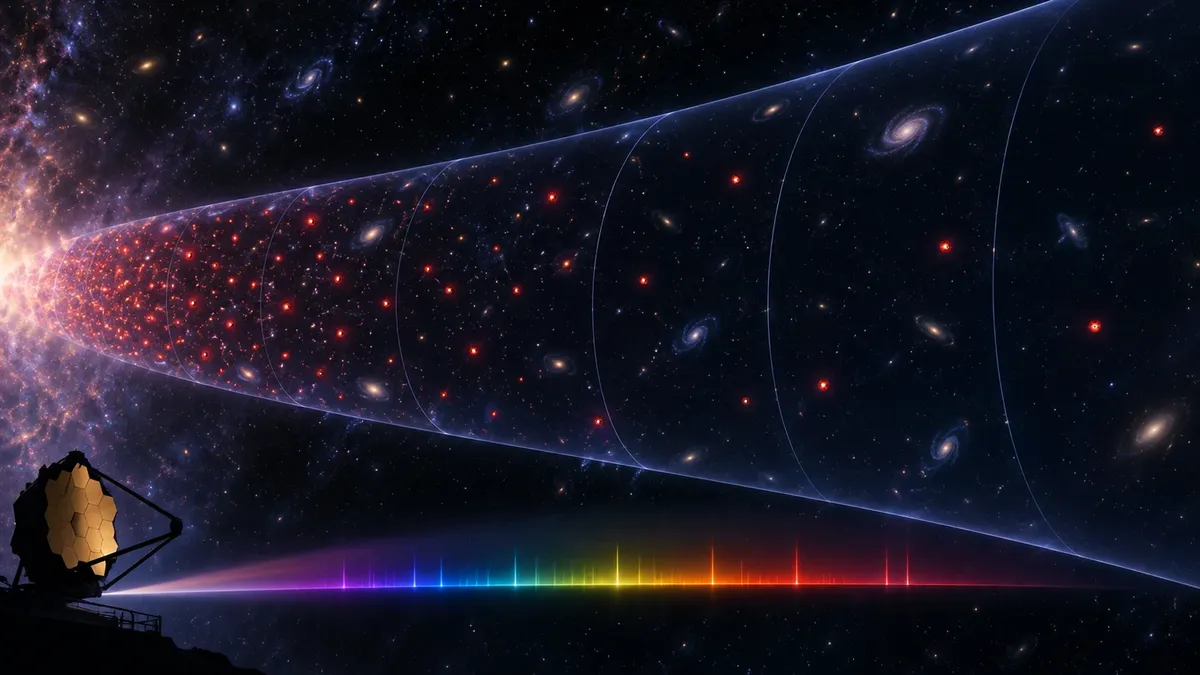
Little Red Dots are compact, red objects in the early universe whose nature remains unsettled. A new study searches for them at “cosmic noon,” when the universe was a few billion years old, and finds evidence that they were less common then—without a clear shift in the characteristic brightness of the population.
Little Red Dots (LRDs) are small, unusually red objects often marked by broad hydrogen emission lines. Those lines can signal activity around a central black hole, but they do not settle what powers the objects. Their abundance through cosmic history is also uncertain: are LRDs common only in the early universe, or have surveys simply struggled to find them at later times?
A study led by Yilun Ma and colleagues looks for LRDs at “cosmic noon,” roughly redshifts 2 to 4, when the universe was several billion years old. The researchers searched nearly 20 square degrees across four fields imaged by the Hyper Suprime-Cam Subaru Strategic Program. They combined optical, near-infrared and infrared measurements to select objects with the characteristic LRD appearance: compact sources with a blue ultraviolet component and a steeply rising red optical spectrum.
That photometric search produced 266 candidates. But color and shape alone are not enough to identify LRDs reliably; other sources, including dusty galaxies and reddened active galactic nuclei, can look similar. The team therefore obtained spectra for 24 candidates using instruments on the Keck, Very Large Telescope and Magellan telescopes. Spectra can reveal emission lines and their widths, helping distinguish likely LRDs from look-alikes.
Ten targets yielded a spectroscopic redshift, and six showed broad H-alpha emission. After examining their broader spectral shapes and other evidence, the researchers classified four as LRDs; two broad-line sources were judged to be reddened active galactic nuclei instead. This small follow-up sample was used to estimate how many of the photometric candidates were genuine LRDs, rather than treating all 266 as confirmed objects.
The team also estimated how likely its selection was to miss LRDs. It created mock measurements from spectra of previously identified LRDs, adjusted them across a range of brightnesses and redshifts, added realistic photometric uncertainties, and ran the objects through the same selection process. The resulting completeness estimates were strongest around redshift 2.2–2.5. To calculate abundance, the authors combined these completeness estimates with the spectroscopically calibrated probability that a candidate was truly an LRD, and accounted for the survey volume in which each object could have been detected.
For objects brighter than an optical absolute magnitude of about -20.5, the study estimates an abundance of roughly 6.8 × 10⁻⁷ per cubic comoving megaparsec at redshifts 2.10–2.55. Compared with estimates near redshift 6, this is about 35 times lower. The comparison supports a picture in which LRDs become less common toward later cosmic times, though it does not identify why. The authors also find that the optical luminosity function—the distribution of objects by brightness—has a characteristic “knee” near magnitude -22. They report no significant change in that characteristic brightness between redshifts around 5 and 2, within the uncertainties. In other words, the population appears to thin out without an established shift in its typical luminosity scale.
These results do not yet provide a definitive census. Only 24 candidates received follow-up spectroscopy, and the inferred purity depends on that limited sample and on how candidates were prioritized for observation. The authors note that their completeness tests could miss LRDs with especially strong spectral breaks and faint ultraviolet light. Estimates from other studies at similar epochs differ substantially, reflecting small samples, field-to-field variation, and differing selection criteria. The paper also cautions that the data do not robustly constrain changes in the luminosity-function slopes; the claim of a stable shape is tentative, not a precise demonstration that the whole distribution is unchanged.
The cause of the declining abundance remains open. It could reflect changing conditions that allow LRDs to form or appear, but this survey does not establish a physical mechanism. Nor does it resolve whether the central engine is an accreting black hole or another kind of object. Larger surveys and more complete spectroscopy will be needed to separate these possibilities. The authors point to future Roman Space Telescope and Rubin Observatory surveys as ways to find much larger samples at lower redshifts.
The work is a preprint submitted to The Astrophysical Journal Letters; the manuscript lists no acceptance date. Its measurements and interpretations should therefore be read as preliminary, and independent follow-up may revise the abundance estimates.
- Little Red Dots
- cosmic noon
- James Webb Space Telescope
- spectroscopy
- luminosity function
- early universe
Related reading
Automatically matched by shared topic keywords. These links do not imply that the sources agree or establish a consensus.
How JWST Could Trace the Seeds of the First Massive Black Holes
Source published
Shared keywords: early universe, james webb space telescope, little red dots
JWST counts faint galaxies to trace a busy era of star formation
Source published
Shared keywords: cosmic noon, luminosity function
Why Astronomers Want a Bigger JWST Survey of the First Galaxies
Source published
Shared keywords: james webb space telescope, little red dots
Early Galaxies Narrow a Search for Neutrino Interactions
Source published
Shared keywords: james webb space telescope
Webb survey links stronger early-galaxy emission to bursts of star formation
Source published
Shared keywords: early universe, james webb space telescope