TRANSMISSION // 2611.26681v1
When One Gravitational-Wave Signal Hides Another
Source published
Simulations show how an individual black-hole binary can distort pulsar-timing estimates of a gravitational-wave background—and why fitting both signals may not be enough.
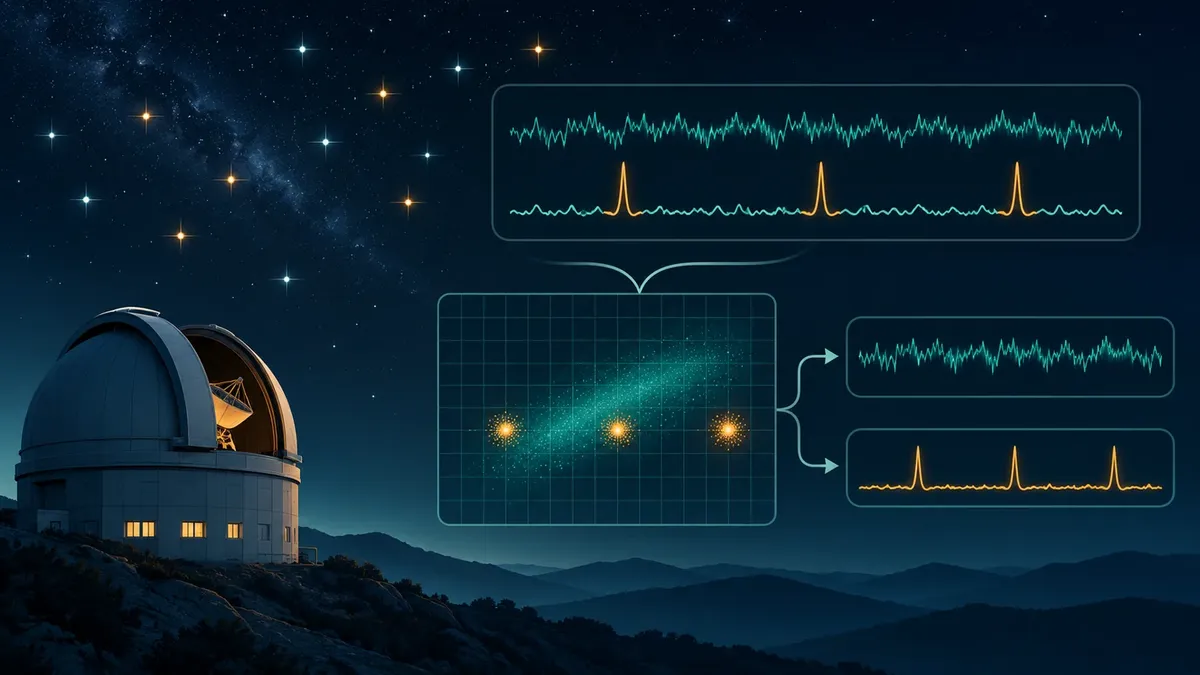
Pulsar timing arrays track radio pulses from many pulsars to search for slow gravitational-wave effects. A key clue to a gravitational-wave background is a particular pattern of correlations between pulsars. What happens when the data also contain a persistent signal from one supermassive black-hole binary? Caitlin A. Witt and Nihan S. Pol investigate that question using simulations based on NANOGrav’s 15-year dataset.
Two kinds of signal in one dataset
A pulsar timing array (PTA) monitors the arrival times of radio pulses from rapidly rotating neutron stars. Researchers look for tiny changes in those arrival times that could be caused by gravitational waves. A gravitational-wave background (GWB) is a combined, unresolved signal that may arise from a population of supermassive black-hole binaries. A key test is whether timing data from different pulsars show the distinctive Hellings–Downs pattern of correlations expected for a background.
A sufficiently prominent individual binary could also produce a persistent signal, often called a continuous wave (CW). If both signals are present, an analysis may mistake part of one for the other, distorting estimates of the background or the individual source.
Witt and Pol use simulations to study this potential confusion and ask whether fitting both signals together solves it. The work does not report a detection of a particular binary in real PTA data.
How the simulations were built
The researchers based their simulations on NANOGrav’s 15-year dataset, with 67 pulsars observed over a maximum baseline of 16 years. They created 100 realizations of noise for each setup and considered cases with no GWB, a common uncorrelated red-noise process, or a GWB with Hellings–Downs correlations. They injected individual binary signals across combinations of three chirp masses, three gravitational-wave frequencies and three luminosity distances. Source sky positions and angular parameters were also varied. Altogether, they analyzed 8,100 simulated datasets.
The team used PTA analysis methods to estimate background and binary parameters. Some analyses omitted the CW from the signal model; others fitted it alongside a common red-noise process. They also examined how the binary affected statistics used to measure inter-pulsar correlations.
An unmodeled binary can skew the background
When the analysis left an injected CW out, the recovered background amplitude and spectral index could be substantially distorted. The direction and size of the effect varied with the binary’s properties, including frequency and chirp mass, and with its sky location. In some cases the inferred background became steeper; in others it appeared stronger and shallower.
The simulations suggest a reason: the binary adds power at frequencies used to estimate the background. Contributions from the signal as it reaches individual pulsars—the pulsar terms—can spread power across multiple frequency bins. A simple power-law background model may absorb some of that power and return shifted parameters.
Fitting a CW alongside the background reduced some effects, but did not guarantee accurate recovery of both signals. The authors report that about 30% of simulations accurately recovered both injected signals. In a subset where key CW parameters were recovered consistently—defined as the injected values falling within the one-standard-deviation interval—the background estimates no longer showed the large scatter seen across the broader joint-analysis sample. About 40% of simulations met that CW-recovery criterion.
The team also found that an unmodeled CW could affect estimates of the strength of Hellings–Downs correlations. In simulations containing both a GWB and a CW, modeling the CW alongside the common process removed the observed relationship between injected CW strength and measured correlation signal-to-noise. This is a result for the simulated analyses, not a guarantee for real data: the paper reports differences among some correlation-statistic estimates and cautions that other effects may be present in observations.
What the results do—and do not—show
The central lesson is that joint searches matter, but including both signals in a model does not automatically make their parameters reliable. The individual binary must also be recovered well. The authors say that their current enterprise-based pipelines took two to three days per analysis, a practical obstacle to running much larger simulation campaigns.
These results come from a specific simulation program based on one PTA dataset and chosen signal and noise assumptions. For example, white-noise parameters were held at their injected values. Real data can involve complications not represented in those simulations, and a background may depart from the simple power law used in parts of the analysis. The authors caution that their results cannot settle the interpretation of tentative features in real datasets.
The supplied manuscript is identified as a draft preprint. Its review or publication status is not specified in the source provided, so its conclusions should be treated as work to evaluate and test further. The study’s contribution is to show across many simulated cases why future PTA analyses need to account carefully for both individual persistent sources and the gravitational-wave background.
- pulsar timing arrays
- gravitational waves
- gravitational-wave background
- supermassive black holes
- continuous waves
- simulation
- data analysis
Related reading
Automatically matched by shared topic keywords. These links do not imply that the sources agree or establish a consensus.
Could daily pulsar observations probe a gravitational-wave blind spot?
Source published
Shared keywords: gravitational waves, pulsar timing arrays
A quicker way to test combined pulsar data
Source published
Shared keywords: gravitational waves, pulsar timing arrays
A simpler strategy holds up in searches for gravitational-wave memory
Source published
Shared keywords: gravitational waves, pulsar timing arrays
Teaching LISA’s data models to expect the unexpected
Source published
Shared keywords: gravitational waves
Why Bigger Telescopes Alone Cannot Perfect Pulsar Timing
Source published
Shared keywords: gravitational waves, pulsar timing arrays