TRANSMISSION // 2611.26680v1
PLATON 7 aims to accelerate exoplanet atmosphere analysis
Source published
A rewrite of the open-source PLATON retrieval code uses JAX and single-precision calculations. Its authors report faster benchmarks and new modeling options, with results that depend on the test and computing setup.
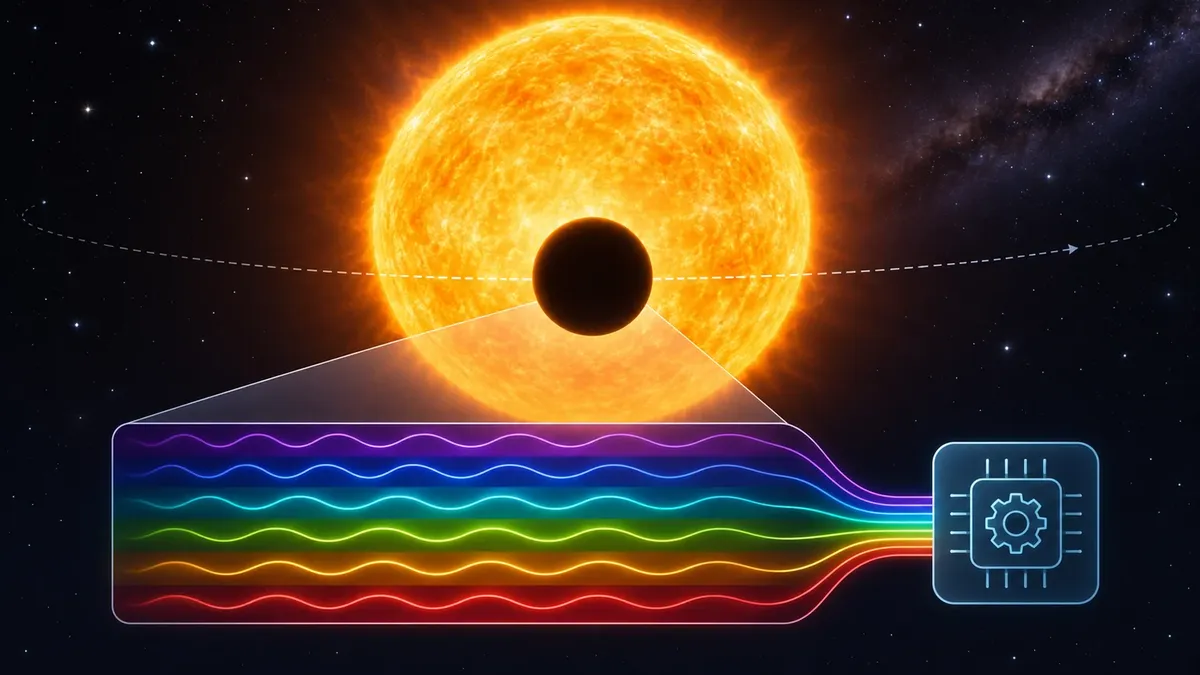
Astronomers infer an exoplanet’s atmosphere by comparing its spectrum with computer-generated models. PLATON 7, a rewritten version of an established retrieval tool, is designed to make those calculations faster. Its authors report a large speedup in benchmarks, but the timings describe particular tests—not every possible use.
Astronomers generally cannot sample an exoplanet’s atmosphere directly. Instead, they study how the planet absorbs or emits light at different wavelengths, then use computer models to infer properties such as composition, temperature and clouds. Atmospheric retrieval explores possible models and asks which ones are consistent with the observed spectrum. Faster calculations can make that exploration more practical as spectra become more detailed.
PLATON is an open-source Python package for modeling and retrieving exoplanet atmospheres, first released in 2018. In a paper describing PLATON 7, its authors report a substantial rewrite that runs much faster while showing, in their tests, little loss of accuracy.
Changing how calculations are done
The main computational changes are the use of JAX for intensive calculations and single precision instead of double precision. Single precision represents numbers with less detail, which can speed up some calculations but can also increase the risk of rounding errors, underflows or overflows. The authors say they addressed these risks by rearranging operations and rescaling quantities, including opacities and polarizabilities, to keep intermediate values near unity.
The paper reports a spectrum-calculation timing on an NVIDIA RTX 5090: PLATON 7 computed a transmission spectrum spanning 0.8 to 5.3 micrometres at resolving power 20,000 in 0.35 milliseconds. Resolving power describes how finely a spectrum separates nearby wavelengths. This is a timing for calculating a spectrum, not the duration of a complete atmospheric retrieval.
The authors separately benchmarked retrieval performance using a free-retrieval setup and the transit spectrum of TOI 6894b. They matched spectral resolution and the number of atmospheric layers across the compared codes. For this test, the benchmark table reports an average of 0.35 milliseconds per forward model for PLATON 7 on the GPU. The corresponding reported time for BeAR was 0.61 milliseconds; PLATON 6 took 20 milliseconds. The authors also compared CPU-based runs, which took longer in this setup. These measurements used a specified computer and software configuration, so they are not guaranteed timings or a universal ranking for every scientific problem.
Another change is the default nested-sampling package. PLATON 7 switches to nautilus, which uses small neural networks to define the boundary of the region being sampled. The authors say that, in their experience, it can be more efficient for higher-dimensional retrievals and can identify some small, high-likelihood regions more effectively. They note that the speed gain depends on the particular retrieval problem rather than having one general multiplier.
Modeling more atmospheric variation
PLATON 7 adds support for treating the morning and evening sides—or limbs—of a transiting planet separately. It also supports non-isothermal limbs and allows users to run forward models with custom temperature and abundance profiles. These features let researchers test more varied atmospheric models; they do not establish that any particular planet has those properties.
The authors report that Claude Fable 5 carried out the rewrite and that they asked Codex and Claude to review changes and fix important issues. This is the authors’ account of AI-assisted review, not evidence of an independent or formal code audit. They also describe extensive testing and recount earlier development difficulties, including bugs associated with lower numerical precision. That history highlights why testing matters: speed is useful only if calculations remain reliable for the scientific cases where the code is used.
The reported accuracy claim and performance timings should be read in the context of the tests described: the accuracy assessment is not a guarantee that every output matches higher-precision calculations in every setting, and benchmark speed depends on the retrieval problem and computing setup. This account summarizes the software paper and its reported tests; it does not independently verify the code or benchmark results.
- exoplanets
- atmospheric retrieval
- PLATON
- JAX
- spectroscopy
- scientific software
Reviewed cross-references
These connections were reviewed by a model, not independently fact-checked by a human. Similarity does not imply agreement; consult the original papers and the evidence below.
Faster noise modelling could sharpen studies of exoplanet atmospheres
Shared method: Both papers use JAX for computationally intensive scientific calculations: PLATON 7 applies it to atmospheric forward modeling, while LUAS implements scalable Gaussian-process inference with it. This is a shared software framework, not evidence that the codes share algorithms or have been compared directly.
Model review: · openai-codex/gpt-6-luna
Evidence and provenance
Selected excerpts, not complete papers. PDF extraction can omit figures or damage equations, tables and reading order; sources may be preprints.
2611.26680v1 — Original paper
Excerpt reference:
static/papers/2611.26680v1.md:31-61
Basis: Paper text
Source SHA-256:523d0c0d2d94f398e4bb9f88c6a72e65bd913748e20dabadb16dd1e751fa94f12611.09198v1 — Original paper
Excerpt reference:
static/papers/2611.09198v1.md:20-68
Basis: Paper text
Source SHA-256:337b34d032a5e353197d55e8f17996e071aa57a8c8dd5f681618d6b2e29a1ac7
Related reading
Automatically matched by shared topic keywords. These links do not imply that the sources agree or establish a consensus.
Phentax adapts black hole waveform calculations for LISA’s crowded signals
Source published
Shared keywords: scientific software
Teaching AI to account for uncertain molecular physics in brown-dwarf atmospheres
Source published
Shared keywords: atmospheric retrieval
A New Blueprint for AI-Assisted Materials Software
Source published
Shared keywords: scientific software
A Python toolkit for simulating clouds on other worlds
Source published
Shared keywords: scientific software
AI agents search for faster atom-simulation algorithms
Source published
Shared keywords: scientific software