TRANSMISSION // 2611.26667v1
GJ 9404 b remains an uncertain planet candidate
Source published
A reanalysis finds that models accounting for GJ 9404’s stellar activity do not provide enough evidence for a widely accepted planet detection. More spectroscopy is needed.
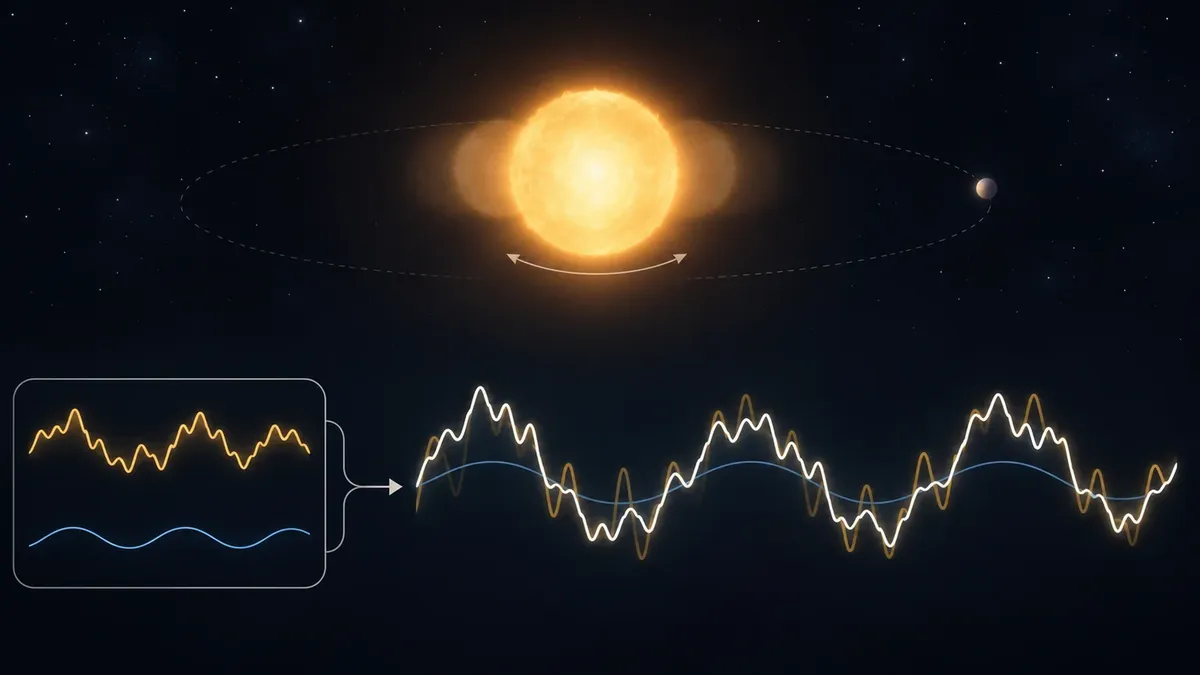
A repeating wobble in a star can come from an orbiting planet, but activity on the star can also affect measurements of its motion. A reanalysis of GJ 9404 finds that its roughly 13-day signal is not enough to establish a planet once stellar activity is included in the modelling.
A wobble with more than one possible source
Astronomers can detect planets by measuring how their gravity makes a star move toward and away from Earth. These changes in line-of-sight motion are called radial velocities. But a star is not always steady: rotation and magnetic activity can alter its surface and the light used to measure that motion. Those changes can complicate the search for a planet.
GJ 9404 is a nearby M dwarf, about 23.8 parsecs from Earth. Earlier studies reported a possible planet with an orbital period of about 13.46 days; one subsequent study described it as confirmed using radial-velocity data alone. The new preprint revisits the available spectroscopy and asks whether the evidence supports a planet when stellar activity is modelled as well.
Comparing the measurements
The researchers reprocessed historic spectra from the HARPS-N instrument and obtained 54 radial-velocity measurements spanning 1,432 days. They also examined two indicators of changes in the star: the full width at half maximum (FWHM) of spectral lines, and the Mount Wilson S-index, based on emission in the cores of the calcium II H and K lines. The paper says six HIRES measurements were excluded because there were few and they were distant in time from the HARPS-N series.
The team compared models with and without a planetary signal, including models for long-term trends and stellar activity. They used Gaussian processes, statistical tools for representing variations correlated over time. In their multi-measurement activity model, the different data series were linked through a shared latent activity process but could respond to it with different scaling. They tested several ways of describing that activity and considered both circular and elliptical planet orbits.
A peak near a proposed orbital period does not by itself show that a planet caused it. The key question is whether a planet signal is supported when plausible stellar variations are also included.
Activity models weaken the planet case
In their analysis of activity periods, the researchers found a dominant mode at 262 ± 2 days, with 96% of the reported weight, and a weaker mode near 1,043 days. Separately, the paper describes an evidence-favoured long-term model with zero-order trends and a common-period sinusoid. These are distinct parts of the analysis; the text does not establish that the 262-day activity mode is the same feature as that long-term model.
The preferred planet-free activity model returned a stellar rotation period of about 23.6 days. The authors say their spectroscopy neither corroborates nor refutes an earlier measurement of the star’s rotation period.
Models that included a planet captured a radial-velocity signal near 13 days, but the paper reports that all planet-bearing Gaussian-process models were disfavoured relative to the corresponding planet-free models. The authors report Δln Z ≤ −0.4 for these comparisons; their abstract summarizes the support for a planet in the 2–100-day range as reaching at most Δln Z = −0.4. They say this is insufficient for a widely accepted detection. They cite Δln Z ≥ 5 as a conventional threshold for statistical significance, not as a universal rule.
The estimated signal also varied by model. In the ESP2 eccentric-planet model, the fitted semi-amplitude converged to zero; the other planet-bearing models measured values near 3 ± 1 metres per second. This modelling result does not establish that the roughly 13-day signal comes from a planet.
A provisional result
The preprint does not show that GJ 9404 b cannot exist. It finds that the current evidence, after accounting for stellar activity, is not sufficient for a widely accepted detection. The authors call for additional spectroscopy to better quantify the star’s activity and determine whether any radial-velocity signals merit further attention.
The analysis uses 54 radial-velocity measurements, and its conclusions depend on the available observations and the activity models considered. Additional data could help constrain the star’s behaviour. The study is an arXiv preprint and may not have completed peer review; this account is based on the supplied manuscript, whose extracted text contains some formatting damage. The authors’ title frames GJ 9404 b as a planetary candidate, while their central finding is that further observations are needed.
- GJ 9404
- exoplanet candidates
- stellar activity
- radial velocity
- M dwarfs
- Gaussian processes
Related reading
Automatically matched by shared topic keywords. These links do not imply that the sources agree or establish a consensus.
Gaia and Hipparcos map possible companions around 100,000 stars
Source published
Shared keywords: exoplanet candidates, radial velocity
Faster noise modelling could sharpen studies of exoplanet atmospheres
Source published
Shared keywords: gaussian processes
When a Prediction Model Benefits From Forgetting Data
Source published
Shared keywords: gaussian processes
PanelGP links stock-return and risk forecasts, with limits on risk calibration
Source published
Shared keywords: gaussian processes
Human–AI teams run X-ray experiments with a traceable decision record
Source published
Shared keywords: gaussian processes