TRANSMISSION // 2611.26662v1
A Long Gamma-Ray Burst With Merger-Like Clues
Source published
GRID-11B measured a 5.68-second burst with properties the authors describe as Type-I-like. The clues suggest a possible merger origin but do not confirm one.
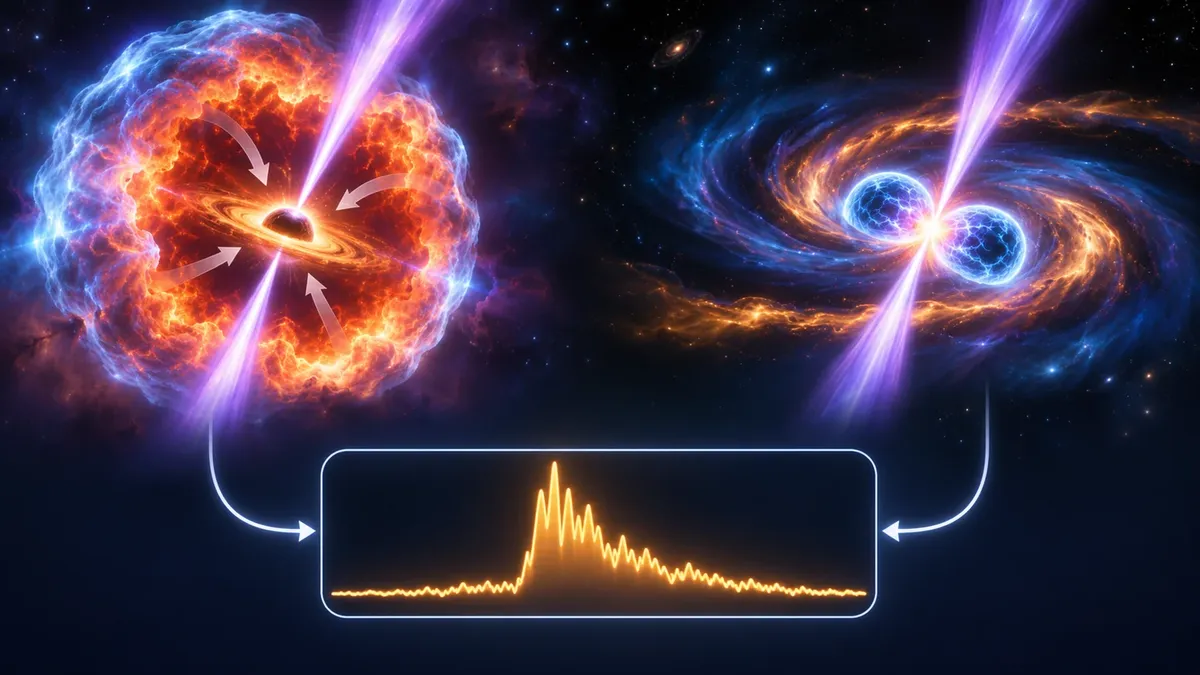
GRB 261010A lasted longer than the usual short-burst cutoff, yet some of its measured properties resemble those associated with short bursts. An analysis of GRID-11B observations finds a suggestive combination of clues—but does not establish what caused the burst.
Gamma-ray bursts (GRBs) are intense flashes of high-energy radiation. Many short bursts are associated with mergers of compact objects, while many long bursts are associated with the collapse of massive stars. But duration does not settle a burst’s origin. GRB 261010A lasted longer than the conventional two-second boundary for short bursts, while some of its other measured properties led its authors to describe it as “Type-I-like,” a category associated here with merger-like properties.
Chenyu Wang and colleagues analyzed observations made by GRID-11B, part of a student-led gamma-ray monitoring constellation. The instrument detected GRB 261010A on October 10, 2026. The analysis covers the main emission episode in GRID-11B’s 100–2,000 kiloelectronvolt energy band. The authors report that the instrument did not detect the fainter extended emission reported by other instruments, and they exclude that emission from their analysis.
The team examined the burst’s timing and spectrum. They measured its duration, called T90, and its minimum variability timescale, which characterizes rapid changes in the signal. To describe how the measured emission varied with photon energy, they fitted the spectrum with a cutoff power-law model.
The measured T90 was 5.68 seconds, with reported uncertainties of +1.04 and −0.32 seconds. The minimum variability timescale was 51.6 milliseconds, with uncertainties of +10.5 and −9.8 milliseconds. The fitted spectrum peaked at about 1,089 kiloelectronvolts, with uncertainties of +171 and −80 kiloelectronvolts. These measurements describe the main episode observed by GRID-11B, not all the emission reported from the event.
Why do the authors consider a possible merger origin? They calculate the burst’s energy and spectral peak for two candidate host redshifts, 0.070 and 0.785. Those alternatives produce different estimates of the burst’s energy. Under both, the authors find low values of a derived quantity called ε and place the burst broadly in a Type-I-like region relative to the Amati relation, an empirical relationship between GRB energy and spectral peak. They also report that the measured variability timescale is typical of short bursts, even though the burst’s duration is longer than the usual short-burst boundary.
Together, these features make GRB 261010A qualitatively reminiscent of GRB 211211A, a long-duration burst for which an associated kilonova supports a compact-object merger interpretation. The comparison is a reason to investigate GRB 261010A further—not evidence that the two bursts share a confirmed origin. The paper does not report a kilonova or otherwise confirm a merger for GRB 261010A.
The interpretation remains uncertain. The analysis uses two candidate host redshifts, and the inferred energy differs depending on which is adopted. The Type-I-like indicators are indirect: the authors’ comparison with a relation and their calculated ε values suggest a classification, but do not directly identify the progenitor. GRID-11B also detected only the main episode, leaving the reported fainter extended emission outside this analysis.
The source is a focused observational paper, and the material available here does not establish independent peer review or broader scientific acceptance. Its conclusions should therefore be read as the authors’ interpretation of one burst’s measured properties, not as a settled classification. The paper’s central point is a tension worth exploring: GRB 261010A has a long measured duration but several features the authors consider short-burst-like. Those clues motivate investigation of a possible compact-object merger origin; they do not prove one.
- gamma-ray bursts
- GRB 261010A
- GRID-11B
- compact-object mergers
- prompt emission
- Amati relation
Related reading
Automatically matched by shared topic keywords. These links do not imply that the sources agree or establish a consensus.
Fading X-rays connect merger-driven gamma-ray bursts to their opening flash
Source published
Shared keywords: compact object mergers, gamma ray bursts
Early X-rays may help reveal what powers gamma-ray bursts
Source published
Shared keywords: compact object mergers, gamma ray bursts
Do gamma-ray bursts have two kinds of X-ray encore?
Source published
Shared keywords: gamma ray bursts
Reshaping telescope grids could widen the search for gamma-ray bursts
Source published
Shared keywords: gamma ray bursts
Could line photons explain GRB 221009A’s MeV feature?
Source published
Shared keywords: gamma ray bursts