TRANSMISSION // 2611.26659v1
Could Massive-Particle Interferometers Detect Gravitational Waves?
Source published
A theoretical study proposes reading gravitational waves through the phase shift of a massive quantum particle in a loop. The concept is tunable, but practical sensitivity remains uncertain.
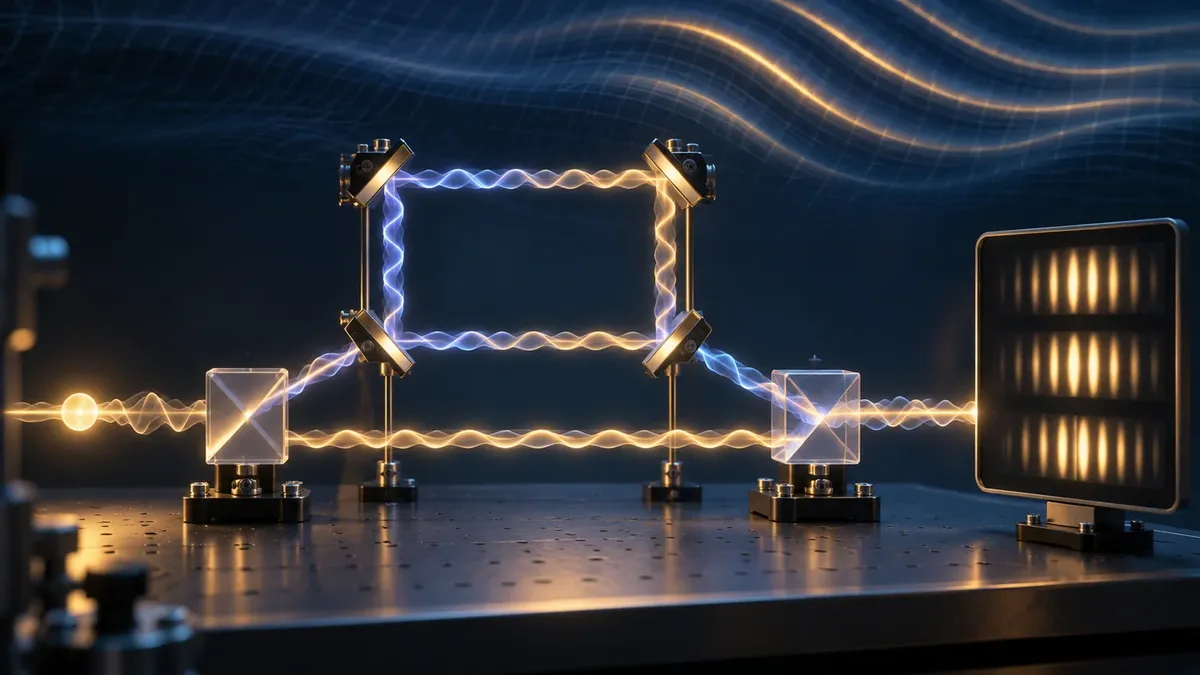
LIGO detects gravitational waves by tracking changes in the length of laser interferometer arms. Alireza Maleki explores a different idea: send a massive quantum particle along two paths and look for a wave-induced difference in their phases. The calculations suggest a tunable response, while leaving major questions about real-world performance.
Gravitational waves are tiny ripples in spacetime, and detecting them requires measuring effects that are extraordinarily small. LIGO uses laser light traveling along long arms; changes in the relative travel of the light reveal a passing wave. In a study published in Scientific Reports, physicist Alireza Maleki investigates a different approach: could a massive quantum particle’s motion through an interferometer provide another way to read out those ripples?
The proposal is theoretical, not a report of a working gravitational-wave detector. Its central idea is to split a particle’s quantum wave into two paths: a reference route and a rectangular loop. A gravitational wave produces a changing tidal effect across space. As the particle travels through the loop, that effect adds a phase to its quantum state. When the paths recombine, the phase difference changes the odds of detecting the particle at either output. In effect, the detector would translate a passing wave into a shift in an interference pattern.
Calculating a tunable response
Maleki derives the phase response for the two gravitational-wave polarizations, called plus and cross, assuming a simplified setup. The wave travels perpendicular to the interferometer’s plane, the particle moves at constant speed along the loop, and the wave is treated as a weak disturbance. The analysis calculates how the phase depends on particle mass, speed, loop dimensions and wave frequency.
Those parameters provide a way, in principle, to tune which frequencies the device responds to. The paper compares example configurations, including a short loop with faster particles and a much longer loop with slower particles. In the model, the latter responds best at lower frequencies, while the former has a smoother response over a broader range. Some frequencies have weak or vanishing response, so the device would not be equally sensitive everywhere.
The paper also runs a forward simulation using the strain signal associated with the black-hole merger GW190521 as an input. It calculates the phase that the proposed interferometer would register under chosen assumptions. This is a modeled response to an existing signal—not an experimental detection, nor evidence that the proposed instrument could observe that event in practice.
The gap between a model and a detector
The paper discusses several practical considerations, including environmental disturbances, parameter precision and the need to keep the particle’s paths coherent. It estimates some effects, such as phases from nearby air molecules and dust, under specific assumed conditions. But such estimates do not establish overall detector sensitivity: important issues, including seismic noise, readout noise, environmental gravity gradients and reliable splitting and recombination, remain to be fully assessed. The paper itself says instrumental imperfections need separate analysis and describes its results as an idealized detector concept.
The most demanding challenge is creating and controlling a sufficiently massive quantum system in a spatial superposition while preserving coherence. The study discusses possible candidate systems and required operating conditions, but it does not demonstrate that a detector meeting the full set of requirements exists. Nor does its calculated frequency reach establish that a tabletop instrument would outperform or replace current observatories. The authors present the approach as potentially complementary, with a response that could be adjusted through experimental parameters.
What the study establishes—and what it does not
The main result is a mathematical account of how a gravitational wave could imprint a measurable relative phase in this proposed arrangement, along with calculations showing how the response changes with frequency and design choices. The analysis motivates further work on feasibility and practical sensitivity; it does not show an observed gravitational wave or a tested instrument.
Although the supplied source identifies the work as published in Scientific Reports in 2026, publication does not remove the distinction between a theoretical proposal and experimental validation. The calculations rely on simplified assumptions, and practical performance depends on effects that are not fully quantified here. The idea is therefore best understood as a possible new measurement architecture—not a new detector ready to listen to the universe.
- gravitational waves
- massive-particle interferometry
- quantum physics
- matter-wave interferometry
- gravitational-wave detectors
Reviewed cross-references
These connections were reviewed by a model, not independently fact-checked by a human. Similarity does not imply agreement; consult the original papers and the evidence below.
Can gravity’s quantum phase survive an entanglement washout?
Shared method: Both proposals use matter-wave interferometry to make gravitationally induced path phases observable at recombination. Maleki models a gravitational-wave tidal phase for a massive particle; Feng and Vedral study a Newtonian conditional phase between two masses under dephasing. The shared phase-readout approach does not establish that either detector proposal is experimentally feasible or validate the other’s distinct signal model.
Model review: · openai-codex/gpt-6-luna
Evidence and provenance
Selected excerpts, not complete papers. PDF extraction can omit figures or damage equations, tables and reading order; sources may be preprints.
2611.26659v1 — Original paper
Excerpt reference:
static/papers/2611.26659v1.md:12-67
Basis: Paper text
Source SHA-256:3eaa8df333d9c2575b94e2a39fab298bf6f535169864d5fd0c16f0689f246ca42611.26659v1 — Original paper
Excerpt reference:
static/papers/2611.26659v1.md:701-757
Basis: Paper text
Source SHA-256:3eaa8df333d9c2575b94e2a39fab298bf6f535169864d5fd0c16f0689f246ca42611.12229v1 — Original paper
Excerpt reference:
static/papers/2611.12229v1.md:56-105
Basis: Paper text
Source SHA-256:3c7fd8eb92d2a07cd742e69224020558fd6dbe235ab3bc32586d18ddeb014cb72611.12229v1 — Original paper
Excerpt reference:
static/papers/2611.12229v1.md:165-217
Basis: Paper text
Source SHA-256:3c7fd8eb92d2a07cd742e69224020558fd6dbe235ab3bc32586d18ddeb014cb7
Related reading
Automatically matched by shared topic keywords. These links do not imply that the sources agree or establish a consensus.
Blazar jets could create a background that complicates high-frequency gravitational-wave searches
Source published
Shared keywords: gravitational waves
Separating black hole signals from glitches in simulated LISA data
Source published
Shared keywords: gravitational waves
Can gravity’s quantum phase survive an entanglement washout?
Source published
Shared keywords: matter wave interferometry
How fast can Yang–Baxter circuits grow in complexity?
Source published
Shared keywords: quantum physics
Geometry as a shield for logical quantum information
Source published
Shared keywords: quantum physics