TRANSMISSION // 2611.26658v1
In an Apollo 14 model, a seismometer’s shadow adds tilt
Source published
An analytical model suggests that radiative heat exchange through an Apollo 14 thermal blanket, combined with the instrument’s shifted shadow, could add tilt noise. The estimate is model-dependent, not a direct measurement.
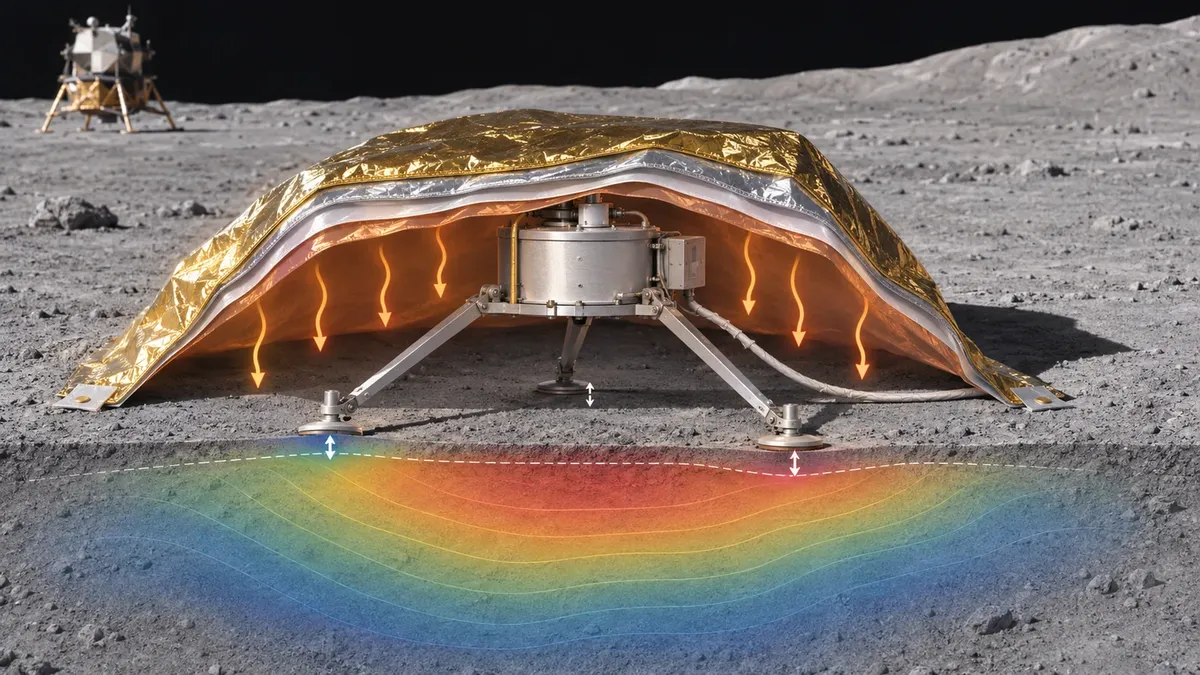
A thermal shield can limit how sunlight heats lunar soil, but uneven heating around a seismometer may still deform the ground beneath its feet. A study models how that deformation could tilt the Apollo 14 instrument—and finds that, for its modeled blanket and shadow geometry, making the shield larger would not eliminate the effect.
A seismometer on the Moon must distinguish ground motion from other influences on its readings. One possible disturbance begins with the ground itself: if nearby surfaces absorb different amounts of sunlight, uneven heating can make the soil expand by different amounts. If the instrument’s feet move unequally, the seismometer tilts. For a horizontal sensor, tilt can make lunar gravity register as an apparent signal.
Sreejaya Kizhaekke Pakkathillam, Aneesha Ann Joseph and Philippe Lognonné developed a model to estimate this effect. They applied it to the Apollo 14 Passive Seismic Experiment, considering its thermal shield, instrument body and nearby equipment. The work also discusses possible implications for future lunar seismometers and proposed gravitational-wave instruments.
Modeling heat, deformation and tilt
The model represents lunar soil, or regolith, as a uniform, elastic half-space: an idealized layer extending downward without end. It calculates how surface features—including shields, rocks and equipment—alter the heat entering the ground, creating lateral temperature differences. The authors then calculate how those differences could deform the surface and produce different vertical motions at the seismometer’s three feet.
To handle circular features, the researchers use Hankel transforms, a mathematical technique for problems with radial symmetry. The model is linear, so contributions from multiple features can be calculated separately and combined. The authors compare their estimates with archived Apollo 14 recordings near local noon, but the model’s predicted tilt is not itself a measurement from those recordings.
A shifted shadow in the modeled Apollo setup
The Apollo 14 shield was a multilayer insulation blanket, not a perfectly opaque cover. The model estimates that radiative exchange between the warmed blanket and the ground beneath it passes about one-fiftieth of solar-flux fluctuations to the regolith. This does not mean that sunlight literally shines through the blanket. In the model, the instrument body blocks this exchange over part of the blanket, creating a shadowed region beneath it.
Near local noon at the Apollo 14 site, the Sun is a few degrees from overhead, shifting the body’s shadow by about 2–5 centimetres. With the shadow displaced from the tripod’s center, the feet can experience different ground deformation.
For this modeled configuration, the median tilt amplitude spectral density in the 1–5 millihertz band is about 7–8 × 10⁻¹¹ radians per square root hertz. The authors estimate that this is more than three orders of magnitude above their opaque-shield result. In their calculations, enlarging an opaque shield reduces tilt. But with the modeled blanket and displaced body shadow, increasing the shield radius does not reduce the shadow-related tilt in the same way. The comparison depends on assumed blanket properties, shadow displacement and Apollo 14 layout; it is not a general finding that an instrument’s shadow always matters more than its shield.
The authors also model nearby Apollo equipment. In their opaque-shield calculation, its contribution is about an order of magnitude smaller than the shield’s contribution when a small centering error is included. In the idealized case of a perfectly centered tripod, the shield’s tilt cancels by symmetry.
What remains uncertain
The modeled noon tilt is below the quietest Apollo 14 noise levels examined in the study. The authors therefore do not identify this specific estimate as an explanation for Apollo’s observed noise. They note other possible thermal effects not included in the model, such as responses of the sensor and its mounting, cable-related stresses and local differences in soil properties.
The estimates also rely on simplifying assumptions. The soil is treated as uniform, isotropic and elastic, with constant properties; the instrument is represented as a rigid tripod. The model neglects factors including slipping feet and internal mechanical resonances. It represents the shifted shadow as a displaced disk, whereas a real shadow is elongated and heat can spread along the blanket. The authors say these differences are expected to reduce the modeled tilt. Earthshine and the shadow’s changing position over time are also not fully included.
The results are theoretical estimates for specified conditions, not direct observations of shadow-induced tilt. The study is an arXiv preprint; the supplied source does not establish its peer-review status. Its design discussion points to reducing temperature differences across an instrument’s footprint, limiting radiative exchange with the ground and keeping shadows symmetric around the supports as factors to consider. Further work would be needed to determine how well the estimates apply to a particular future deployment.
- lunar seismology
- thermoelastic tilt
- lunar regolith
- thermal shields
- Apollo 14
- gravitational-wave detectors
Related reading
Automatically matched by shared topic keywords. These links do not imply that the sources agree or establish a consensus.