TRANSMISSION // 2611.26538v2
When Is an AI Bias an Interaction?
Source published
A preprint tests a common way of flagging intersectional bias and proposes ADDIS, which compares subgroup results with an additive-effects baseline.
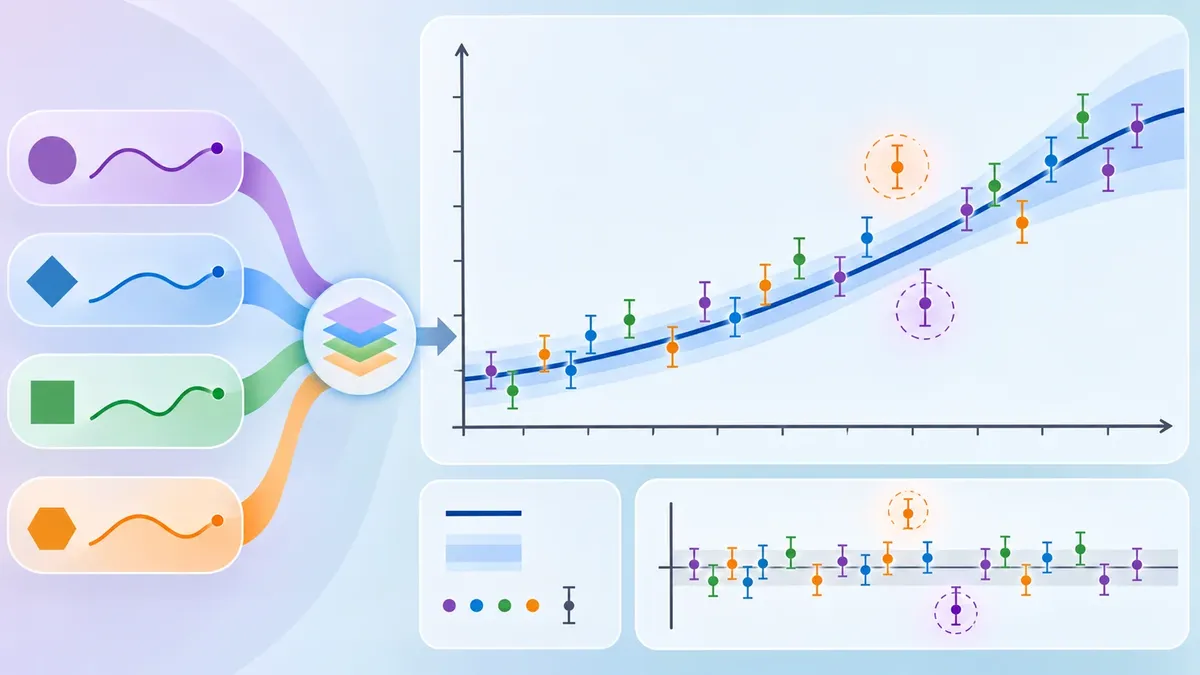
When a language model responds differently to people with several identity attributes, how can an audit tell whether the combination matters beyond the attributes considered separately? A preprint tests a common screening rule and proposes a statistical method built around that question.
Why the baseline matters
Audits often examine groups defined by combinations of identity attributes. But a difference for one subgroup does not, on its own, show that the attributes interact: separate effects associated with each attribute can produce a difference without any additional interaction.
The authors argue that a common screening rule can mistake this additive pattern for intersectional bias. Their alternative asks whether a subgroup’s result departs from what a model of separate attribute effects predicts. In this paper, an interaction means a departure from that additive baseline—not, by itself, a judgment about harm.
Testing the methods
The researchers evaluated audit rules on 150 synthetic datasets constructed without interactions. With a shuffle-based null, the standard criterion flagged an average of 66.1 subgroups per dataset as false positives, and flagged at least one in every dataset. When the researchers planted interactions of known size, a repaired version of the standard criterion recovered 32% of them.
They propose ADDIS, or Additive Intersectional Screen. It fits an additive model across attributes, measures each subgroup’s distance from the model’s prediction using Additive Residual Distance (ARD), and tests departures with a Freedman–Lane null. On the synthetic benchmark, the authors report an average of 0.09 false subgroup flags per dataset and recovery of 84% of planted interactions. These figures apply to the benchmark described in the abstract; they do not establish performance across other data or audit designs.
Auditing language models
The researchers also created IndiPersona, a set of 10,000 synthetic Indian personas with six identity attributes, and audited 13 open language models. Across 738 tested subgroups, the standard criterion flagged 7.1% on average, compared with 3.0% for ADDIS.
The abstract reports that gender identity crossed with sexual orientation was the largest pairing in every model. Counterfactual personas—profiles altered to examine responses under changed identities—also revealed a caste-by-class interaction in all but one model. The authors say the observational test lacked enough data to detect that interaction. These are reported results from a synthetic-persona audit, not confirmation that the patterns apply to real people or settings.
What to take away
The results illustrate why an audit needs a clear baseline: a subgroup flagged by a simple rule may reflect separate attribute effects rather than an additional interaction. In the reported experiments, ADDIS produced fewer false flags and recovered more planted interactions than the tested standard criterion. The available abstract does not give enough detail to assess persona construction, response scoring, or performance in other audit settings.
This article is based on the paper’s abstract, not a full review of its methods, tables, or supplementary material. The work is an arXiv preprint; the supplied source does not establish whether it has been peer reviewed. Its findings should therefore be read as reported results that merit further scrutiny.
- AI bias audits
- intersectional bias
- large language models
- statistical testing
- ADDIS
- synthetic personas
Related reading
Automatically matched by shared topic keywords. These links do not imply that the sources agree or establish a consensus.
A Statistical Test for Where Treatment Effects Vary
Source published
Shared keywords: statistical testing
A New Test Asks Which Data Maps Preserve Neighbors—and the Bigger Picture
Source published
Shared keywords: statistical testing
How Moral Concepts Are Organized Inside Language Models
Source published
Shared keywords: large language models
Can language models reason strategically? GENSTRAT tests them in generated games
Source published
Shared keywords: large language models
When LLMs Choose Their Own Bets, Risky Patterns Grow
Source published
Shared keywords: large language models