TRANSMISSION // 2611.26504v1
A spectral map for AI agents facing changing goals
Source published
A preprint’s spectral successor-feature method adapted to moving goals in one gridworld, but privileged information and limited testing constrain the result.
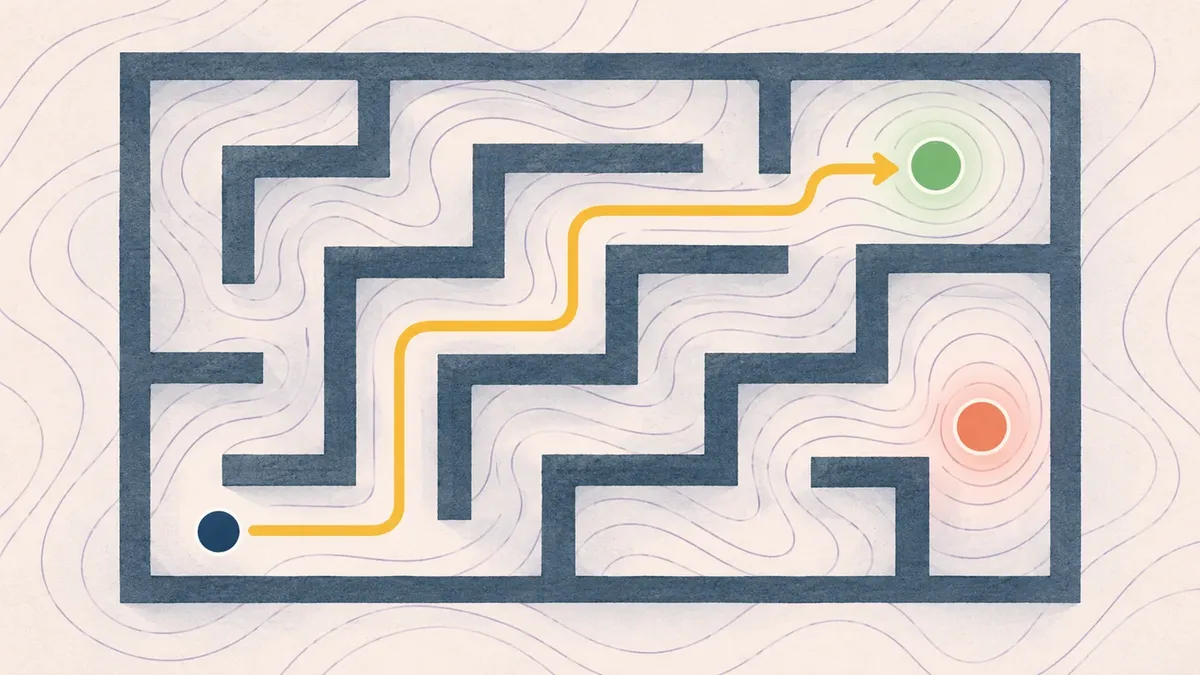
When a reinforcement-learning agent’s goal changes, can it reuse its knowledge of the environment instead of learning the layout again? A preprint proposes building reusable features from the environment’s transition structure. In one small maze, the authors report that their method stayed near its best performance as goals moved. The experiment is promising within that setup, but its comparisons give the methods different information, and broader settings remain untested.
The challenge: a new goal, the same maze
A reinforcement-learning agent learns by taking actions and receiving rewards. If the layout stays fixed but the goal moves, the agent could benefit from retaining what it knows about the environment and updating only which outcomes are valuable.
Successor features aim to separate knowledge of future environment activity from the task’s reward. Reward weights can then be changed for a new task. But successor features usually have to be learned, and their usefulness depends on the features chosen to represent the environment.
Élodie Côté-Gauthier, Doina Precup and Isabeau Prémont-Schwarz propose deriving those features from the environment’s transition structure. Their design draws on a neuroscience proposal connecting entorhinal grid-cell patterns with eigenvectors of the successor representation. This is an inspiration for an AI method, not a test of grid cells in animals.
A basis built from transitions
The method uses eigenvectors of a transition matrix associated with a fixed reference policy. In the experiments, the reference is a uniform random walk on a graph of state-action pairs. This graph construction can symmetrize transitions, effectively including backward edges; it is not simply a policy that chooses equally among the available actions at each step. The resulting low-frequency Laplacian eigenvectors vary gradually over the graph while reflecting its connectivity.
The mathematical result is that, for these eigenvector features, each successor feature is its corresponding base feature multiplied by a known constant. The method can therefore calculate successor features rather than learn them with a separate network. When the reward changes, it updates reward weights through linear regression while leaving the feature basis fixed.
The agent’s behavior is distinct from the reference policy: it chooses actions greedily using action values calculated for the reference policy. This amounts to one step of policy improvement, but those values are not generally exact for the agent’s changing behavior, and the acting policy is not guaranteed to be optimal in every setting.
What the authors tested
The authors evaluated the method in a deterministic 12-by-12 gridworld with 84 open cells, walls and four cardinal actions. Two goal locations appeared in sequence, and the sequence was repeated to examine retention. Each goal task lasted 250,000 steps; the experiments used five random seeds.
They tested two spectral versions. The offline version computed its basis from a random walk run long enough to observe every transition. The online version built a graph from transitions observed during exploration. The paper compares them with SimpleSF, which learns successor features, and DQN, which learns action values directly.
The authors report that both spectral agents approached near-maximal return within a small fraction of the first task and stayed near it across later goal changes, with brief drops when the goal moved. They report sharp drops for SimpleSF and DQN at those changes. The spectral agents did not reach the maximum throughout; the paper points to approximations, including retaining a limited number of eigenvectors and estimating reward weights online.
Important limits on the comparison
The methods did not receive equivalent information. The offline spectral agent began with a complete transition description: its basis came from a random walk that covered every transition. Its pixel-processing network was also trained in advance using renders of every grid cell. The baselines learned representations from their own pixel experience. The online spectral method built its graph from observed transitions, but received the agent’s cell identity directly instead of pixels. The authors describe these results as an upper-bound-style demonstration, not an equal-information head-to-head comparison.
The test also covers just one small grid layout and two goals. It does not establish how the approach performs in larger, stochastic, continuous or partially observed environments, or when the layout changes. The paper describes a further limitation: when positive and negative rewards coexist, values under the reference policy can steer an agent away from a route it needs to reach a goal.
This is a preprint presented as part of NeurReps and WiML Workshops at NeurIPS 2026; the supplied source does not establish peer-reviewed publication. The reported result is specific: in this gridworld, the spectral agents adapted across goal changes under the study’s conditions. Whether the method retains that performance with less privileged information and in more complex environments remains an open question.
- reinforcement learning
- successor features
- continual learning
- spectral methods
- gridworld
- AI preprint
Related reading
Automatically matched by shared topic keywords. These links do not imply that the sources agree or establish a consensus.
A more informed way to train neural networks without backpropagation
Source published
Shared keywords: spectral methods
Can an optimizer help AI learn new tasks without forgetting old ones?
Source published
Shared keywords: continual learning
Task-specific memory helps coding agents retain useful skills
Source published
Shared keywords: continual learning
Beyond Likely Answers: A Preprint Proposes Testing AI for Invariance
Source published
Shared keywords: continual learning
Before combining AI adapters, check what they actually change
Source published
Shared keywords: continual learning