TRANSMISSION // 2611.26461v2
A New Way to Simulate Dark Energy Clustering
Source published
A fluid framework follows dark-energy fluctuations during simulated halo collapse, offering a step toward three-dimensional cosmological simulations.
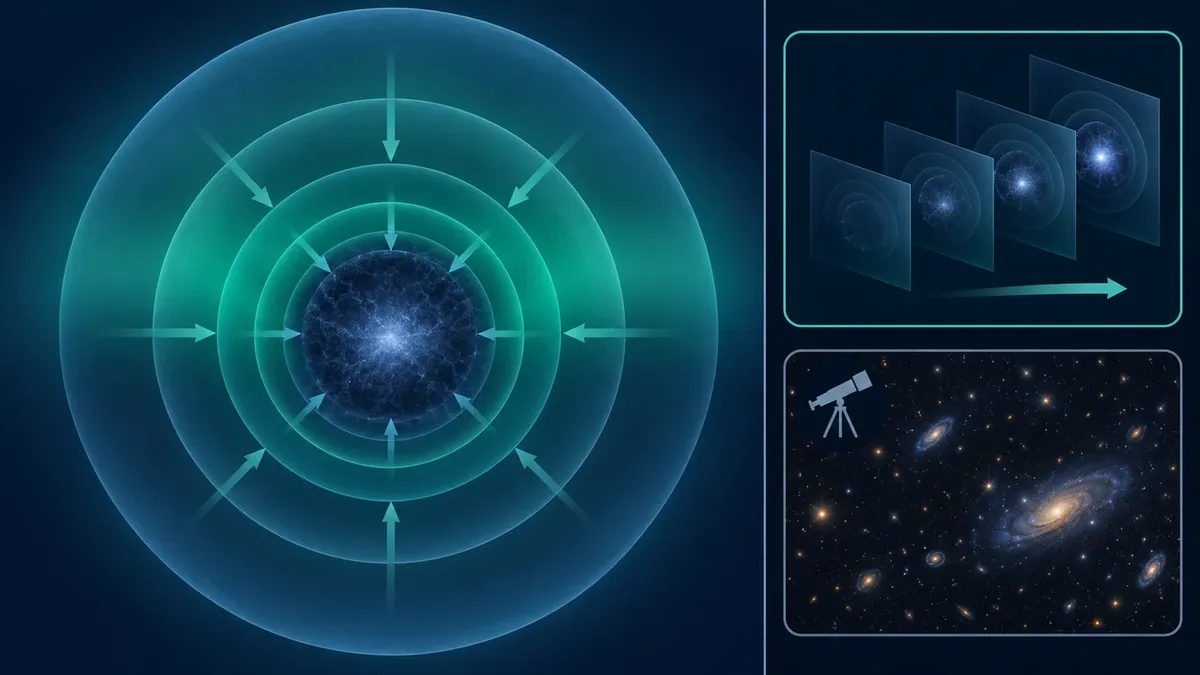
Dark energy is one proposed explanation for the universe’s accelerating expansion. Some models allow it to clump, rather than remain smooth. A new fluid method aims to track those fluctuations as they grow beyond the range where small-perturbation approximations are reliable.
Dark energy is often modeled as a smooth component of the universe, but some theories allow its density to vary from place to place. Those differences could matter as cosmic structures form. The challenge is to calculate what happens when dark-energy fluctuations become large enough that linear approximations may no longer describe them well.
In an arXiv preprint, Yunhao Gao and colleagues present a fluid method for studying nonlinear dark-energy evolution in certain scalar-field theories known as k-essence. Their main question is methodological: can the equations be formulated so simulations can follow large density variations without relying on expansions that assume those variations stay small?
Splitting the action
The method divides the dark-energy action into kinetic and potential parts. Instead of directly evolving the total dark-energy density and pressure, the framework evolves the kinetic density, the fluid’s velocity, and the scalar field. The potential contribution enters as a source that can transfer energy to or from the kinetic part.
This makes the kinetic component’s equation of state simple: its pressure equals its density. The authors derive the fluid equations from the underlying scalar-field theory, rather than imposing an approximate pressure–density relation on the total fluid. In their formulation, deriving the equations does not require expansions in small density perturbations—a useful feature when studying strong clustering.
To demonstrate the method, the team runs spherical-collapse simulations. The calculations represent the system as concentric shells and evolve dark matter and dark energy together as a dark-matter halo collapses. They test two representative k-essence models, called XE and SV, and vary the dark-energy sound speed and halo mass. Sound speed matters because pressure can resist the growth of density variations, while gravity pulls matter inward.
What the simulations show
In these examples, dark-energy density perturbations grow as collapse proceeds. For the fiducial setup—a halo mass of 10¹⁴ solar masses and a background sound speed squared of 10⁻⁶—the central dark-energy density contrast reaches roughly order unity by the present epoch. The simulations therefore demonstrate that this method can follow dark-energy fluctuations into a nonlinear regime under the tested conditions.
The profiles also respond to the competing effects of pressure and gravity. For a given halo mass, lower sound speeds generally produce stronger dark-energy clustering, consistent with weaker pressure support. At fixed sound speed, more massive halos produce perturbations extending across larger distances. In the very-low-sound-speed cases, the simulated profiles develop a relatively flat central region and a sharper transition near the halo boundary.
The authors test convergence by varying numerical settings and comparing selected kinetic-density profiles. Most changes produce differences of about 0.1%; one larger time step lowers the central density by roughly 1%. These checks indicate that the reported profiles change only modestly under the tested parameter variations. They do not establish numerical reliability for every setting: at a higher background sound speed, the current discretization and time-stepping produce oscillations that prevent evolution to the present.
What remains uncertain
These are spherical-collapse calculations, not full three-dimensional simulations. The initial conditions were chosen to demonstrate the method rather than to represent a realistic cosmological starting point. The study examines two illustrative models, so it does not establish how all dark-energy theories behave, nor does it show that dark energy has been observed to cluster.
For the higher-sound-speed regime where their simulations develop numerical oscillations, the authors expect dark-energy perturbations to be small and suggest that linear solvers may describe them adequately. That is the authors’ expectation, not a validation from a full comparison across models and numerical methods.
The next step is to extend the framework to three-dimensional cosmological simulations, potentially using particle-based methods. Such work would be needed to investigate possible effects on observable quantities, including matter clustering, halo populations, and gravitational lensing. For now, the paper offers a computational framework and a proof-of-concept application, not observational evidence for a particular form of dark energy.
This article is based on an arXiv preprint. The supplied source does not establish its peer-review status, and the results should be understood in light of the paper’s limited set of models, simplified initial conditions, and spherical geometry.
- dark energy
- k-essence
- cosmological simulations
- spherical collapse
- nonlinear clustering
- sound speed
Reviewed cross-references
These connections were reviewed by a model, not independently fact-checked by a human. Similarity does not imply agreement; consult the original papers and the evidence below.
Dark energy’s nonlinear behavior may reveal hidden physics
Shared method: Both papers use the fully nonlinear fluid framework based on splitting the k-essence action and apply it in spherical-collapse simulations. The framework study examines two representative models and varies sound speed and halo mass; the related model-comparison study uses the framework to compare two models with matched background and linear dynamics, reporting central dark-energy density differences up to 50% for cluster-sized halos. These findings are specific to the models and simulation setup described in the papers.
Model review: · openai-codex/gpt-6-luna
Evidence and provenance
Selected excerpts, not complete papers. PDF extraction can omit figures or damage equations, tables and reading order; sources may be preprints.
2611.26461v2 — Original paper
Excerpt reference:
static/papers/2611.26461v2.md:1973-2031
Basis: Paper text
Source SHA-256:952faef7337ddce540b45cf27d908361208608a61296440a54a6cce12cd98c7d2611.26460v2 — Original paper
Excerpt reference:
static/papers/2611.26460v2.md:213-330
Basis: Paper text
Source SHA-256:efe82775d6366a4f2c6bf2088e877fc521f37cef8d475fba94e266abf31427b9
Related reading
Automatically matched by shared topic keywords. These links do not imply that the sources agree or establish a consensus.
Dark energy’s nonlinear behavior may reveal hidden physics
Source published
Shared keywords: dark energy, sound speed, spherical collapse
Galaxy Motions Help Untangle Models of Dynamical Dark Energy
Source published
Shared keywords: dark energy
Could dark matter’s hidden properties change the cosmic web?
Source published
Shared keywords: cosmological simulations, dark energy
One simulation, many dark-energy histories
Source published
Shared keywords: cosmological simulations, dark energy
Why turbulent gas can slow its own chemistry
Source published
Shared keywords: cosmological simulations