TRANSMISSION // 2611.26460v2
Dark energy’s nonlinear behavior may reveal hidden physics
Source published
Two dark-energy models with matching expansion histories and linear dynamics develop different central densities in spherical-collapse simulations.
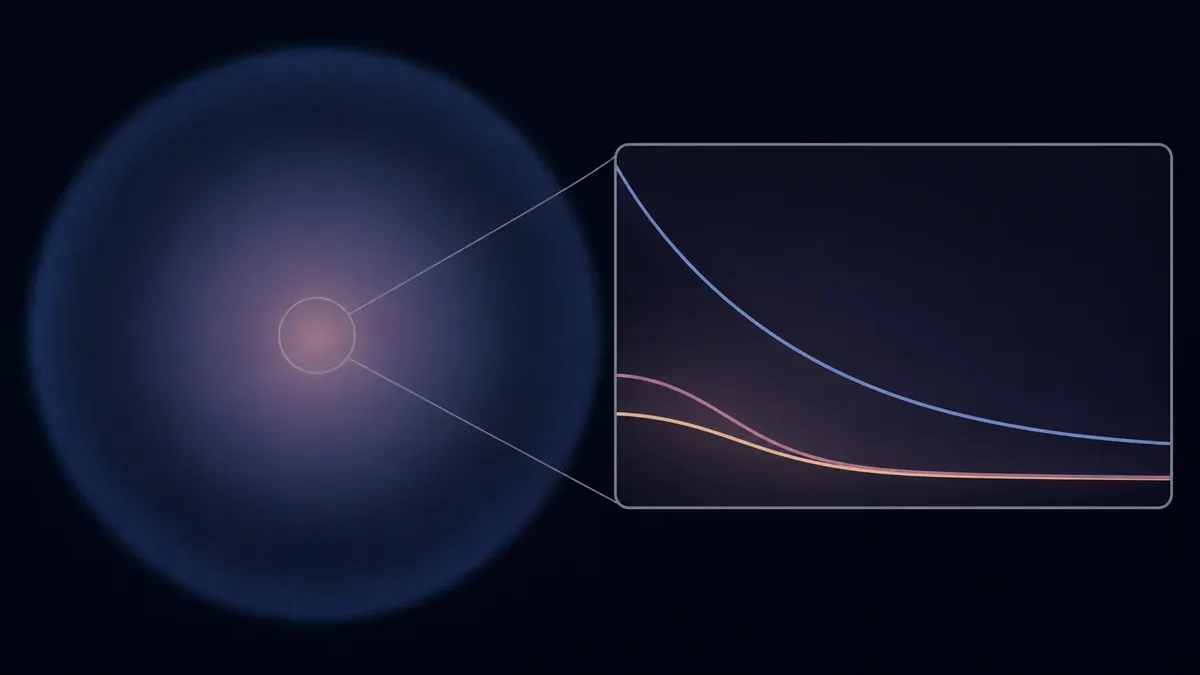
Can two dark-energy theories that share the same cosmic expansion history and linear behavior still differ inside a collapsing halo? A new preprint suggests they can: simulations find different dark-energy densities near halo centers, with differences in the models’ local sound speeds helping explain the result.
A deeper test of dark-energy models
Dark energy is the name given to whatever drives the Universe’s accelerated expansion. Cosmologists describe candidate theories using quantities such as the equation of state, which relates dark energy’s pressure to its density, and a sound speed specified for the homogeneous cosmic background. These parameters describe important aspects of a theory, but they may not capture every detail of how it behaves in dense, nonlinear environments.
Yunhao Gao and colleagues ask whether theories that share the same background expansion and linear dynamics can nevertheless behave differently inside collapsed structures. The paper points to planned surveys such as Euclid and LSST as motivation for improving predictions of how dark energy might affect cosmic structure. The question is whether nonlinear structure could reveal differences hidden by simpler descriptions.
Simulating a collapsing halo
The researchers introduce a fluid framework intended to follow clustering dark energy into the nonlinear regime, where matter has gathered into dense structures and small-perturbation approximations no longer suffice. The framework is derived from an underlying scalar-field description rather than relying only on prescribed background quantities.
They apply it in spherical-collapse simulations of two k-essence dark-energy models, labelled XE and SV. The models are constructed to have the same equation of state over time and the same prescribed background sound speed squared. The paper states that they have identical background and linear dynamics; the differences arise as the simulations follow their nonlinear evolution.
In the reported setup, the models share a chosen background cosmology. The initial dark-energy density perturbation is set to zero at the starting redshift, z = 49. The simulations then follow radial density profiles as a dark-matter halo collapses. This is a controlled calculation of two specified models, not a survey measurement of real halos.
Different densities near the center
Despite their matched background and linear behavior, XE and SV develop different dark-energy density profiles in the halo’s central region. The abstract reports central dark-energy densities differing by up to 50% for cluster-sized halos. In the paper’s specific comparison, the SV model’s total dark-energy density in the central regions is about 50% higher than XE’s; its kinetic density is about 80% higher. These figures describe the models and regions simulated, not a general prediction for all dark-energy theories.
The dark-matter profiles also differ through gravity, though less strongly. The authors report a difference of a few percent in the combined dark-matter-plus-dark-energy density profile, remaining appreciable out to around 2 megaparsecs in their setup.
The proposed main driver is the local sound speed. The sound speed specified on the homogeneous background need not equal its value inside a halo. The simulations find different local sound speeds in the two models. In particular, the authors say that an increase in XE’s local sound speed near the center strengthens the suppression of dark-energy clustering there.
Other theory-dependent terms appear less important in the cases studied, but this conclusion has qualifications. The authors report that the source term S and function K vary from their background values by about 10⁻⁶ over the simulated period. Their analysis also gives conditions for neglecting perturbations in these terms, including that the equation of state stays sufficiently far from −1 and that certain background quantities do not change too rapidly. The paper notes that these conditions do not cover every dark-energy model.
What the result does—and does not—show
The central point is that matching a model’s expansion history and linear dynamics may not fully determine its behavior in nonlinear environments. In these simulations, differences in the local sound speed accompany different dark-energy density profiles within the halo.
That suggests a possible route to distinguishing theories, not an established observational method. The study uses spherical collapse, not full three-dimensional cosmological simulations or measured survey data. The authors identify three-dimensional simulations as an important next step toward determining whether the predicted differences produce observable signatures.
This article describes a preprint available on arXiv. The supplied source does not establish its peer-review status. Its results are calculations for two specified models under stated assumptions; they do not show that dark energy has been detected clustering in real halos. Further modelling and comparison with observations would be needed to assess whether these differences can be measured and separated from other effects.
- dark energy
- cosmology
- nonlinear structure formation
- spherical collapse
- sound speed
- k-essence
- dark matter halos
Reviewed cross-references
These connections were reviewed by a model, not independently fact-checked by a human. Similarity does not imply agreement; consult the original papers and the evidence below.
A New Way to Simulate Dark Energy Clustering
Shared method: Both papers use spherical-collapse simulations of k-essence dark energy. The framework paper develops the action-splitting fluid method; the origin paper applies a fully nonlinear fluid framework to compare two models with matched background and linear behavior. These are companion papers by the same authors, so this is a methodological connection, not independent confirmation.
Model review: · openai-codex/gpt-6-luna
Evidence and provenance
Selected excerpts, not complete papers. PDF extraction can omit figures or damage equations, tables and reading order; sources may be preprints.
2611.26460v2 — Original paper
Excerpt reference:
static/papers/2611.26460v2.md:57-141
Basis: Paper text
Source SHA-256:efe82775d6366a4f2c6bf2088e877fc521f37cef8d475fba94e266abf31427b92611.26461v2 — Original paper
Excerpt reference:
static/papers/2611.26461v2.md:119-174
Basis: Paper text
Source SHA-256:952faef7337ddce540b45cf27d908361208608a61296440a54a6cce12cd98c7d
Related reading
Automatically matched by shared topic keywords. These links do not imply that the sources agree or establish a consensus.
A New Way to Simulate Dark Energy Clustering
Source published
Shared keywords: dark energy, sound speed, spherical collapse
Galaxy Motions Help Untangle Models of Dynamical Dark Energy
Source published
Shared keywords: dark energy
Could dark matter’s hidden properties change the cosmic web?
Source published
Shared keywords: dark energy, nonlinear structure formation
Finding more cosmological information in DESI’s nearby galaxies
Source published
Shared keywords: dark energy
A faster way to weigh dark matter halos in simulated universes
Source published
Shared keywords: dark matter halos