TRANSMISSION // 2611.25927v2
Fast-JEPA speeds planning in simulated visual-control tasks
Source published
Fast-JEPA speeds up simulated visual-control planning by building a goal-directed action plan, then comparing complete alternatives with direct predictions of their endpoints.
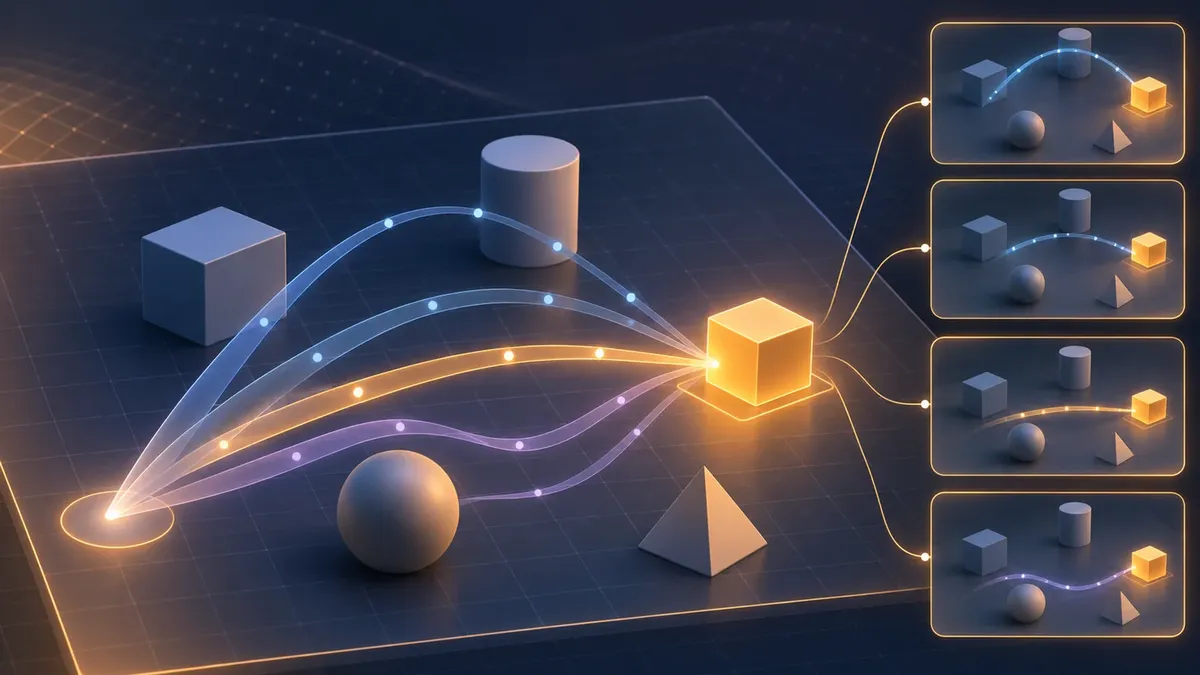
A planner can use a learned model of the world to estimate what different actions might do. But predicting every intermediate step for every candidate plan can be slow. Fast-JEPA, an arXiv preprint, changes how those predictions are used: it predicts intermediate outcomes while constructing a plan, then compares finished plans by predicting their endpoints directly. In the authors’ simulations, the approach paired high task success with lower planning latency than the tested INTACT system.
A robot choosing how to move an object faces a trade-off: consider more possible action sequences to improve its chances, or choose quickly enough to act while the scene is still relevant. Learned “world models” help by predicting the consequences of actions. But a planner can spend substantial time repeatedly asking its learned model to predict each step of each candidate plan.
Fast-JEPA, described in an arXiv preprint, asks whether that prediction work can be reorganized. Its central idea is to use intermediate predictions when building an action sequence, but avoid repeating a chain of state predictions when comparing completed sequences. Instead, it predicts each candidate’s endpoint and checks how closely that predicted outcome matches a visual goal.
A proposal, then a focused search
The system first builds a goal-directed proposal: an action plan intended to make progress toward the goal. As it constructs the plan chunk by chunk, the learned model predicts outcomes from the same starting observation, and those predictions guide later action choices. A predicted state is not fed back as the starting point for the next model prediction.
Next, Fast-JEPA uses the proposal to focus a search over alternatives. It applies the cross-entropy method, which samples candidate plans and gradually concentrates on those with lower predicted goal error. Completed candidates are evaluated with direct predictions of their terminal outcomes rather than recursive, step-by-step predictions of intermediate states. The original proposal and the best plan found so far remain eligible for selection.
This distinction matters: the method still uses intermediate predictions to help construct a plan, but uses endpoint predictions to compare finished plans. For the paper’s visual-goal objective, the authors argue, the predicted endpoint is sufficient for that comparison.
Results in simulated tasks
The researchers evaluated Fast-JEPA on four visual-control tasks: PushT, Reacher, Cube and TwoRoom. They report an average success rate of 96.50% and a mean complete-planning latency of 10.88 milliseconds. Against INTACT, one of the locally evaluated comparison systems, the reported average was 95.58% success at 26.19 milliseconds. The authors describe Fast-JEPA as 2.41 times faster, with a higher average success rate in this comparison.
The paper also introduces DynaGoal, a benchmark that changes task conditions or imposes time constraints on planning and execution. On DynaGoal-Shift, where goals or environment geometry change, Fast-JEPA’s reported average success was 73.83%. On DynaGoal-Deadline, which tests completing tasks within specified time budgets, the reported average was 87.67%. These tests used models trained on the original tasks without additional training or fine-tuning.
A separate response-delay evaluation found that performance varied by task: success fell sharply for Reacher and Cube as imposed delays grew, while TwoRoom showed a different pattern. Faster planning, then, does not eliminate the effects of delayed feedback.
Ablations offer clues about the design. Without its goal-directed proposal, average success fell from 96.33% to 68.17% under the tested search budget. Removing refinement made planning faster, but reduced average success from 96.33% to 93.83%; the benefit of refinement differed among tasks. These results suggest that both a useful starting plan and additional comparisons contributed in these experiments, though their value depended on the task.
What the evidence does—and does not—show
The study reports simulation results, not demonstrations on physical robots. Its main evaluations used 100 episodes per task and three independently trained models; some search-budget sweeps used a single training seed. Latency was measured on a particular GPU, and actual planning speed can depend on hardware, batching and implementation. The paper also cautions that choosing a plan with lower predicted goal error does not guarantee higher success when the plan is carried out. In its budget-envelope analysis, the same cases were used to select and report the best configuration, so that analysis is descriptive rather than an independent test of configuration selection.
The reported results cover the benchmarks the researchers tested; they do not establish that the approach will generalize to unfamiliar robots or physical settings. DynaGoal adds changing conditions and timing constraints, but remains a set of benchmark protocols rather than a test of every kind of uncertainty. The work is an arXiv preprint, not evidence of peer-reviewed approval, so its claims should be treated as preliminary pending further scrutiny and independent replication.
- Fast-JEPA
- simulated robot planning
- latent world models
- visual control
- predictive search
- robotics
Related reading
Automatically matched by shared topic keywords. These links do not imply that the sources agree or establish a consensus.
Teaching World Models Which Actions Matter
Source published
Shared keywords: visual control
Why one action may not teach an AI how actions work
Source published
Shared keywords: visual control
WARP-JEPA speeds up AI planning by learning which routes to try
Source published
Shared keywords: visual control