TRANSMISSION // 2611.25804v2
Milky Way Star Patterns May Share a Dynamical Story
Source published
A GALAH study finds links among the Milky Way’s ridges, moving groups and vertical phase spiral, but does not establish what caused them.
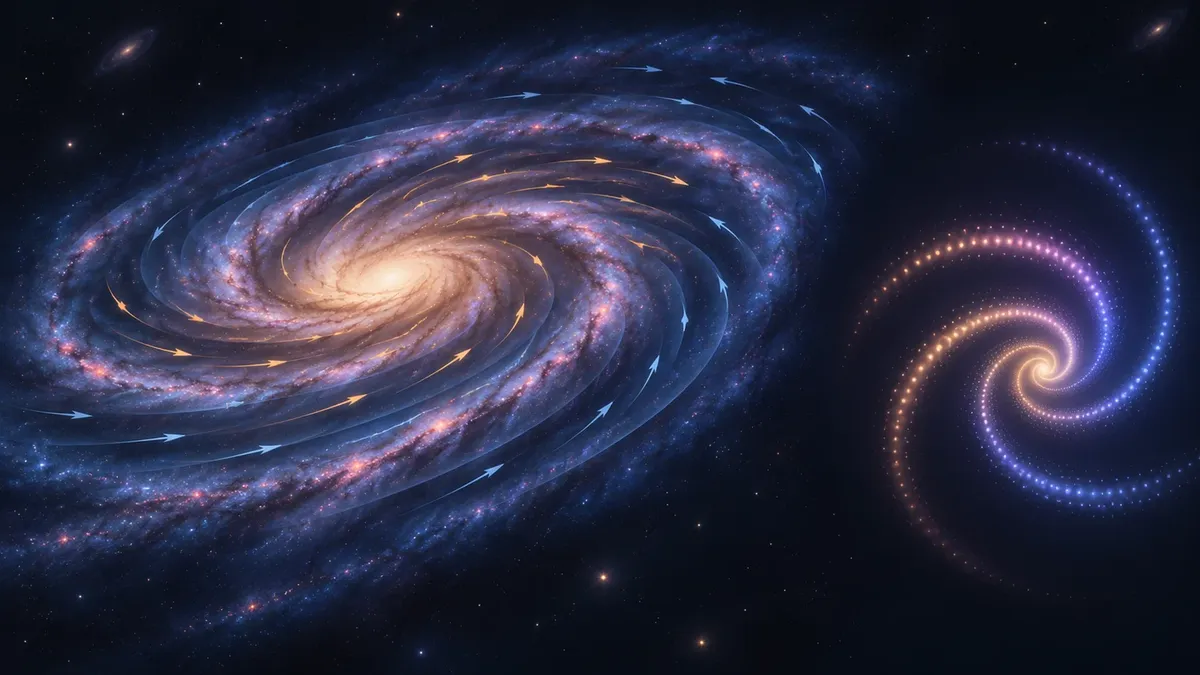
Maps of the Milky Way show patterns in how stars move through its disk. A study of more than 333,000 stars finds connections among several of these patterns, while leaving their underlying cause unsettled.
The Milky Way’s disk contains structures in the motions of its stars. Some appear as ridges in maps of stars’ positions and rotation; another is a spiral in maps of vertical position and velocity. Are these separate features, or related views of the disk’s dynamics? A study using GALAH’s fourth data release examines that question.
The researchers analysed 333,412 disk stars with reliable chemical and dynamical information. They compared ridges and phase spirals across maps of stellar abundances, ages, positions, velocities and orbital quantities. These different views can reveal patterns that are not equally apparent in any single map.
Ridges and spirals in the data
In maps of Galactic radius against rotation speed, the team found ridges that trace approximately constant-angular-momentum tracks. Related ridges in a map of angular momentum and radial action stand out especially when the stars are shown by their maximum orbital height. These ridge regions are preferentially associated with metal-rich, low-alpha populations.
In the solar neighbourhood, defined in this analysis as 7.2–9.2 kiloparsecs from the Galactic centre, the researchers recovered a clear spiral in vertical position and velocity. The spiral’s appearance changed depending on which stellar property was mapped: radial velocity showed a two-armed pattern, while azimuthal velocity and two orbital frequencies showed one-armed spiral-like patterns. The spiral also left signatures in maps of radial action and angular momentum, linking it to in-plane orbital information.
Age mattered, too. Ridges appeared in broadly similar locations across age groups, although their contrast varied. The phase spiral was more tightly wound in younger populations and more loosely wound in older ones; it was most prominent in the 3–6 and 6–9 billion-year groups.
A link, not a cause
Several ridges correspond in angular momentum to known moving groups—groups of stars with related motions. When the researchers excluded stars in six moving-group regions, the spiral became less distinct in mean radial-velocity maps. This comparison supports a link among ridges, moving groups and the phase spiral, but does not show that the moving groups cause the spiral.
The authors interpret the patterns as related features of the disk’s phase-space dynamics, with age and chemical composition helping reveal how different stellar populations respond. Their findings suggest a common dynamical framework and a possible shared origin for the structures, but do not identify one definitive cause.
This account is based on the paper’s abstract and an arXiv preprint; the work may not have undergone peer review. The abstract describes the sample and reported patterns but does not provide enough methodological detail to assess all sources of uncertainty or independently evaluate the analysis.
- Milky Way
- Galactic disk
- GALAH DR4
- phase spiral
- stellar dynamics
- moving groups
- Galactic archaeology
Reviewed cross-references
These connections were reviewed by a model, not independently fact-checked by a human. Similarity does not imply agreement; consult the original papers and the evidence below.
Reading the Milky Way’s gravity in a spiral of stellar motions
Supporting evidence: Both studies find that phase-spiral structure carries dynamical information: the GALAH analysis reports residual spiral signatures in the in-plane actions, while Guo et al. use snail shape curves to constrain the vertical potential. These are complementary inferences from different samples and methods, not independent measurements of the same potential or perturbation history.
Model review: · openai-codex/gpt-6-luna
Evidence and provenance
Selected excerpts, not complete papers. PDF extraction can omit figures or damage equations, tables and reading order; sources may be preprints.
2611.25804v2 — Original paper
Excerpt reference:
static/papers/2611.25804v2.md:12-63
Basis: Paper text
Source SHA-256:a7a8fd1e9fd3c8e24fa779b6ef51e1e532fbb2635efe251fb54869c81eb0599f2611.13837v1 — Original paper
Excerpt reference:
static/papers/2611.13837v1.md:16-54
Basis: Paper text
Source SHA-256:c0f2609aedecc4ff1f3e1e86430d1a92637dd8550d7e8ed397832249c5ab7189
Related reading
Automatically matched by shared topic keywords. These links do not imply that the sources agree or establish a consensus.
A Proposed Infrared Instrument Could Trace the Milky Way’s History
Source published
Shared keywords: galactic archaeology, milky way
Red giants’ individual vibrations sharpen estimates of their ages
Source published
Shared keywords: galactic archaeology
Stellar motions support an excess of small stars in massive galaxy cores
Source published
Shared keywords: stellar dynamics
A Faster Way to Follow Stars Escaping a Globular Cluster
Source published
Shared keywords: milky way
Reading Cepheid chemistry through a star’s pulsating atmosphere
Source published
Shared keywords: milky way