TRANSMISSION // 2611.25688v2
How strong magnetic fields reshape electron screening
Source published
A theoretical calculation finds that Landau levels make static electric screening direction-dependent, with sharp features near level thresholds and a changing role for the Kohn anomaly.
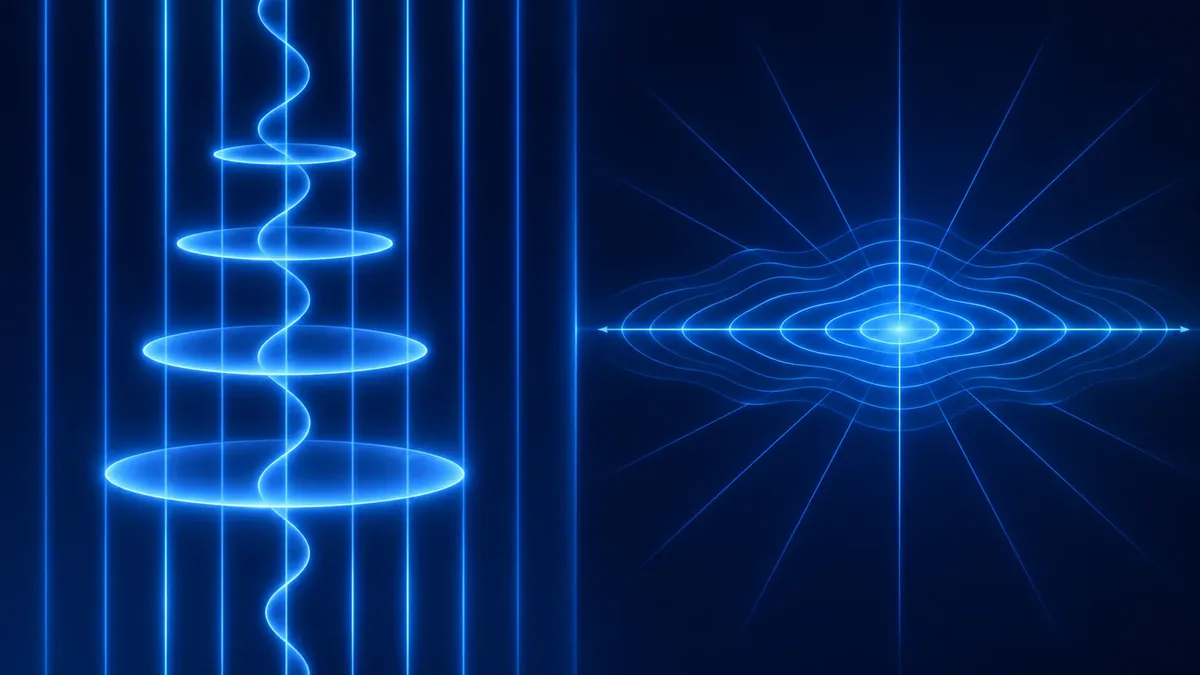
In a strong magnetic field, electron motion across the field is quantized into Landau levels, while motion along it remains continuous. A theoretical study calculates how this quantum structure affects the way an electron gas screens electric charges—and how the response varies with direction and electron density.
An electric charge placed in a material does not always exert its full influence on distant charges. Mobile electrons rearrange in response, reducing the electric field—a process called screening. In a strong magnetic field, that response may depend on direction: electron motion across the field is divided into discrete Landau levels, while motion along it remains continuous. The question addressed in this study is how that quantum structure changes static electric, or Coulomb, screening.
Tomoyuki Maruyama and colleagues develop a relativistic calculation for an electron gas at zero temperature. They use the random-phase approximation (RPA), a framework for describing screening through the collective response of electrons, and calculate the photon self-energy, which encodes how the medium modifies electromagnetic interactions. Their calculation evaluates the static density response with contributions from occupied Landau levels, examining how screening varies with density, momentum transfer and the angle between a disturbance and the magnetic field. It does not calculate the full frequency-dependent response or include coupling to transverse electromagnetic modes. The authors also omit QED vacuum polarization to focus on the density-dependent response for the conditions considered.
Landau levels leave a distinctive imprint
The calculations show oscillations in screening properties as electron density changes. These arise as Landau levels become occupied. At the threshold where a new level begins to fill, the ideal zero-temperature calculation produces a sharp enhancement in the density of available states and a divergence in the calculated Debye screening mass. The authors note that finite temperature, disorder or a finite Landau-level width would smear this singularity. It is therefore important to read the divergence in the context of the model’s idealized assumptions, rather than as evidence that real systems necessarily have unbounded screening.
Within one Landau-level occupation cycle, changes in density can have a less dramatic effect than changes in magnetic-field strength, according to the paper. The response also depends on direction, and the balance varies across the cycle. At low density, the Kohn anomaly—a sharp feature associated here with a one-dimensional nesting condition between Fermi points within an occupied Landau level—can be important. The condition is that the momentum component parallel to the magnetic field, q_z, matches twice the relevant Fermi momentum, 2k_F. The total momentum transfer need not point purely along the field. The paper also reports that, at very low density, the angular response is nearly isotropic apart from the immediate vicinity of forward scattering, where the anomaly matters.
At higher density within the occupation cycle, the momentum associated with the anomaly shifts into a high-momentum region. In the screening momentum range examined, its singular contribution becomes less prominent, and a smoother orientation-dependent anisotropy is more visible. The authors report a subtle competition: depending on the density domain, screening can be enhanced more in the parallel or perpendicular direction. They characterize the orientation-dependent enhancements as a few percent, while describing the Kohn anomaly’s low-density effect as dramatic; this comparison concerns the reported regimes and quantities, not every feature in the calculation.
When the magnetic field is weaker and more Landau levels participate, the response develops additional oscillatory structure. The calculations also show a trend toward the isotropic three-dimensional limit as the field weakens. These are theoretical results within the model, not measurements of a particular material or simulations of a specific astrophysical object.
What the results do—and do not—establish
The findings offer a microscopic account of how Landau quantization can shape static screening. They may be relevant to questions about charged impurities, transport and lattice properties in strongly magnetized matter, including neutron-star crusts. Those applications are motivation, not outcomes tested by this calculation: the study does not model a specific impurity or crust.
The scope matters. The results assume zero temperature and use RPA; threshold singularities may be softened by finite temperature, disorder or Landau-level broadening. The authors identify dynamic screening and the full coupled electromagnetic response as important extensions. The calculation does not establish experimentally that the predicted anisotropy occurs in a particular system.
This article is based on the authors’ work listed as an arXiv preprint in the supplied source record. That record does not establish a peer-review status or independent confirmation. The supplied paper text is an extraction, and its equations and figures may have formatting limitations. The authors state that no data were created or analyzed. The results are best understood as a theoretical calculation mapping possible screening behavior under specified assumptions—not as a confirmed observation.
- Landau levels
- magnetic fields
- electron screening
- Kohn anomaly
- Debye screening
- neutron-star crusts
- RPA
Related reading
Automatically matched by shared topic keywords. These links do not imply that the sources agree or establish a consensus.
Listening to stellar pulses puts new limits on hidden magnetism
Source published
Shared keywords: magnetic fields
ALMA probes magnetic forces in a massive stellar nursery
Source published
Shared keywords: magnetic fields
When Periodic Boundaries Complicate Magnetic Helicity
Source published
Shared keywords: magnetic fields
Blazar polarization hints at magnetic changes that build on one another
Source published
Shared keywords: magnetic fields
Simple patterns emerge in models of magnetic neutron stars
Source published
Shared keywords: magnetic fields