TRANSMISSION // 2611.25683v2
How a robot hand uses touch when the lighting changes
Source published
TipDex-VTLA uses a policy’s sensitivity to lighting and tactile forecast errors to adjust unexecuted actions. Tests on four real-world tasks suggest better performance in unseen lighting, with limits to the evidence.
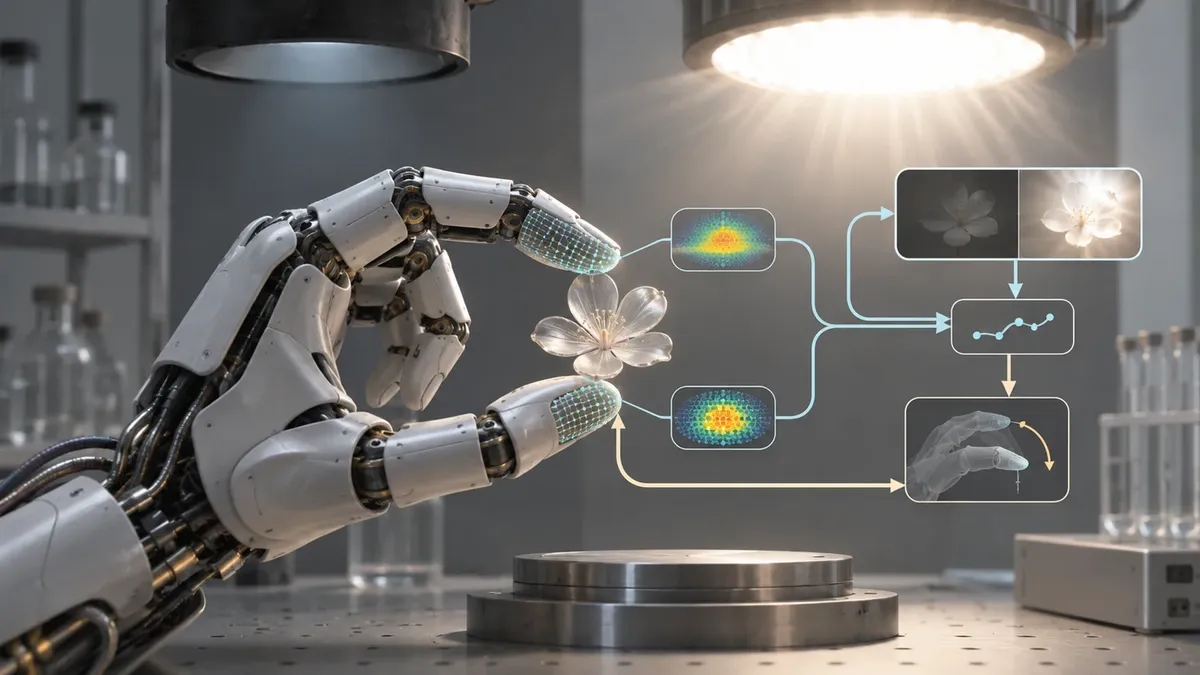
A robot can see the same object differently when the lights change—and that shift can alter its planned movements. TipDex-VTLA pairs an estimate of visual reliability with checks on expected touch, then uses both to adjust actions that have not yet been carried out.
A dim room or a bright reflection can change what a robot sees without changing the object in front of it. For a dexterous robot hand, that mismatch matters: a policy may drift toward a different action even though the physical scene is the same. TipDex-VTLA, a preprint by Xudi Ge and colleagues, asks whether touch can help correct those actions—and when it should do so.
The researchers combine two signals. One estimates how sensitive a policy’s actions are to changes in illumination. The other checks whether the robot’s measured touch matches a forecast of what it expected to feel. Together, the signals regulate bounded adjustments to actions that have not yet been executed.
Estimating when vision may be unreliable
The first component, Visual Action Sensitivity Estimation (VASE), learns a proxy for visual reliability. During training, the researchers pair each original observation with a version altered to simulate different lighting while preserving the viewpoint and physical state. A frozen reference policy processes both images under the same other conditions. If its predicted actions differ, VASE learns to assign a lower reliability score to the altered observation.
That score has an important qualification: it measures the policy’s consistency under the tested image changes, not whether its action is correct or whether the task will succeed. It is a proxy, not a general measure of confidence.
The second component, Tactile Anticipation and Correction during Execution (TACE), compares incoming touch measurements with forecasts made for matching times and action schedules. If touch differs from the forecast, TACE treats that discrepancy as a reason to allow stronger correction. Visual reliability sets a baseline: less reliable vision can also permit more adjustment. The system changes features used to generate replaceable, unexecuted actions, while keeping their scheduled execution times fixed.
In practical terms, the robot first predicts what contact should feel like. As it acts, it checks that prediction against its tactile sensors. If the scene looks visually uncertain or contact differs from expectation, the policy can revise what it is about to do rather than simply continuing with the original action sequence.
Tests in simulation and on a robot
The team evaluated the method on four real-world tasks: transferring an egg, pinching a grape, extracting tissue and pouring mung beans. The robot system used two arms with dexterous hands, tactile arrays and multiple cameras. The researchers report training with 300 demonstration trajectories, split between training the base policy and forecaster and training the refinement components.
For the real-world evaluation, each method and task was run for 20 trials under standard lighting and 20 under unseen lighting conditions. Across the four tasks, TipDex-VTLA’s average full-task success rate was 87.5% under standard lighting and 73.8% under the challenging unseen lighting. These are averages across the study’s tasks and trial setup, not guarantees about other robots, objects or environments.
The authors also tested the method on eight tasks in the UniVTAC simulation benchmark, where it achieved a reported mean success rate of 84.9%. In component-removal tests, performance under unseen lighting was lower when VASE, tactile verification or the gating mechanism was removed. The paper also reports reduced trajectory error in selected illumination tests when feature correction was enabled. These findings support the authors’ interpretation that the two signals can play complementary roles in this setup; they do not establish that either signal will help in every manipulation task.
What remains uncertain
The evidence is bounded. The real-world study covers four tasks, a particular robot and tactile-sensing setup, and a defined set of lighting changes. It does not show how the method performs under every kind of visual disturbance, across different hardware, or in longer deployments. The authors identify broader visual disturbances and task-level feedback as directions for future work.
The comparison with earlier methods also needs context: the paper says some published simulation baselines retain their original configurations and reported results, rather than being evaluated in an identical setup. That makes broad ranking claims difficult to interpret. The researchers say they plan to release the data and code, but the results described here are from an arXiv preprint, which may not have undergone peer review. Independent replication and evaluation on a wider range of conditions would help establish how far the approach generalizes.
- robotics
- tactile sensing
- dexterous manipulation
- robot learning
- illumination robustness
- vision-tactile policies
Reviewed cross-references
These connections were reviewed by a model, not independently fact-checked by a human. Similarity does not imply agreement; consult the original papers and the evidence below.
Teaching Robots Through Verified Synthetic Touch
Supporting evidence: In separate real-world evaluations, both papers report benefits associated with tactile information: TipDex-VTLA reports lower unseen-lighting success when tactile verification is removed, while VeriTouch reports lower average success when synthetic tactile observations are replaced with no-contact inputs. These results support only the bounded point that touch contributed in each study’s setup; they use different tasks, policies, and tactile methods and are not a direct comparison.
Model review: · openai-codex/gpt-6-luna
Evidence and provenance
Selected excerpts, not complete papers. PDF extraction can omit figures or damage equations, tables and reading order; sources may be preprints.
2611.25683v2 — Original paper
Excerpt reference:
static/papers/2611.25683v2.md:779-824
Basis: Paper text
Source SHA-256:9dd80231e3beca73fe2c8da86ddb69780276a361330cc5915b73eef1e6bcb9e82611.30572v1 — Original paper
Excerpt reference:
static/papers/2611.30572v1.md:989-1133
Basis: Paper text
Source SHA-256:3a556e823387ef6a21c430ed29565613ad56d4ae76ec2df38d235e2f4bca5f24
Related reading
Automatically matched by shared topic keywords. These links do not imply that the sources agree or establish a consensus.
A finger-guided gripper aims to scale robot learning
Source published
Shared keywords: robot learning
A critic helps robot policies learn from logged experience
Source published
Shared keywords: robot learning
Teaching Robots Through Verified Synthetic Touch
Source published
Shared keywords: robot learning, tactile sensing
How CHORD helps robot hands learn from human demonstrations
Source published
Shared keywords: dexterous manipulation
OmniPiano tests AI control with up to five virtual piano-playing hands
Source published
Shared keywords: dexterous manipulation