TRANSMISSION // 2611.25594v2
When preference training changes a robot model’s probabilities
Source published
In a simulated robot task, Bradley–Terry training shifted an initially accurate language world model toward outcomes absent from its enumerated cases. The effect on decisions varied with the setup.
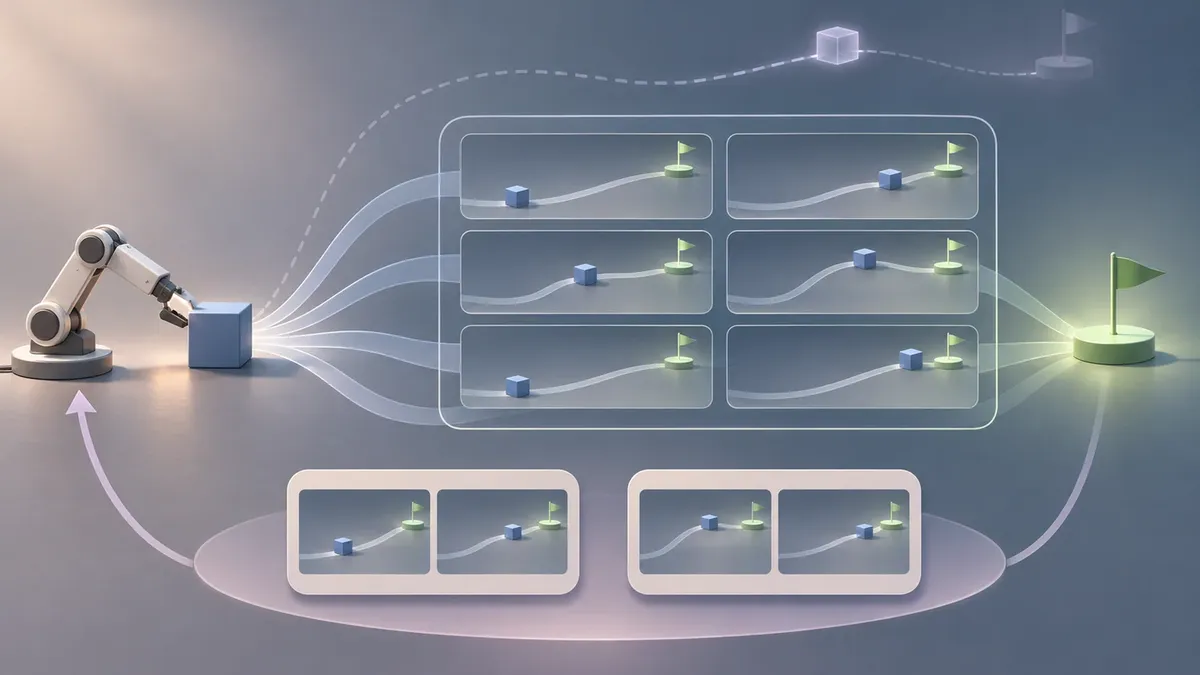
Pairwise feedback can tell a model which of two possible outcomes seems closer to what happened. But does learning to win those comparisons also teach the model how often each outcome occurs? In a simulated robot-pushing task, researchers found that a Bradley–Terry objective could move an initially accurate model away from the outcome probabilities calculated for the simulation.
A world model helps a robot plan by estimating what might happen after an action. It can assign probabilities to possible outcomes, then use them to judge whether an action is too risky. This study asks whether comparison-based feedback—judging which of two described outcomes is closer to what happened—can reliably teach those probabilities.
The researchers simulated a robot pushing a cube toward a goal, past a protected object. Hidden conditions included friction, control latency and small errors in the stated gap. By enumerating combinations of those conditions, they calculated a reference distribution over 12 possible outcomes for each setup. A language model trained on these distributions was tested on unseen layouts, where its reported hazard-probability error was 2.4 percentage points.
The team then trained the model on pairwise comparisons from a judge following a specified rule. They compared two objectives: Bradley–Terry, which learns from which candidate outcome wins, and a likelihood-based method that accounts for how the judge produces labels. Both received the same comparisons. The researchers also tested outcome-based training and a control to help distinguish effects of the objective from changes caused simply by continued training.
With Bradley–Terry training, the model placed 33 to 43 percentage points of probability on outcomes that none of a condition’s enumerated cases produced. The likelihood-based method did not show a comparable shift. The researchers calculated the Bradley–Terry objective’s optimum before training, and it predicted the direction and approximate endpoint of the change. Their explanation is that ranking outcomes by how well they match what happened is not the same as learning how frequently they occur.
The shift recurred on unseen conditions and under several experimental changes, including different rules for sampling candidate outcomes and a denser enumeration of hidden conditions. It also remained when four outcomes classified as physically impossible in this setup were removed: roughly 29 percentage points still went to outcomes absent from a condition’s enumerated cases. These categories are not interchangeable. An outcome missing from the tested cases is not necessarily impossible in the real world; it may simply not occur among the particular conditions used to calculate the reference distribution.
The decision consequences depended on the setup. With a risk threshold inherited from the model before feedback, Event BT—the model trained with the Bradley–Terry objective—had about 3 percentage points less utility per decision than the likelihood-based Full Channel model on trained conditions, and 1 to 2 points less on unseen ones. The difference arose through more false rejections: safe actions were held back. Re-tuning the threshold using held-out ground truth removed this utility gap, but requires information comparative feedback may be intended to replace. When the four physically impossible outcomes were excluded, the average utility difference between the methods was below 1 percentage point across six seeds, although a small increase in regret when choosing actions remained.
These results concern a controlled simulation, not every world model or preference-training setup. The main experiments used one language model, one task and one judge, without visual input; most settings had only two feedback seeds. The measure of probability assigned to absent outcomes also depends on the enumerated reference: using a denser grid lowered it, and the study’s prespecified stability margin was not met. The paper mentions supplementary real-robot experiments, but the evidence here does not establish how broadly the main result transfers to physical robots or other training methods.
The authors describe their finding as an existence result: even truthful comparisons can produce inaccurate probabilities when used with this particular objective. It does not show that pairwise feedback is inherently unhelpful, or that the alternative objective is practical when a judge’s rule is unknown. The work is an arXiv preprint; the supplied source does not establish its peer-review status, and the results warrant further scrutiny and testing.
- language world models
- Bradley–Terry
- robotics
- comparative feedback
- probability calibration
- simulation
Reviewed cross-references
These connections were reviewed by a model, not independently fact-checked by a human. Similarity does not imply agreement; consult the original papers and the evidence below.
A reset-free way to test robot policies in the real world
Shared method: Both papers use Bradley–Terry methods, but for different purposes: Shi et al. fit a training objective to outcome comparisons and report distorted outcome probabilities in their simulated robot-push setting; Sandhu et al. aggregate soft-win comparisons to rank robot policies. The probability distortion reported by Shi et al. does not establish that ScaleEvals’ rankings are distorted; the populations, targets, and uses of the method differ.
Model review: · openai-codex/gpt-6-luna
Evidence and provenance
Selected excerpts, not complete papers. PDF extraction can omit figures or damage equations, tables and reading order; sources may be preprints.
2611.25594v2 — Original paper
Excerpt reference:
static/papers/2611.25594v2.md:277-389
Basis: Paper text
Source SHA-256:732b95ef7fe1abf8d9d298d43cba1ad3cd177b63c1242f2a9b9b69f587e672552611.28411v1 — Original paper
Excerpt reference:
static/papers/2611.28411v1.md:151-191
Basis: Paper text
Source SHA-256:9ba590eeabe7a8c39a09b2b6e48f96d0feb44b554b4c85b07be25aaee8c59b34
Related reading
Automatically matched by shared topic keywords. These links do not imply that the sources agree or establish a consensus.
A Driving AI That Weighs What Might Happen Next
Source published
Shared keywords: language world models
Satellite history improves next-week fire-detection rankings in Bolivia benchmark
Source published
Shared keywords: probability calibration
What a visual AI benchmark reveals about confidence
Source published
Shared keywords: probability calibration
Telecom churn study finds selective gains for foundation models over tuned trees
Source published
Shared keywords: probability calibration
One EEG Model, Three Kinds of Decisions
Source published
Shared keywords: probability calibration