TRANSMISSION // 2611.25310v1
How a star feeds a black-hole binary
Source published
A hybrid 3D simulation follows a star transferring mass to a black hole. It finds dense outer gas streams but little change in the estimated merger time for this modeled system.
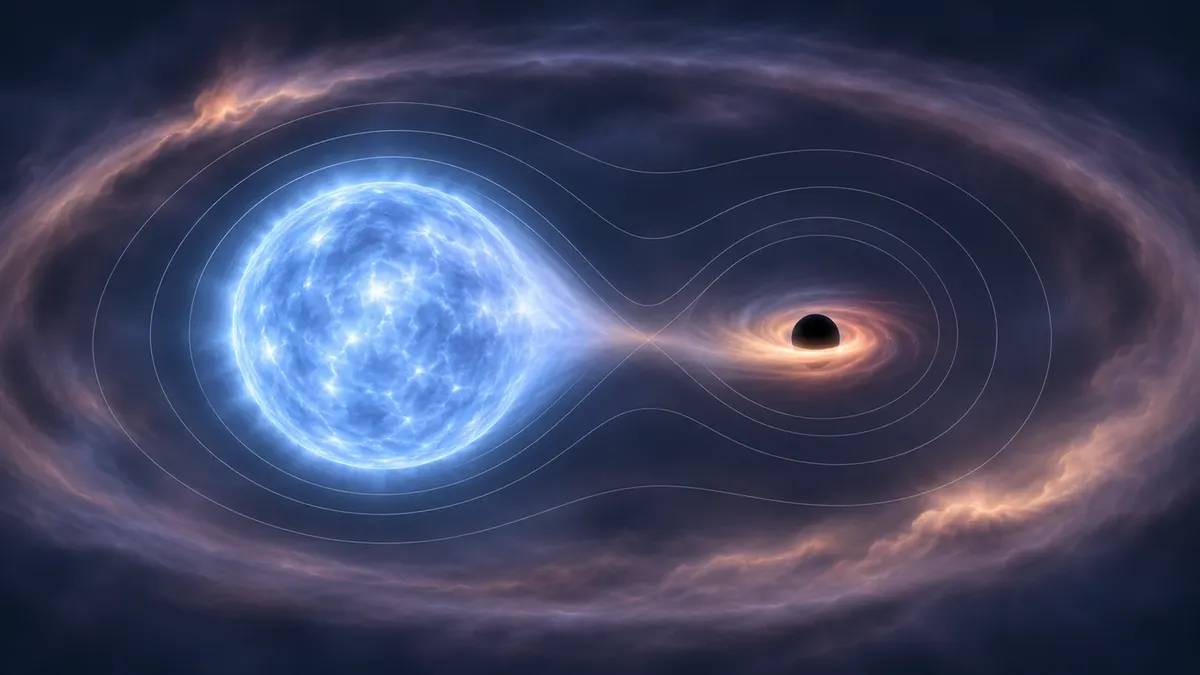
When a massive star transfers material to a black hole, the changing flow can shape the binary’s evolution. Dickson and colleagues developed a way to connect three-dimensional gas simulations with long-term stellar evolution, then applied it to one candidate progenitor of a merging black-hole binary. Their results show where familiar estimates track the flow—and where outer streams complicate the picture.
Mass transfer in a close binary is more than gas moving from one star to another. The donor star changes as it loses material, the orbit responds, and some gas may leave the system. Following these linked changes in three dimensions over the long timescales of stellar evolution is computationally challenging.
David Dickson and colleagues combined the stellar-evolution code MESA with the three-dimensional hydrodynamics code VH-1. Their method alternates between one-dimensional steps that evolve the star and binary, and 3D calculations of the surrounding gas flow. They used the 3D flow through the inner Lagrange point, L1—the main gateway between the two objects—to set the mass-transfer rate for the next stellar-evolution step. Outflows through the outer Lagrange regions, L2 and L3, were measured but not fed back into the binary’s evolution. The system was instead evolved under an Eddington-limited mass-transfer assumption.
The test system was selected as a likely merging binary-black-hole progenitor candidate: a low-metallicity star that began with 30 times the Sun’s mass, paired with a 9.3-solar-mass black hole. The simulation ran from the end of the star’s main-sequence lifetime to carbon depletion in its core. It covered two Case B mass-transfer phases: an early phase associated with the donor’s thermal response after expansion, and a later phase driven by slower nuclear evolution.
The researchers compared the simulated L1 flow with standard one-dimensional prescriptions. The prescription by Kolb and Ritter generally tracked the 3D transfer rate closely, remaining within 20% until the final stages of envelope stripping. Near the end of the early phase and throughout the late phase, however, it underestimated the simulated rate by as much as 60%. A prescription by Marchant and colleagues tended to overestimate the rate in this model. These comparisons describe one system, not a universal test of the formulas.
The simulations also revealed dense streams around L2 and L3. Such flows could form even when the donor did not reach the corresponding outer equipotential surfaces. The L2 stream appeared during the late phase despite underfilling that surface, and remained above the donor’s photospheric density. The paper’s abstract reports that the L2 outflow accounted for 1.1% of mass loss and 3.8% of angular-momentum loss in the early phase; its table gives 1.2% for the early-phase mass figure. For the late phase, the reported figures are 0.3% and 1.0%, respectively. Including L3, the collective losses were under 4% by these measures. Some material may remain in a circumbinary disk rather than escape, so these figures do not establish how much ultimately leaves the system.
Near the end of the early phase, one-dimensional prescriptions predicted substantial L3 overflow, but the 3D model remained within the L3 region. The authors note that the lower overflow in this model avoided the common-envelope possibility suggested by one cited prescription. That is a model-specific implication, not evidence that 3D calculations will always predict greater stability. The authors say the dense outflows could potentially affect X-ray observations, but the simulation does not establish what observers would detect.
Under the study’s assumptions, the estimated merger time changed little: 6.223 billion years for the 3D-informed evolution, compared with 6.200 billion years for a one-dimensional calculation using the Kolb–Ritter prescription. Both estimates assume the donor collapses directly into a black hole without losing mass after the simulation ends. The result therefore concerns this model and assumption, not all potential merger histories.
The method is a computational advance, but the study examines only one binary. The authors report artificial oscillations during rapid envelope stripping and note that spatial resolution may affect the modeled accretion disk. Their treatment also simplifies conditions close to the black hole, where radiation, magnetic fields, and relativistic effects can matter. Further simulations across different systems are needed to test how widely these findings apply.
This work is available as an arXiv preprint; the supplied source does not confirm peer review or publication. Its conclusions are best read as results from a specific numerical model. The main contribution is a framework for connecting 3D gas dynamics to long-term stellar evolution, while testing how well established approximations describe one candidate black-hole-binary progenitor.
- binary black holes
- mass transfer
- 3D hydrodynamics
- stellar evolution
- Lagrange points
- gravitational waves
Reviewed cross-references
These connections were reviewed by a model, not independently fact-checked by a human. Similarity does not imply agreement; consult the original papers and the evidence below.
Merging stars could give newborn black holes a faster spin
Shared method: Both studies use MESA to model stellar evolution: Dickson et al. couple it to 3D hydrodynamics for binary mass transfer, while Satish et al. use it to examine post-merger stellar evolution and estimate black-hole spins. This is a shared tool, not evidence that the studies test the same process or reach comparable findings.
Model review: · openai-codex/gpt-6-luna
Evidence and provenance
Selected excerpts, not complete papers. PDF extraction can omit figures or damage equations, tables and reading order; sources may be preprints.
2611.25310v1 — Original paper
Excerpt reference:
static/papers/2611.25310v1.md:174-231
Basis: Paper text
Source SHA-256:0969de0db5df4d3e6827327b2b107dcc2e226858d8d6c3bef662d02ba02a17052607.05495v2 — Original paper
Excerpt reference:
static/papers/2607.05495v2.md:15-65
Basis: Paper text
Source SHA-256:cb0ebcc071f5d148ecfe0f6b7ca6f7f406d3e1442e18278837ee0f0da2494ed6
Related reading
Automatically matched by shared topic keywords. These links do not imply that the sources agree or establish a consensus.
A crowded peak, then a possible gap: the black-hole masses in gravitational-wave mergers
Source published
Shared keywords: binary black holes, gravitational waves, stellar evolution
Merging stars could give newborn black holes a faster spin
Source published
Shared keywords: gravitational waves, stellar evolution
Eccentric black-hole signals may reveal the environments around them
Source published
Shared keywords: binary black holes, gravitational waves
Dying stars’ pulses may explain unexpectedly wide white dwarf binaries
Source published
Shared keywords: stellar evolution
Two lithium-rich dwarfs pose a puzzle in M 4
Source published
Shared keywords: stellar evolution