TRANSMISSION // 2611.25254v2
How robots can plan their own adaptations
Source published
PLANTA jointly plans a robot’s mission and changes to its configuration, then replans if conditions invalidate its plan. It was evaluated in underwater inspection and ground navigation scenarios.
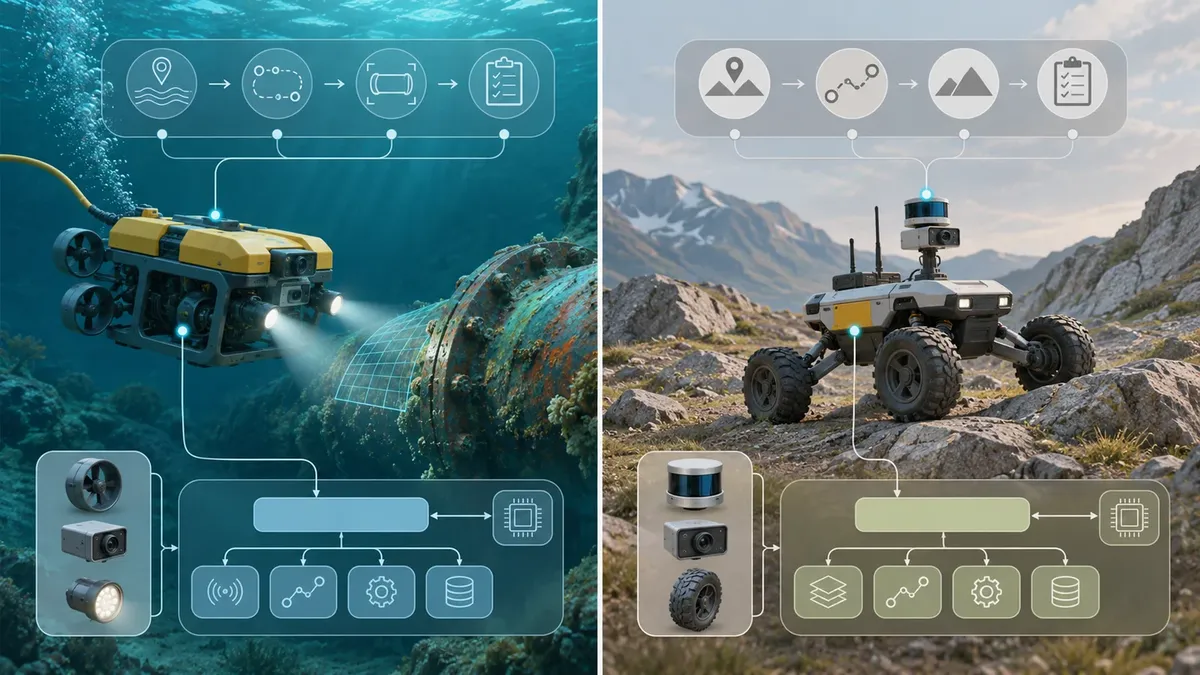
A robot’s available actions depend on its configuration, while its mission determines which capabilities it needs. PLANTA is designed to plan both together, rather than treating mission planning and reconfiguration as separate decisions.
When conditions change, a robot may need more than a different next move. It might also need a different configuration—one that enables actions required by its mission. Those choices are linked: configuration affects what the robot can do, and the task plan determines which capabilities it needs. A paper introduces PLANTA, an approach that plans these decisions together.
Connecting tasks and robot capabilities
PLANTA combines two formal descriptions. An ontology, written in the Web Ontology Language (OWL), represents possible robot architectures and their associated functions and quality requirements. The Planning Domain Definition Language (PDDL) describes actions the robot can take and the mission goals it must achieve.
The system automatically translates and integrates these models, allowing a planner to consider task actions and reconfiguration actions within the same plan. In practical terms, it can reason about what the robot should do as well as changes to its setup that may be needed to do it.
PLANTA uses satisficing planning: it seeks a plan that meets the specified goals, rather than necessarily proving that the plan is the best possible one. If changes during execution invalidate the current plan, the system replans.
Two robotic scenarios
The authors evaluated PLANTA in two scenarios: underwater inspection and ground navigation. The abstract says the results support the feasibility of runtime co-adaptation—the joint adjustment of task plans and robot architecture during operation.
In the evaluated navigation scenario, PLANTA used less planning time and memory than optimal-policy generation while producing plans of similar quality. This comparison is specific to that scenario. The abstract provides no measurements, so it does not show the size of the difference or whether it would hold in other settings.
What the evidence can tell us
The approach addresses a coordination problem: a mission plan may rely on actions that the current configuration cannot perform, while a configuration change made without regard to the mission may not provide the capabilities the task requires. PLANTA brings these decisions into a shared planning process and replans when execution conditions invalidate the plan.
The available evidence is limited to the abstract. It does not describe the scenarios’ scale, the architectures tested, or how plan quality was assessed. Those details matter when judging how broadly the findings might apply and how the comparison was conducted. The abstract also does not establish whether the approach has been tested on physical robots in real-world missions.
This article is based on the paper’s abstract, not a full-text review. The source is an arXiv preprint with a listed publication date of November 18, 2026; the supplied evidence does not establish its peer-review status. The results support feasibility in the reported scenarios, but the abstract alone is not enough to assess generalizability or deployment readiness.
- robot planning
- adaptive robotics
- robot architecture
- mission planning
- PLANTA
- runtime adaptation
Related reading
Automatically matched by shared topic keywords. These links do not imply that the sources agree or establish a consensus.
PhiJEPA tests whether AI can infer hidden visual features
Source published
Shared keywords: robot planning
When searching harder makes a robot worse
Source published
Shared keywords: robot planning
BoxBox lets coding agents revise their tools during software optimization
Source published
Shared keywords: runtime adaptation
Exo lets AI agents rewrite their harness while working
Source published
Shared keywords: runtime adaptation