TRANSMISSION // 2611.25194v2
MADJEPA: Three Training Stages for Medical Anomaly Detection
Source published
MADJEPA combines self-supervised image learning, teacher–student distillation and synthetic anomalies. On six benchmark datasets, it ranked first on three, but remains an early research result.
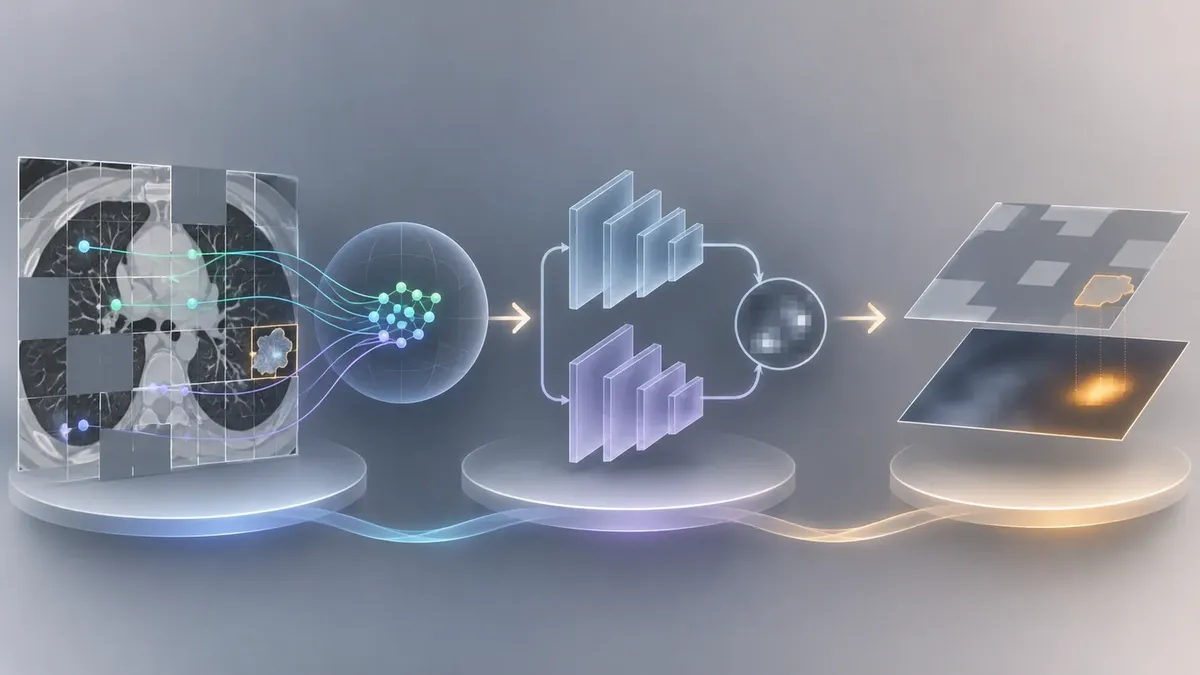
Can an AI system learn what healthy medical images look like—and flag departures without being trained on labeled disease examples? MADJEPA tackles that problem by combining three learning stages rather than relying on a predictive image model alone.
Learning normality is harder than it sounds
Medical anomaly detection aims to identify image features that differ from the range of healthy anatomy. That is not the same as sorting images into a fixed list of diagnoses: unusual findings may be rare, varied or not represented in training labels. A system trained only on healthy images must learn normal patterns while avoiding two opposite mistakes—treating unfamiliar healthy tissue as abnormal, or overlooking a subtle disease-related change.
The authors of MADJEPA ask whether a joint-embedding predictive architecture, or JEPA, can help. Rather than reconstructing image pixels, this kind of model learns to predict representations of hidden image regions from visible context. The team adapts that idea into a three-stage detector, evaluated on six datasets in the BMAD benchmark, spanning brain MRI, liver CT, retinal OCT, chest X-rays and digital histopathology.
Three stages, three signals
First, the model uses I-JEPA, an image-based JEPA, to learn representations from normal training images. It predicts the latent features of masked regions from the surrounding image. In plain language, it learns relationships among parts of healthy images without needing pixel-level disease labels.
Second, a smaller student network is trained to imitate the I-JEPA target encoder on normal images. At test time, the authors compare the student’s and teacher’s representations. Their rationale is that the student, trained only on normal examples, may respond differently to an abnormal region than the more broadly pretrained teacher. A larger disagreement can therefore contribute to an anomaly score. This is a proposed detection signal, not proof that every disagreement corresponds to disease.
Third, the researchers create pseudo-anomalies: synthetic altered regions generated by inpainting healthy images with a prompt-based image-generation model and masks shaped from overlapping ellipses. A classifier learns to distinguish these altered images from normal ones. Its score is combined with the two representation-based scores. The system also builds pixel-level anomaly maps from patch differences. Pixel-level annotations for evaluation are available on three of the six datasets.
Results across varied benchmarks
The paper reports image-level and, where available, pixel-level area under the receiver operating characteristic curve (AUROC), a measure of how well scores rank anomalous examples above normal ones across thresholds. Results are averaged over five random seeds.
MADJEPA ranked first among the compared methods on three datasets: liver CT (BTCV+LiTS), chest X-ray (RSNA) and histopathology (CAMELYON16). It ranked second on brain MRI (BraTS2021) and reported competitive results on the two retinal datasets. The authors also report that it was the only evaluated method to exceed 80% AUROC across all six datasets and the reported metrics. That is a benchmark-specific result, not evidence of clinical readiness or performance on every hospital’s images.
Ablation tests—experiments that remove or isolate parts of a method—support the value of combining stages. Across the datasets, the combined scores performed better overall than any stage used alone, and the authors conclude that I-JEPA by itself was not enough for competitive detection. Which individual stage performed best varied by dataset, underscoring that no single signal dominated everywhere.
What the evidence does—and does not—show
The findings are promising, but several qualifications matter. The evaluation uses six benchmark datasets with official training, validation and test splits; it does not establish how the method would perform prospectively in clinical workflows or on data from new institutions and scanners. AUROC summarizes ranking ability and does not, by itself, tell clinicians how often a system would raise false alarms at a chosen operating threshold. The paper’s qualitative examples include false-positive regions, and the authors note that anomaly maps do not always match lesion boundaries perfectly.
The method depends on synthetic anomalies made with a generative model, so the usefulness of that training stage may depend on how well generated changes represent relevant abnormalities. Hyperparameters are tuned on each benchmark’s validation split, and the best combination of scores differs across datasets. The paper reports an average inference time for one stage, but that alone is not a full assessment of deployment costs or workflow impact.
MADJEPA is described in an arXiv preprint, which may not have undergone peer review. Its reported comparisons are the authors’ experiments, not an independent replication. The authors say they have released code, which may help researchers examine and reproduce the work. For now, the study supports a narrower conclusion: combining predictive representations, distillation and pseudo-anomaly training can be competitive on these benchmarks, while real-world generalization and clinical usefulness remain open questions.
- medical anomaly detection
- MADJEPA
- self-supervised learning
- joint-embedding predictive architecture
- medical imaging
- artificial intelligence
Reviewed cross-references
These connections were reviewed by a model, not independently fact-checked by a human. Similarity does not imply agreement; consult the original papers and the evidence below.
Teaching a car monitor to spot unusual object tracks
Shared method: Both studies use JEPA-style prediction in latent space to learn representations without anomaly labels: MADJEPA predicts masked medical-image patch representations, while Fertig et al. adapt JEPA prediction to automotive object time series before applying anomaly detectors. This is a shared architectural principle, not evidence of equivalent performance or transfer between domains.
Model review: · openai-codex/gpt-6-luna
Evidence and provenance
Selected excerpts, not complete papers. PDF extraction can omit figures or damage equations, tables and reading order; sources may be preprints.
2611.25194v2 — Original paper
Excerpt reference:
static/papers/2611.25194v2.md:298-348
Basis: Paper text
Source SHA-256:457fc05df05314354783df883105d9007e6401e8c3d3dbd80bba4d25e8c4ad5f2602.09985v2 — Original paper
Excerpt reference:
static/papers/2602.09985v2.md:216-319
Basis: Paper text
Source SHA-256:3d90f407c80a9a7956ce6e426c662a33ec3f05df7f17b7ac1fcd505b6cb3515c
S-JEPA learns several possible answers to a hidden image region
Shared method: Both papers use I-JEPA-style masked image prediction in latent space: MADJEPA makes it the first stage of a medical anomaly detector, whereas Giakoumoglou et al. replace the deterministic predictor with a stochastic latent-variable model. The connection is the shared prediction framework; the excerpts do not establish that S-JEPA improves MADJEPA or medical anomaly detection.
Model review: · openai-codex/gpt-6-luna
Evidence and provenance
Selected excerpts, not complete papers. PDF extraction can omit figures or damage equations, tables and reading order; sources may be preprints.
2611.25194v2 — Original paper
Excerpt reference:
static/papers/2611.25194v2.md:298-348
Basis: Paper text
Source SHA-256:457fc05df05314354783df883105d9007e6401e8c3d3dbd80bba4d25e8c4ad5f2611.09302v1 — Original paper
Excerpt reference:
static/papers/2611.09302v1.md:124-177
Basis: Paper text
Source SHA-256:a84447b581e019ee228eb3c95eec6adbf89ee206c34ddda717cc1aaa72f2a955
Related reading
Automatically matched by shared topic keywords. These links do not imply that the sources agree or establish a consensus.
A world model reads quantum dynamics to infer hidden interactions
Source published
Shared keywords: joint embedding predictive architecture, self supervised learning
A market-wide clue helps a stock-learning AI separate shared shocks from individual signals
Source published
Shared keywords: self supervised learning
DuoJEPA: A Bridge Between Embedding Spaces
Source published
Shared keywords: medical imaging, self supervised learning
LEF-JEPA targets object structure without preserving every visual detail
Source published
Shared keywords: self supervised learning
A GAN-based route to learning from full 3D brain MRI
Source published
Shared keywords: self supervised learning