TRANSMISSION // 2611.25120v2
A confirmed eccentric orbit—and a possible hidden companion
Source published
Precise measurements confirm that 51 Eridani b follows a highly eccentric orbit. A second object could explain the star’s motion, but remains unconfirmed.
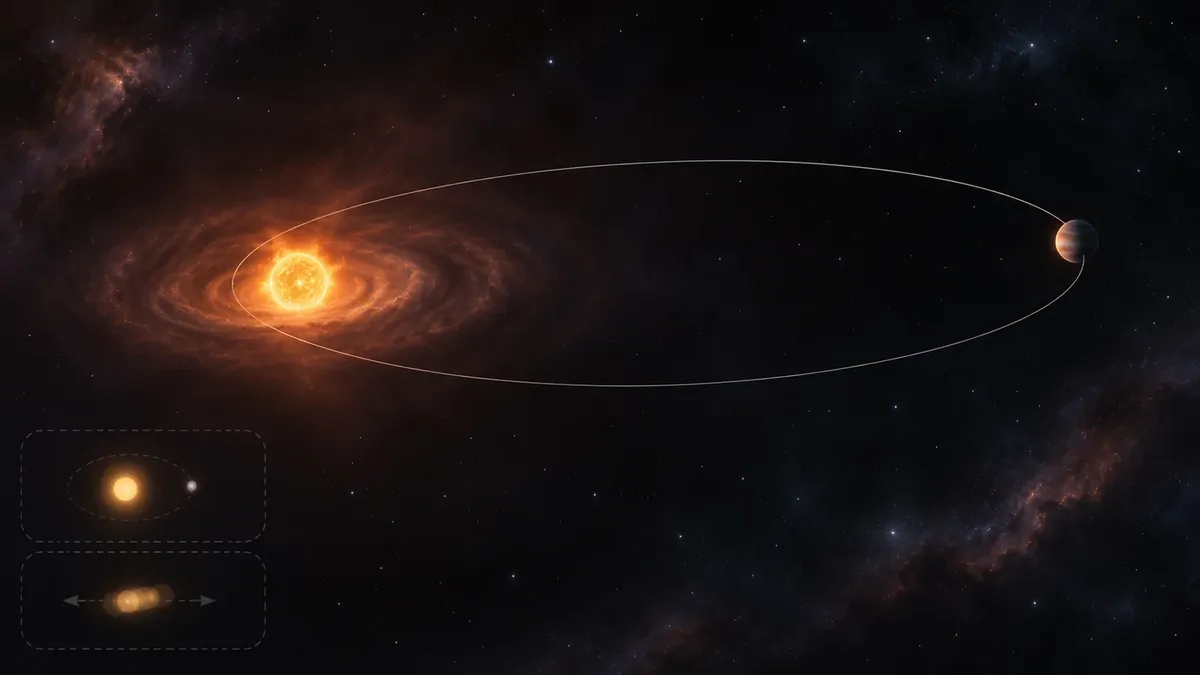
A young giant planet’s elongated path may hold clues to its past. New measurements of 51 Eridani b pin down its orbit with unusual precision, while raising—but not settling—the possibility that another companion helped shape it.
Astronomers have confirmed that 51 Eridani b, a young, directly imaged planet, travels around its star on a markedly elongated orbit. The result sharpens a puzzle: how did a planet on a wide orbit acquire such a high eccentricity? The researchers also find that an unseen companion could explain some apparent motion of the host star, though the evidence does not establish that such an object exists.
Orbital eccentricity describes how stretched an orbit is: zero means circular, while higher values indicate a more elongated path. The paper estimates 51 Eridani b’s eccentricity at about 0.573, with an uncertainty of roughly 0.003. Its orbit’s semi-major axis—the characteristic size of the orbit—is about 9.35 astronomical units, where one astronomical unit is the average Earth–Sun distance. The planet is roughly 20 million years old, and its mass remains uncertain.
Tracking a planet’s motion
The team monitored the planet from 2019 to 2025 with GRAVITY and GRAVITY+ on the Very Large Telescope Interferometer. Interferometry combines light from multiple telescopes to measure positions at very fine angular scales. The researchers retained only observations with reliable instrument calibration and significant planet detections; the paper tabulates six new relative-position measurements. The orbit analysis also incorporates earlier relative astrometry, relative radial-velocity measurements from HiRISE, and measurements of the star’s motion from Hipparcos and Gaia.
The team fitted Keplerian orbit models to the combined data, using statistical sampling to explore which orbital parameters match the observations and how uncertain they are. They also analyzed JWST coronagraphic images, which suppress starlight to look for faint objects, and used numerical simulations to assess whether proposed system configurations could remain dynamically stable.
The high-precision relative measurements strongly support the eccentric orbit. The eccentricity estimate stays similar when different sets of absolute astrometry are included. The star’s measured motion, however, does not fit neatly with the motion expected from the known planet alone. The authors caution that this mismatch does not provide a dependable mass measurement for 51 Eridani b: estimates from absolute astrometry depend on the data and modeling choices.
A companion is a possibility, not a discovery
A model that includes a second companion can better account for residuals in the star’s absolute astrometry. In one such model, the candidate’s 95% range spans about one to 2,900 Jupiter masses and an orbital distance of roughly 0.3 to 3.1 astronomical units. That broad range encompasses very different kinds of objects. The inferred architecture—and the strength of the model preference—changes with the mass assumptions, or priors, used in the analysis.
Crucially, this preference is conditional on the absolute-astrometry measurements. The authors say the evidence from the planet’s relative astrometry is not strong: a single-planet trajectory can pass through those measurements with only marginally poor residuals. They also note that systematic errors in the absolute astrometry could produce an apparent signal. They therefore describe the companion as a candidate and the evidence as suggestive, not as an independent confirmation that another object is present.
If the candidate exists, it might have gravitationally disturbed 51 Eridani b and helped place it on its eccentric orbit. The paper presents that as a possible explanation, not a demonstrated history. The measurements do not uniquely identify how the planet reached its current path. Stability simulations favor some closer-in configurations, but stability is not proof that the companion exists.
JWST imaging provides a separate constraint on objects outside the known planet’s orbit. The analysis finds no point sources and rules out planets more massive than Jupiter beyond 25 au and more massive than Saturn beyond 100 au, under the adopted imaging and mass-model assumptions. These limits concern external companions; they do not rule out the proposed inner candidate at 0.3–3.1 au.
The authors point to future Gaia epoch astrometry and additional interferometric monitoring as tests of the candidate. Until those observations provide further evidence, the clearest conclusion is the precise confirmation of 51 Eridani b’s eccentric orbit—not a confirmed second companion or a settled explanation for the planet’s past. This account is based on an arXiv preprint; preprints may not have completed peer review, and the paper itself identifies limitations in the available astrometric data.
- 51 Eridani b
- exoplanets
- orbital eccentricity
- GRAVITY interferometry
- Gaia astrometry
- planetary dynamics
Reviewed cross-references
These connections were reviewed by a model, not independently fact-checked by a human. Similarity does not imply agreement; consult the original papers and the evidence below.
Gaia and Hipparcos map possible companions around 100,000 stars
Shared method: Both studies use Hipparcos–Gaia absolute astrometry to constrain possible companions: the 51 Eridani study fits host-star astrometry alongside planet measurements, while Thompson et al. model G23H astrometric constraints across a large stellar sample. The analyses and data combinations differ, so this is a methodological connection, not corroboration of the proposed 51 Eri companion.
Model review: · openai-codex/gpt-6-luna
Evidence and provenance
Selected excerpts, not complete papers. PDF extraction can omit figures or damage equations, tables and reading order; sources may be preprints.
2611.25120v2 — Original paper
Excerpt reference:
static/papers/2611.25120v2.md:746-806
Basis: Paper text
Source SHA-256:45fbf1c8be9e7f5e5eebbdaf5789e4ee3acc2e0008adf535e76c271733a015912611.12841v1 — Original paper
Excerpt reference:
static/papers/2611.12841v1.md:49-136
Basis: Paper text
Source SHA-256:ef58aa5fa76432a1c3ce57d2e67d3142cd0674335137af29d0749439ab07d33b
Related reading
Automatically matched by shared topic keywords. These links do not imply that the sources agree or establish a consensus.
Why Super-Earth Orbits May Evolve Separately
Source published
Shared keywords: orbital eccentricity, planetary dynamics
Modeling Webb’s starlight reveals a planet signal hidden in the glare
Source published
Shared keywords: 51 eridani b
Can a passing star push a planet out of the habitable zone?
Source published
Shared keywords: planetary dynamics
Eccentricity remains uncertain in three gravitational-wave events
Source published
Shared keywords: orbital eccentricity
How neutron-star tides may create late orbital eccentricity
Source published
Shared keywords: orbital eccentricity