TRANSMISSION // 2611.25105v2
How MAWAM helps robot teams act together
Source published
MAWAM jointly predicts robot teams’ actions and future camera views. Tests with physical robots and in simulation report promising results, with limits to keep in mind.
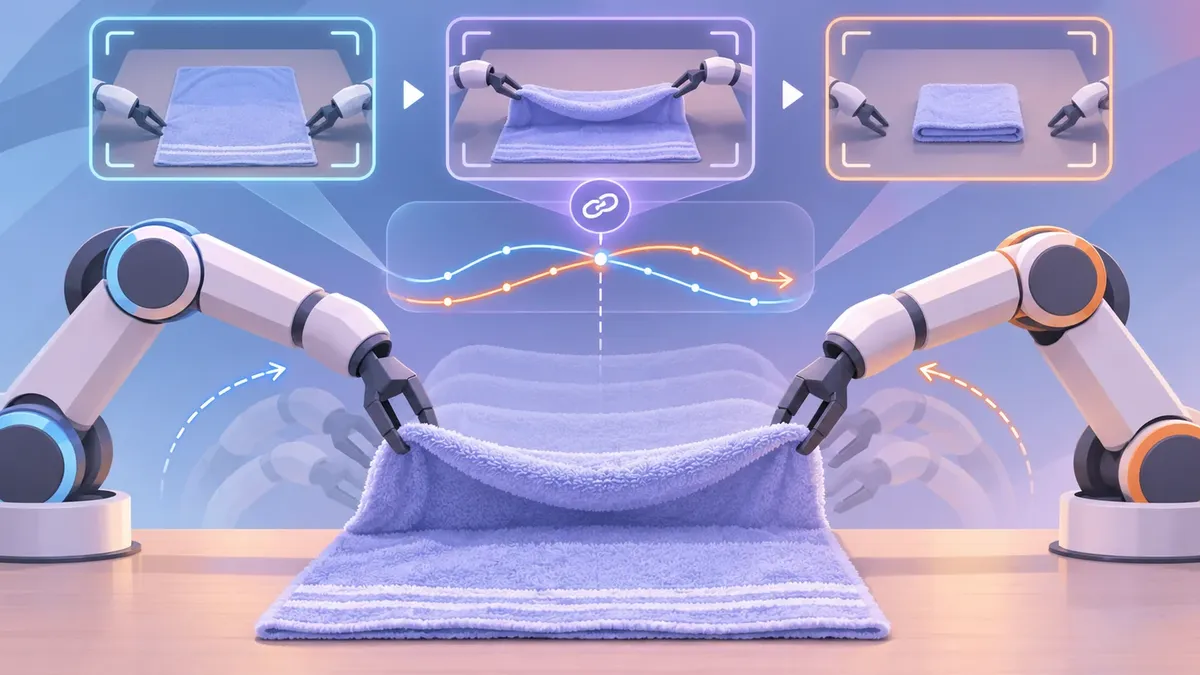
When robots share a task, one move can change the scene for the others. MAWAM is designed to predict a team’s actions together with the future views those actions are intended to produce.
A team of robots handling a soft towel or passing an umbrella has to coordinate more than its individual movements. Each robot’s actions change the shared scene, and that scene shapes what its teammates can do next. A research paper asks whether a single model can help by predicting both the robots’ actions and the future camera views associated with them.
The model, called MAWAM (Multi-Agent World-Action Model), was developed by researchers affiliated with NVIDIA, the University of Hong Kong and MIT. The authors report evaluations with physical robots and in simulation.
One joint prediction
MAWAM starts from a model trained for a single robot. It keeps each robot’s camera views, state, role and controls associated with that robot, while a shared Transformer uses cross-agent attention to connect information across the team. The model jointly generates action chunks—short sequences of executable movements—and predicted future views for the robots’ cameras. It does not first make one robot’s plan and then separately produce another’s response: the action and view tokens for all robots are denoised together.
The robots execute the first part of their action chunks in synchrony, then use new observations to condition another team prediction. This repeated cycle allows the next actions to take account of the updated scene. In the physical-robot setup, each robot had three private camera views and there was no shared global camera.
Training has two stages. First, MAWAM adapts to individual robots’ cameras and controls. Then it learns from synchronized team demonstrations, which provide actions and views from the same unfolding tasks. The model also represents robot identity separately from task role. That distinction lets robots share a responsibility without merging their separate observations or control outputs.
Tests with physical robots and in simulation
The real-robot evaluation used two Galaxea R1 Pro robots and three tasks: collecting laundry in a bag, folding a bath towel, and handing over an umbrella. Each method was tested in 30 trials per task. MAWAM’s average success rate was 67.8% across the three tasks. The paper reports this as 18.9 percentage points above MA-VLA, a comparison model tested with the same demonstrations and camera setup. MAWAM had the highest reported success rate among the tested methods on each task.
The authors also evaluated MAWAM on eight RoboFactory tasks in simulation, with teams of two to four arms. The model’s average success rate was 90.3%. Examples include a four-arm relay in which a shoe is passed along a line, and tasks where multiple arms work with a shared object. These simulation results are not evidence that the same performance will transfer to unfamiliar real-world settings.
Ablation tests removed individual parts of the system. In the simulated four-arm relay, removing cross-agent attention reduced success from 95% to 39%. On the simulated Place Food task, removing future-view supervision during team training reduced success from 78% to 47%. These comparisons indicate that the components helped in those particular evaluations; they do not show that the effects will be identical across tasks.
Limits and uncertainty
The physical-robot results cover three tasks and 30 trials per task. That is a limited sample of conditions, and the reported success rates have statistical uncertainty. The simulation evaluation adds tasks but remains a simulation study, not additional real-world testing.
The authors say their experiments use fixed teams of up to four agents. Extending the method to larger or changing teams, robots with different bodies or sensors, and collaboration with human partners remains future work. The paper also reports that generating a joint sample takes longer as the simulated team grows from two to four arms, underscoring that scaling involves practical costs as well as coordination.
This is an arXiv preprint; the available source does not establish that it has undergone peer review. Its results should be read as the authors’ reported experiments rather than settled evidence. MAWAM’s central idea is to model team actions alongside the future camera views they are meant to create—a promising approach whose broader usefulness still needs testing.
- robotics
- multi-agent systems
- robot manipulation
- world models
- artificial intelligence
Reviewed cross-references
These connections were reviewed by a model, not independently fact-checked by a human. Similarity does not imply agreement; consult the original papers and the evidence below.
A robot's-eye view, generated from outside video
Supporting evidence: Both papers report results consistent with visual prediction or generation contributing to robot-policy performance: MAWAM’s ablations associate team-stage future-video supervision with higher Place Food success, while AuroraWorld reports improved policy results using generated egocentric observations. These are different methods, tasks, and settings, so they support only this bounded connection—not a direct performance comparison or a general causal conclusion; AuroraWorld also notes that synthetic-observation policies do not consistently match policies trained on recorded egocentric views.
Model review: · openai-codex/gpt-6-luna
Evidence and provenance
Selected excerpts, not complete papers. PDF extraction can omit figures or damage equations, tables and reading order; sources may be preprints.
2611.25105v2 — Original paper
Excerpt reference:
static/papers/2611.25105v2.md:1063-1074
Basis: Paper text
Source SHA-256:7ecb87fbe0ce13bd01780c62ad1359df8ffa969edf4eb890c90c63f55a0ac6082611.00177v1 — Original paper
Excerpt reference:
static/papers/2611.00177v1.md:902-1021
Basis: Paper text
Source SHA-256:51fa1c602592723ce01037eb0349bc8a528b48be281a4916ec37096c8fc249ae2611.00177v1 — Original paper
Excerpt reference:
static/papers/2611.00177v1.md:1858-1936
Basis: Paper text
Source SHA-256:51fa1c602592723ce01037eb0349bc8a528b48be281a4916ec37096c8fc249ae
Related reading
Automatically matched by shared topic keywords. These links do not imply that the sources agree or establish a consensus.
A lazier search helps robots plan complex retrieval tasks
Source published
Shared keywords: robot manipulation, world models
A smarter cache could help robot models act faster
Source published
Shared keywords: artificial intelligence, robot manipulation
Can AI-generated worlds keep up with robots and self-driving cars?
Source published
Shared keywords: world models
WorldFlow predicts motion in both pixels and 3D
Source published
Shared keywords: world models
A robot's-eye view, generated from outside video
Source published
Shared keywords: robot manipulation, world models