TRANSMISSION // 2611.24782v2
What Final Weights Reveal About Training History
Source published
An arXiv preprint reports that trained networks can retain selective, decodable information about their initialization and task order, but not a complete record of training.
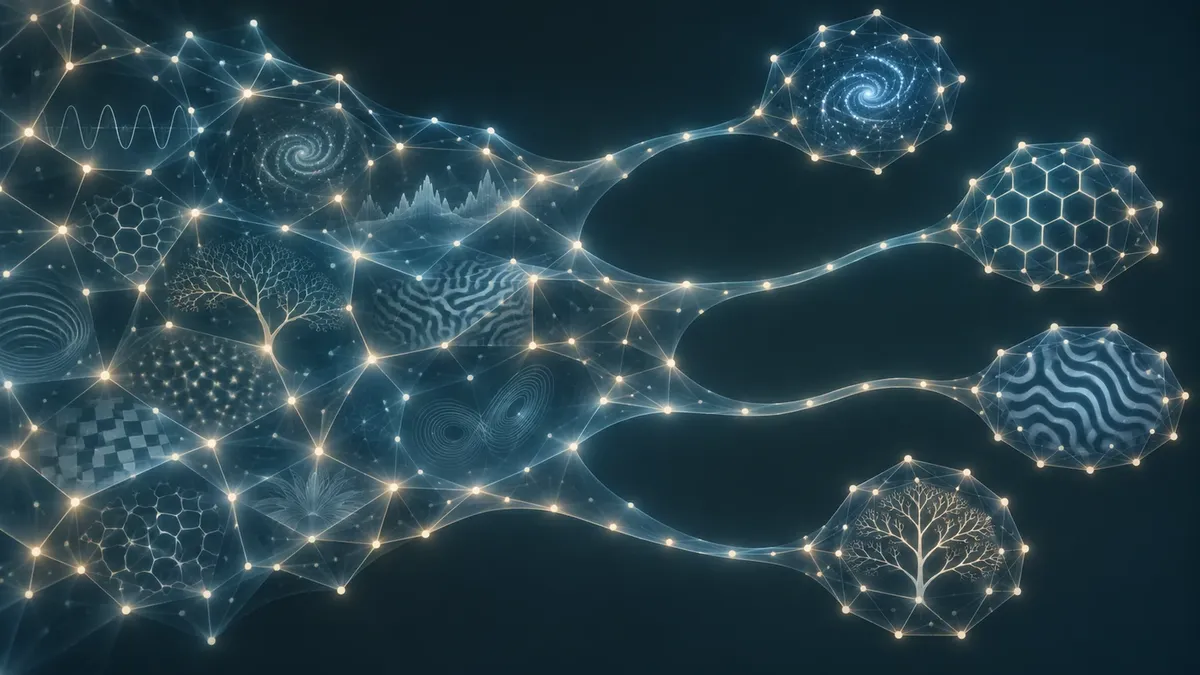
When networks learn a shared task, can their final weights reveal anything about their individual training histories? An abstract-only preprint reports that some clues can be decoded, while many details of the learning path remain unrecoverable.
A neural network’s final weights describe how it behaves, but might they also contain clues about how it was trained? Patrick Krauss and colleagues tested whether a network’s final weights and internal representations reveal parts of its learning history.
The abstract reports experiments examining initialization, the order of earlier tasks, and intermediate weight states. The results suggest that some historical information remains decodable after further training, but not that a model preserves a complete record of every step.
What the researchers report
Training changed the relationship between networks’ starting and ending points: initial pairwise distances did not consistently predict final distances. Yet all 30 trained networks were matched to their initial weights when each was compared with ten candidates per dataset.
Networks sharing an initialization also developed recognizable final hidden representations across different batch schedules. But directly comparing initial activity did not recover network identity. These results concern different ways of looking for historical clues; the abstract does not establish that every analysis can identify a network’s past.
The researchers also tested whether earlier task order could be decoded after additional learning. According to the abstract, a linear probe classified the order of two earlier tasks with 100% accuracy on 80 held-out networks after ten epochs of a common final task. This is a result from the reported experiment, not evidence that task order can always be inferred from trained networks.
Earlier intermediate weight states were partly predictable, while individual initial weights could not be reliably reconstructed. The abstract also reports that perturbed networks regained classification performance without returning to their unperturbed training paths. So similar performance did not require following the same route back.
Finally, 2,157 of 2,160 aligned endpoint pairs showed no positive loss barrier at the interpolation points sampled by the researchers. The abstract describes these as low-loss connections between distinct solutions. This finding concerns the sampled connections; it does not mean that the networks ended at one identical set of weights.
Clues, not a complete record
Together, the reported findings suggest that final weights can carry selective information about a network’s history, even when training on a shared task leads to related successful solutions. Decoding a clue is not the same as reconstructing the full training trajectory. Nor does decodability alone show that the information affects the network’s predictions.
There are limits to what can be assessed here. This account is based on the paper’s abstract, rather than a full review of its methods and analyses; the available material does not allow a detailed assessment of the datasets, architectures, probe design, or statistical uncertainty. The work is an arXiv preprint, and the supplied evidence does not establish whether it has been peer reviewed. The findings should therefore be read as results from the reported experiments, not as a general rule about all neural networks.
- neural networks
- machine learning
- training history
- neural network weights
- internal representations
- arXiv preprint
Reviewed cross-references
These connections were reviewed by a model, not independently fact-checked by a human. Similarity does not imply agreement; consult the original papers and the evidence below.
When the Same Shape Has Different Neural Network Weights
Supporting evidence: Both studies show why interpreting network weights requires separating meaningful information from parameter-coordinate effects: Krauss et al. report matching trained networks to their initial weights after neuron alignment, while Cha et al. show that function-preserving permutations and rescalings can disrupt shape recognition by some weight readers. These are complementary, not direct replications: one decodes training history in classification networks, the other audits visual-content readers on shallow neural fields.
Model review: · openai-codex/gpt-6-luna
Evidence and provenance
Selected excerpts, not complete papers. PDF extraction can omit figures or damage equations, tables and reading order; sources may be preprints.
2611.24782v2 — Original paper
Excerpt reference:
static/papers/2611.24782v2.md:598-656
Basis: Paper text
Source SHA-256:1fc8ae8278767f2c3c6d85dabe1eb1999197de7cd85465d3950cb6b6fac31b332611.05798v1 — Original paper
Excerpt reference:
static/papers/2611.05798v1.md:13-85
Basis: Paper text
Source SHA-256:ec9c47227c9d94382428b5f4b50ea0cecb97e58f967fb5b5b113c4da700d41682611.05798v1 — Original paper
Excerpt reference:
static/papers/2611.05798v1.md:86-182
Basis: Paper text
Source SHA-256:ec9c47227c9d94382428b5f4b50ea0cecb97e58f967fb5b5b113c4da700d4168
Related reading
Automatically matched by shared topic keywords. These links do not imply that the sources agree or establish a consensus.
Can neural networks have representational atoms?
Source published
Shared keywords: internal representations, machine learning, neural networks
Can a language model build a neural network from physical laws?
Source published
Shared keywords: neural network weights
A rewiring test probes how language models read neural networks
Source published
Shared keywords: neural network weights
What Can the Shape of Neural Network Weights Tell Us About Learning?
Source published
Shared keywords: machine learning, neural network weights
Can a model’s future features be spotted early?
Source published
Shared keywords: machine learning, neural networks