TRANSMISSION // 2611.24664v2
How three datasets constrain neutron-star matter
Source published
A preprint combines gravitational waves, NICER measurements and radio pulsar masses to infer dense matter, with results shaped by its model choices and assumptions.
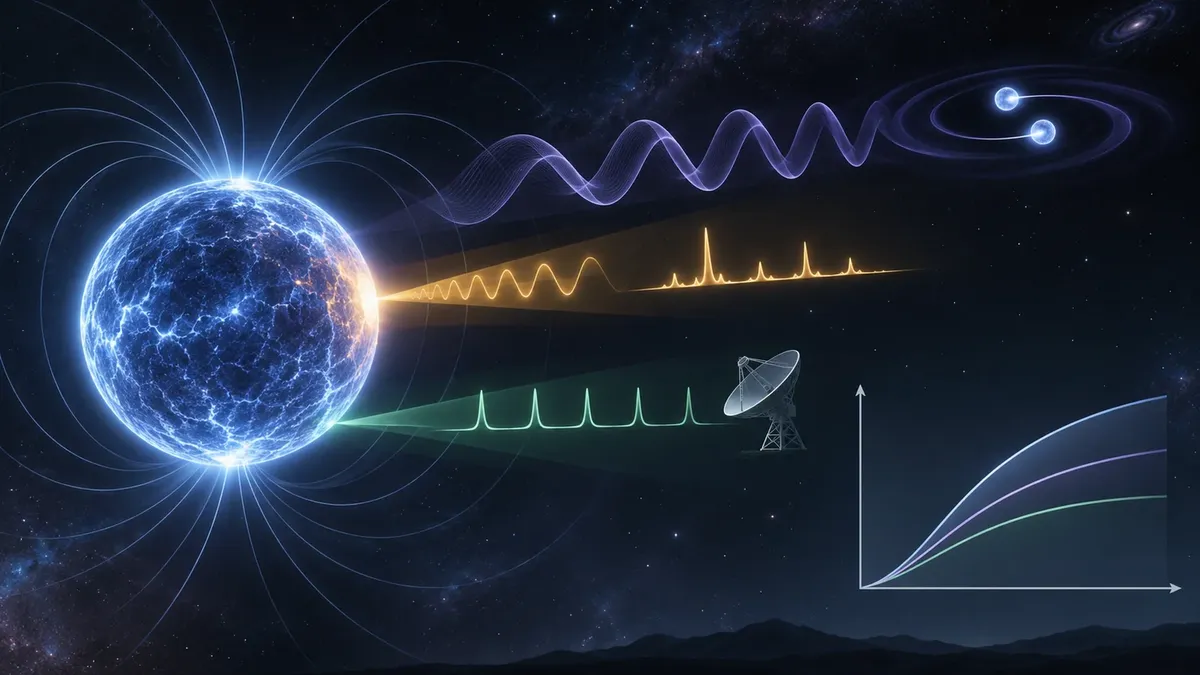
The densest matter inside neutron stars cannot be reproduced in laboratories, and its pressure at extreme densities remains uncertain. This preprint combines gravitational-wave, X-ray and radio observations to estimate how pressure changes with density. Its conclusions depend on a particular parametrization and on the assumption that there is no high-density phase transition.
Neutron stars contain some of the densest matter known in the observable universe. Physicists describe this matter with an equation of state: a relationship between density and pressure. That relationship helps determine a star’s radius, how it responds to a companion’s gravity and the greatest mass it can support. At the highest densities, the equation of state remains uncertain.
Tamal RoyChowdhury and colleagues ask how combining three kinds of observations can constrain it. They use gravitational-wave data from neutron-star mergers, NICER X-ray measurements of pulsar masses and radii, and radio-timing measurements of massive pulsar masses. These probes provide different information: radio timing supplies masses, while NICER provides mass-radius measurements.
Reusing observations to test models
The researchers extend the GWXtreme framework to combine the datasets. They reuse posterior samples from analyses that did not assume a particular equation of state, then apply equation-of-state-informed priors in a hierarchical inference. For gravitational-wave and NICER observations, they approximate distributions of relevant measured parameters using kernel density estimation (KDE).
They conduct two related analyses. One compares a selected set of tabulated candidate equations of state using Bayesian evidence, reported as Bayes factors relative to the reference model SLY. The other infers pressure across density using a four-parameter spectral parametrization. This is a specific model family, with priors and physicality requirements—not an unrestricted reconstruction. The researchers use Markov chain Monte Carlo to sample its parameters and estimate credible regions.
The analysis uses two binary-neutron-star merger events, four NICER pulsars and radio mass measurements for three massive pulsars. The authors also analyze the observation channels separately to see how each affects the results. An important assumption applies throughout: the inference excludes high-density phase transitions.
Overlapping, complementary constraints
The joint analysis estimates a radius of 11.93 kilometres for a 1.4-solar-mass neutron star, with a 90% credible interval of +1.02/−0.83 kilometres. It estimates a maximum mass for a non-rotating neutron star of 2.31 solar masses, with a 90% credible interval of ±0.23 solar masses. This maximum mass is inferred from the combined analysis; it is not a direct measurement of a star at that mass.
Within the study’s datasets and model, gravitational-wave and NICER observations constrain overlapping low-to-intermediate density regions, using information about tidal effects and stellar radii. Radio measurements of massive pulsars become more informative at higher densities because the equation of state must support the observed masses. The paper describes radio data as especially informative above roughly three times nuclear saturation density; these are not sharp, exclusive boundaries between probes.
For this parametrization, its priors and the observations used, combining the datasets produces narrower pressure-density constraints than analyzing individual channels. The channels can also favor different candidate models: some receive relatively strong support from radio data but weaker support from gravitational-wave and NICER data. Among the selected candidates, GMSR(H4)BSk24 has the strongest support in the joint comparison relative to SLY. That does not establish it as the best equation of state among all possibilities. The rankings do not follow a simple soft-to-stiff ordering; the detailed variation of pressure with density matters.
What the estimates leave open
The reported intervals describe uncertainty within the analysis, not every uncertainty in the underlying physics or modeling. The candidate comparison covers only the models tested, while the parametrized inference depends on its four-parameter form, priors and physicality requirements. The paper estimates KDE-related uncertainty in gravitational-wave and NICER Bayes factors by resampling posterior samples. It also notes that KDE calculations may become less efficient as datasets grow.
The authors do not jointly infer neutron-star population properties, leaving that for future work. They assume no high-density phase transition, so the results do not test how such a transition would change the inferred equation of state. Their stellar-structure calculations use a non-rotating solver. The paper says this is generally suitable for binary systems with small component spins, but may be less accurate for NICER pulsars, which have millisecond periods and potentially important rotational effects.
This is an arXiv preprint, and its findings should be treated as provisional rather than settled consensus. Its central result is specific: under the observations, parametrization and assumptions used here, gravitational-wave, NICER and radio data provide complementary constraints on neutron-star matter.
- neutron stars
- equation of state
- gravitational waves
- NICER
- radio pulsars
- dense matter
- Bayesian inference
Reviewed cross-references
These connections were reviewed by a model, not independently fact-checked by a human. Similarity does not imply agreement; consult the original papers and the evidence below.
An AI learns physics-shaped ways to infer hidden properties
Shared method: Both studies use hierarchical Bayesian inference with a shared neutron-star equation of state: the origin paper combines source likelihoods across gravitational-wave, NICER and radio data, while PhyRSI factorizes inference into a shared equation of state and per-star parameters. Their datasets and computational approaches differ, so this is a methodological connection, not a comparison of results.
Model review: · openai-codex/gpt-6-luna
Evidence and provenance
Selected excerpts, not complete papers. PDF extraction can omit figures or damage equations, tables and reading order; sources may be preprints.
2611.24664v2 — Original paper
Excerpt reference:
static/papers/2611.24664v2.md:121-208
Basis: Paper text
Source SHA-256:23e38eb269d253a7b5b5a4f18afc132e3b33c27a4d64a232467e721b64c7aea32611.24664v2 — Original paper
Excerpt reference:
static/papers/2611.24664v2.md:309-407
Basis: Paper text
Source SHA-256:23e38eb269d253a7b5b5a4f18afc132e3b33c27a4d64a232467e721b64c7aea32611.27006v1 — Original paper
Excerpt reference:
static/papers/2611.27006v1.md:1027-1104
Basis: Paper text
Source SHA-256:530ab0b03772eac0c48bc26ef81138915ce1c444fcc4a35621ca4f4a6fbbb7fb2611.27006v1 — Original paper
Excerpt reference:
static/papers/2611.27006v1.md:67-243
Basis: Paper text
Source SHA-256:530ab0b03772eac0c48bc26ef81138915ce1c444fcc4a35621ca4f4a6fbbb7fb
Related reading
Automatically matched by shared topic keywords. These links do not imply that the sources agree or establish a consensus.
Why nuclear measurements may not settle neutron-star tides
Source published
Shared keywords: equation of state, gravitational waves, neutron stars
An AI learns physics-shaped ways to infer hidden properties
Source published
Shared keywords: bayesian inference
Neutron Star Tides Could Complicate Tests of Einstein’s Gravity
Source published
Shared keywords: equation of state, gravitational waves, neutron stars
How neutron-star tides could reveal the stars’ hidden vibrations
Source published
Shared keywords: gravitational waves, neutron stars
A hot-matter test for neutron-star equations of state
Source published
Shared keywords: dense matter, equation of state, neutron stars