TRANSMISSION // 2611.24110v2
JWST’s proposed time-lapse of the Milky Way’s center
Source published
A white paper proposes repeated JWST observations to track stars and study gas, star formation and gravity near the Milky Way’s center.
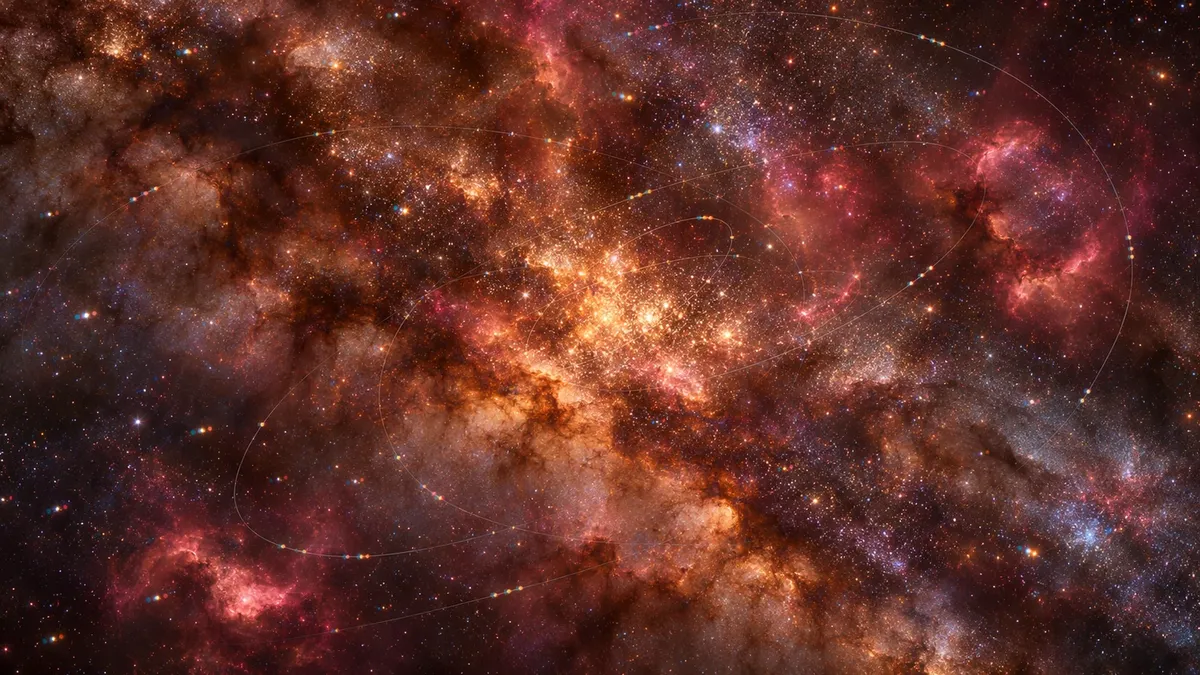
The Milky Way’s center is crowded, dusty and difficult to untangle. A white paper outlines a plan to revisit it with JWST, using repeated infrared images to track stars and investigate questions ranging from hidden clusters to planet-forming disks. The proposed observations are a research plan, not a report of new discoveries.
The center of the Milky Way contains a supermassive black hole, a dense nuclear star cluster, a nuclear stellar disk and clouds of gas and dust. It is also an active star-forming region. Yet dust obscures many objects, and overlapping stars make it difficult to determine which belong to which structures or how those structures formed.
A white paper led by Rainer Schödel and colleagues proposes a way to study the region over time with the James Webb Space Telescope (JWST). The plan uses JWST’s NIRCam and MIRI imaging instruments. It is a proposal and science case, not a report of completed observations or findings.
Why observe the same region repeatedly?
A single image shows where stars appear to be. Images taken years apart can reveal how their positions change. Those motions can help distinguish populations of stars, identify groups moving together and test models of the region’s gravity. With enough observations, astronomers may also measure accelerations: changes in a star’s motion that can provide evidence about nearby mass.
The paper’s timeline needs a distinction between existing and proposed data. Its detailed table counts the ongoing JWST Galactic Center Treasury survey as the first epoch, then lays out three later epochs, roughly four years apart, for a total of four epochs. The proposed follow-up observations would add to the Treasury data; they are not four new epochs. The paper describes the follow-up as requiring about 420 hours, with observations spaced three to five years apart. Its abstract instead summarizes the plan as three observing cycles spaced about four years apart.
The observations would combine motion measurements with infrared images in multiple filters. Infrared light can penetrate dust that blocks visible light, while measurements in different wavelength bands can help distinguish stars, dust and other sources. The plan uses NIRCam for detailed imaging of stars and MIRI for longer-wavelength information, including emission associated with dust and young stellar objects. Filter coverage builds cumulatively across the existing and proposed epochs: the paper describes each epoch as adding bands, rather than presenting the follow-up as a single, already complete set of extra filters.
Questions the plan could address
The authors organize their science case around ten questions. They include whether undiscovered young star clusters are hidden in the region; whether the unusual mix of stellar masses found in some known clusters is typical of the Galactic Center; and how star formation proceeds in this extreme environment. The team also describes using stellar motions and measurements of extinction to investigate the three-dimensional arrangement of gas clouds, and using infrared emission and stellar membership to study how long planet-forming disks survive near massive stars.
Repeated observations could also help search for stellar-mass black holes and possible intermediate-mass black holes. The paper outlines strategies: an unseen object might be inferred from unusually fast motions or accelerations of nearby stars. These are proposed methods, not claims that the observations have detected such objects.
The authors estimate that the full program could measure proper motions for roughly ten million stars. Their estimates of how many stars JWST and Roman could observe depend on the comparison being made. The paper says Roman’s precise measurements in this crowded region would be limited to brighter stars, while a figure compares an optimistic Roman completeness estimate with a conservative JWST estimate based on one detector exposure. Under those specific assumptions, it estimates that NIRCam could detect more than five times as many stars as Roman’s Wide Field Instrument. This is a qualified projection, not a universal guarantee about the telescopes’ reach or the eventual number of usable measurements.
A forecast, not a finding
The paper describes how the authors expect the science questions to become accessible as observations accumulate; some require later epochs. It also notes that certain goals, such as measuring accelerations across the region, are more demanding than measuring proper motions. The projected precision and source counts depend on the observations, instrument performance and analysis, and should not be read as guaranteed outcomes.
The document is an arXiv white paper proposing a program. It does not establish that the observing time will be awarded, that the schedule or filters will remain unchanged, or that every proposed measurement will succeed. Its value here is to set out a plan and explain what repeated JWST observations might make possible—not to announce results from a completed survey.
- Galactic Center
- James Webb Space Telescope
- NIRCam
- MIRI
- stellar motions
- star formation
- intermediate-mass black holes
- planet-forming disks
Reviewed cross-references
These connections were reviewed by a model, not independently fact-checked by a human. Similarity does not imply agreement; consult the original papers and the evidence below.
JWST Maps Omega Centauri’s Crowded Core
Shared method: Both studies use JWST astrometry to measure stellar motions in crowded cluster centers: the Galactic Center proposal forecasts proper motions and accelerations to search for intermediate-mass black holes, while oMEGACat-JWST reports precise stellar astrometry and says future monitoring will constrain the motions of fast stars in ω Centauri. The proposed Galactic Center program and the existing ω Centauri catalog are different settings and stages; the latter excerpt does not report an IMBH detection.
Model review: · openai-codex/gpt-6-luna
Evidence and provenance
Selected excerpts, not complete papers. PDF extraction can omit figures or damage equations, tables and reading order; sources may be preprints.
2611.24110v2 — Original paper
Excerpt reference:
static/papers/2611.24110v2.md:348-402
Basis: Paper text
Source SHA-256:3db9e82846f68dda86b80b90d0853f633e95653227183a47c6325ae55eae34cb2611.23150v1 — Original paper
Excerpt reference:
static/papers/2611.23150v1.md:125-171
Basis: Paper text
Source SHA-256:bedab6d0fa5a84ec27f16cdd801ec3cf9aa3e556aee5499c315f9cf4498198a7
Related reading
Automatically matched by shared topic keywords. These links do not imply that the sources agree or establish a consensus.
Stellar motions support an excess of small stars in massive galaxy cores
Source published
Shared keywords: james webb space telescope
A proposed Webb survey would map dust, ice and shadows in planet-forming disks
Source published
Shared keywords: james webb space telescope
Webb survey links stronger early-galaxy emission to bursts of star formation
Source published
Shared keywords: james webb space telescope, star formation
Ansky’s galaxy shows signs of black-hole activity before its 2019 brightening
Source published
Shared keywords: james webb space telescope
Webb spots a faint oxygen line in a distant galaxy’s core
Source published
Shared keywords: james webb space telescope