TRANSMISSION // 2611.24059v2
Can Ordered Training Logs Help Combine AI Specialists?
Source published
In a 4B-model study, replaying specialists’ training logs in order produced a strong shared model without fresh rollouts during consolidation. The findings are promising but limited to the tested setup.
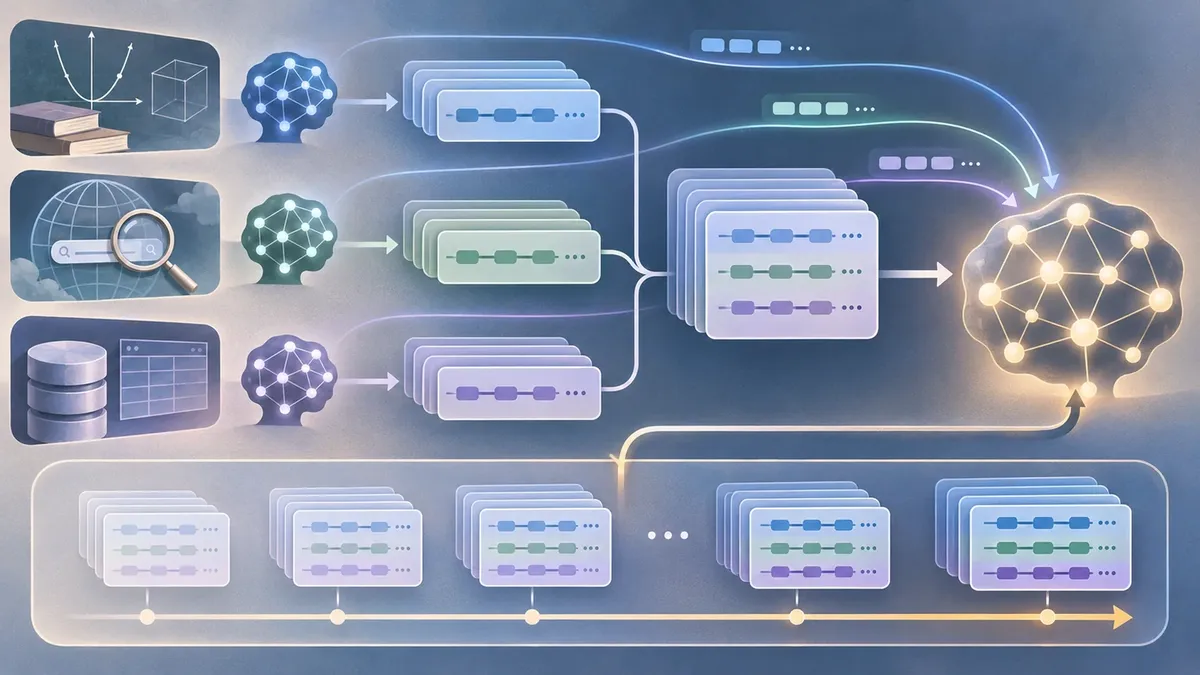
AI specialists trained for different tasks can be difficult and costly to combine. A preprint tests whether one student can learn from their saved reinforcement-learning logs, replayed in the order they were generated, instead of collecting new responses during consolidation.
A different way to combine specialists
Training separate AI models for different tasks lets each focus on its own domain, but combining their capabilities into one model presents another challenge. In multi-teacher on-policy distillation, a student generates new responses and specialist models provide teaching signals on those responses. For long tasks involving tools, that can mean running the environments again during consolidation.
In Replay, Don’t Resample, Zhenrui Yue and colleagues propose multi-expert replay policy distillation (MRPD). The method reuses records from experts’ reinforcement-learning runs: their trajectories, rewards and probabilities for generated tokens. Rather than pool the logs into a mixed dataset, MRPD processes batches from corresponding training steps in the experts’ original order. The experts’ logs are a sequence of batches, not one shared sequence of individual examples.
How the study worked
The researchers used Qwen3-4B models initialized from the same supervised checkpoint. They trained one reinforcement-learning expert per domain for 300 steps: mathematical reasoning with a Python tool, open-domain question answering with search, and text-to-SQL. The logs recorded generated responses, outcomes and token probabilities.
For replay, the student updated its policy on the logged trajectories and rewards. It also learned to match each domain’s final expert predictions at prefixes—the partial responses—found in the logs. Thus the method combined outcome-based learning signals with token-level guidance from the final experts.
MRPD generated no new student responses and made no environment or tool calls during consolidation. It did, however, run the expert models on logged prefixes to obtain predictions, so replay still required substantial computation. The study compared MRPD with online reinforcement learning, methods that distill experts on fresh student samples, and model merging. Evaluation used held-out benchmarks across the three domains.
Findings—and what the comparisons mean
The authors report an overall average score of 58.6 for MRPD, compared with 58.1 for multi-teacher on-policy distillation (MOPD) using the same experts. In their cost measurements, an MRPD step took about one-third as long as a step of MOPD + GRPO, the timed comparison that samples responses and runs expert models as MOPD does. The authors also report that consolidation took about a seventh of the compute used to train the experts. These are measurements from this study’s setup, not guarantees for other models or tasks.
Ablation tests—comparisons that remove or change parts of a method—suggested that replaying specialist-generated trajectories contributed much of the gain. Adding the policy-gradient and expert-distillation terms also helped. Shuffling the training-step order lowered the overall score in the reported comparisons, although the size of the drop varied and some individual domain scores rose. Reducing the number of logged samples per step had a smaller effect with dense distillation: the overall score fell by 0.2 points. With the sampled-token distillation variant, the reduction was 0.5 points. The authors’ interpretation is that logs can function as a curriculum: their order tracks how the experts’ policies developed.
Performance differed across domains. MRPD’s reasoning average remained below the corresponding GRPO specialist’s, while its SQL average was slightly above that specialist’s. Individual results varied by benchmark. The authors also report that ordered replay kept the student relatively close to the policies that generated the logs, a feature their approach relies on.
What remains uncertain
The method’s central condition is shared initialization: the experts and student began from the same checkpoint. The authors did not test what happens when their starting points differ. The experiments also covered one 4-billion-parameter dense model, three domains and 300 training steps. Whether the results extend to larger models, mixture-of-experts architectures or more domains remains unknown. Most configurations were run once; a second MRPD run produced a similar overall score, but this offers limited evidence about run-to-run variability.
This work is an arXiv preprint and may not have been peer-reviewed. Its benchmark comparisons support conclusions about the particular models, tasks and training setup studied, not a general claim that replay will outperform fresh-sample distillation. A careful takeaway is that ordered log replay is a promising consolidation approach under shared initialization, and that the order of the logs affected results in these experiments.
- reinforcement learning
- AI model distillation
- training logs
- language models
- multi-task AI
- model consolidation
Reviewed cross-references
These connections were reviewed by a model, not independently fact-checked by a human. Similarity does not imply agreement; consult the original papers and the evidence below.
How to combine AI specialists into one model
Shared method: Both preprints use multi-teacher on-policy distillation (MOPD) as a specialist-consolidation method: Yue et al. compare MRPD with MOPD using the same experts, while Liang et al. include vanilla MOPD among their baselines. This establishes a shared method, not cross-validation; the settings differ, and the supplied excerpts are selective.
Model review: · openai-codex/gpt-6-luna
Evidence and provenance
Selected excerpts, not complete papers. PDF extraction can omit figures or damage equations, tables and reading order; sources may be preprints.
2611.24059v2 — Original paper
Excerpt reference:
static/papers/2611.24059v2.md:83-171
Basis: Paper text
Source SHA-256:946343f608966e39f04494f9e611aeb70572dc01a266bf37d63a6cdaaef839462611.32515v1 — Original paper
Excerpt reference:
static/papers/2611.32515v1.md:648-752
Basis: Paper text
Source SHA-256:f8994ee672998348663ca99e10386dab5c7e8e53f08e738deb34ac8e89f03164
Related reading
Automatically matched by shared topic keywords. These links do not imply that the sources agree or establish a consensus.
How to combine AI specialists into one model
Source published
Shared keywords: ai model distillation, model consolidation
Teaching a jamming detector to act without hindsight
Source published
Shared keywords: reinforcement learning
A moving anchor for steadier language-model reinforcement learning
Source published
Shared keywords: reinforcement learning
Language models help design rewards for two-stage payment fraud detection
Source published
Shared keywords: reinforcement learning
When an AI’s training score rises but its answers get worse
Source published
Shared keywords: language models, reinforcement learning