TRANSMISSION // 2611.23227v1
When Can a 2D Quantum State Fit a Finite Network?
Source published
A mathematical study links entanglement to exact tensor-network representations for two families of two-dimensional fermion states.
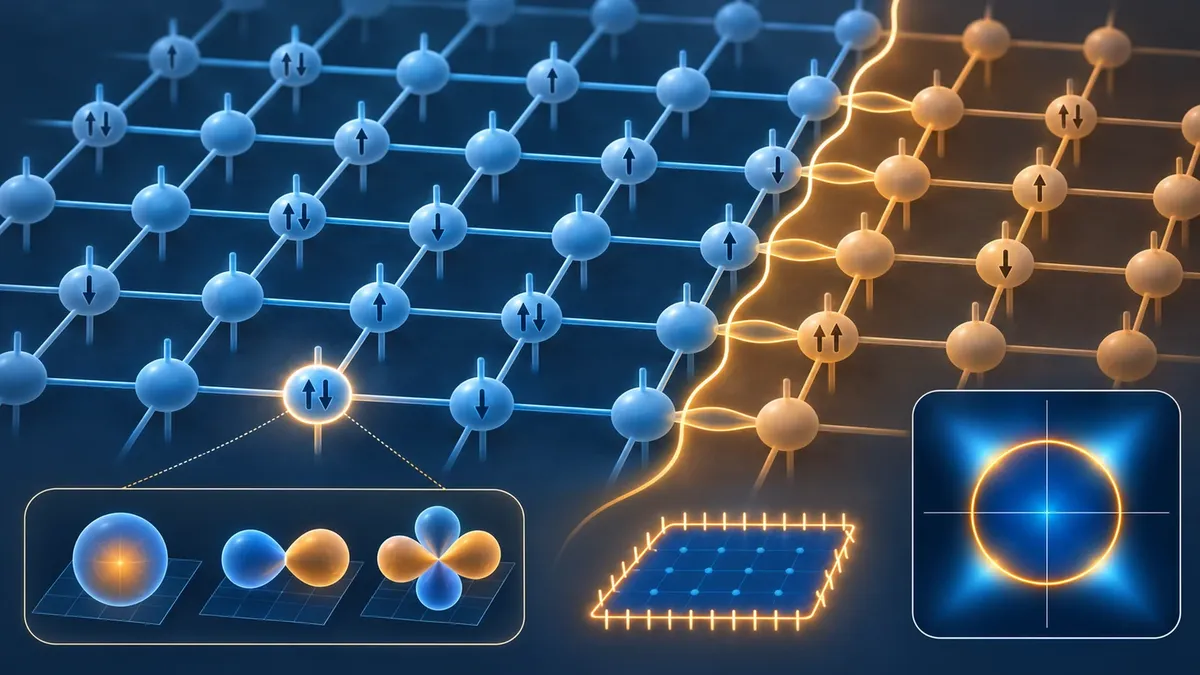
Tensor networks compress complicated quantum states into connected pieces. A new preprint asks when that compression can be exact—not just a useful approximation—for certain two-dimensional fermion systems.
A quantum state can encode correlations among many particles, making its full mathematical description grow rapidly with system size. Tensor networks offer a way to represent some such states more compactly: instead of listing every possible configuration, they connect smaller mathematical objects. The size of the links between those objects, called the bond dimension, is one measure of the resources the representation requires.
In one dimension, a familiar result connects limited entanglement across a cut to an exact matrix product state with a bond dimension that does not grow with the system’s length. The situation is less straightforward in two dimensions. The new preprint by Pok Man Tam, William Musk and Zhehao Dai asks whether a similarly precise connection can be established for particular two-dimensional quantum states of fermions.
The authors focus on two families: single-band Bardeen–Cooper–Schrieffer (BCS) superconductors, and half-filled two-band insulators, a category that also includes semimetals. Their question is not whether every two-dimensional state can be efficiently represented. It is whether, within these specified families, a particular entanglement condition tells us when an exact, finite-bond-dimension Gaussian fermionic tensor network is possible.
Connecting entanglement and representation
The entanglement measure in the paper is the Rényi-0 entropy. Informally, it tracks how many distinct components are needed to describe the entanglement across a division of a state. The authors report proving an equivalence for both families: an area law for this entropy holds if and only if the state has an exact Gaussian fermionic tensor-network representation with finite bond dimension. They also relate the required bond dimension to the Rényi-0 entropy.
An area law means that entanglement across a boundary scales with the boundary’s size, rather than with the full volume of the region. This matters because a finite-bond representation can make a state’s structure more manageable. The reported result gives a criterion connecting that structure to entanglement—but only for the classes of states the paper studies.
The preprint describes two further equivalent characterizations. One uses compactly supported Wannier-type orbitals: localized building blocks used to describe states in a crystal. The other uses the wavefunction in momentum space, which describes how the state varies across allowed momenta. The authors say these descriptions connect the orbitals’ spatial extent and the momentum-space wavefunction’s structure to the bond dimension needed for the network.
What the result does—and does not—show
The headline is a mathematical equivalence, not a demonstration that a particular material has a small tensor-network representation or that a computation has become faster. The abstract does not provide examples, numerical benchmarks, or detailed assumptions for the theorems. It therefore does not let us assess how the results behave in specific models, or how large the finite bond dimension may be in practical cases.
Nor should the conclusion be extended to arbitrary two-dimensional quantum states. The authors explicitly frame the work around two translation-invariant families of Gaussian fermionic states. Whether comparable statements hold outside those settings is not established by the abstract.
The evidence available for this article is the paper’s abstract, not its full text. That means details of the methods and proofs cannot be independently summarized here, and qualifications that may appear in the manuscript are not available in this source. The work is an arXiv preprint, so the supplied information does not establish that it has undergone peer review. The result is best read as a proposed theoretical framework whose proof details and scope should be checked in the full paper and in future work.
For nonspecialists, the useful takeaway is that the study identifies a sharp link—within two specific families—between how entanglement scales and whether a compact network can represent the state exactly. It offers a guide to representability, not a general guarantee that two-dimensional quantum problems are easy to solve.
- tensor networks
- quantum entanglement
- fermions
- Gaussian states
- two-dimensional physics
- BCS superconductors
Related reading
Automatically matched by shared topic keywords. These links do not imply that the sources agree or establish a consensus.
How many copies does it take to learn a quantum state?
Source published
Shared keywords: gaussian states
Quantum computing proposal puts ‘over-squeezed’ atoms to work
Source published
Shared keywords: tensor networks
A quantum environment that remembers—and carries control between spins
Source published
Shared keywords: quantum entanglement, tensor networks
Entanglement Along Time Distinguishes Two Ways to Be an Insulator
Source published
Shared keywords: quantum entanglement
How one quantum boundary can create nonunitary critical behavior
Source published
Shared keywords: quantum entanglement