TRANSMISSION // 2611.23217v1
Why Near-Resonant Planet Systems Can Be Less Ordered
Source published
A preprint finds weaker planet-radius ordering in compact systems near orbital period ratios associated with resonance. The cause remains unclear.
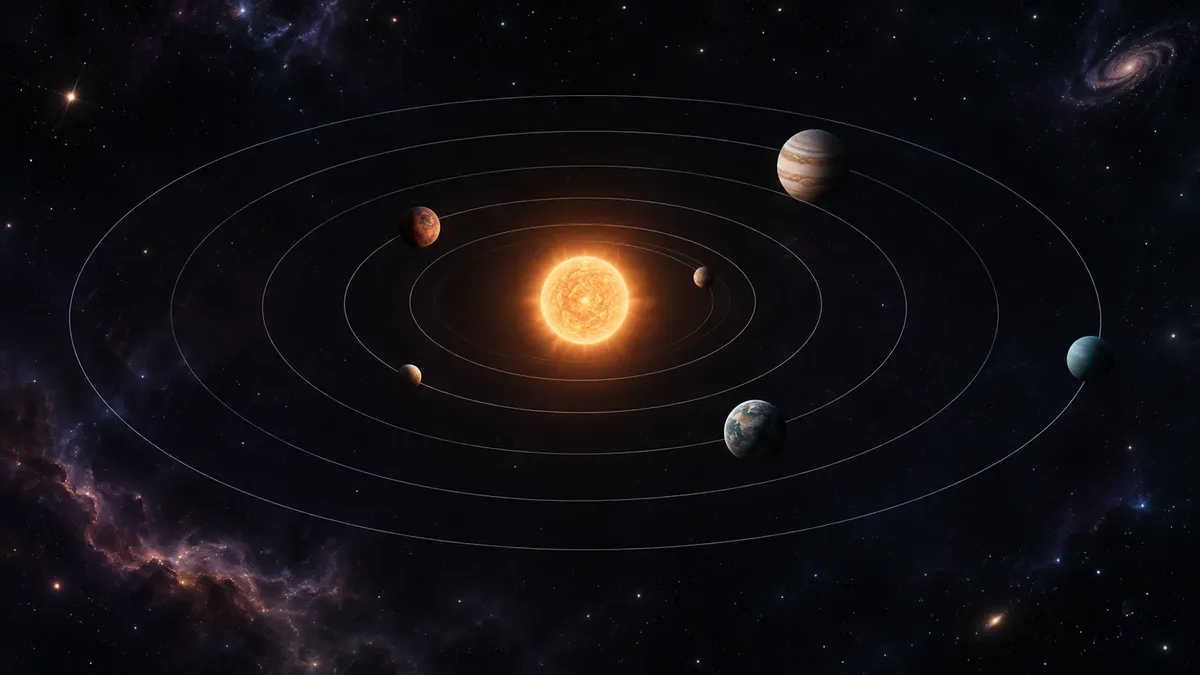
Planets in compact systems can follow patterns in size or mass as their orbits get longer. A new preprint asks whether those patterns differ in systems whose neighboring planets have periods near simple ratios, a feature called near-resonance. It finds weaker radius ordering in those systems, but cannot determine why.
In a compact planetary system, several worlds orbit close to their star. Their sizes might tend to increase or decrease with orbital period, or show no consistent direction. Astronomers have found that planet properties in these systems can be more ordered than random rearrangements would suggest. Does the degree of ordering differ when neighboring planets have orbital periods close to simple ratios, such as 3:2?
A preprint by Agustin Heron, Songhu Wang and Cristobal Petrovich compares the ordering of planet radii and masses in near-resonant and non-resonant systems. It tests an association, not whether resonance preserves a system’s history or causes its present-day pattern. The authors say observations cannot establish whether the difference arose during formation or through later evolution.
How the comparison works
The researchers use data from the NASA Exoplanet Archive. They select compact systems with at least three planets, orbital periods under 100 days, and no planet with a reported radius above four Earth radii. These criteria focus the analysis on small planets, roughly in the super-Earth and sub-Neptune size range.
The radius sample includes transiting planets and candidates from Kepler, K2 and TESS. The mass sample consists of confirmed planets with reported masses, drawn from all transit surveys; it is smaller and less observationally uniform. The paper reports 17 systems with 51 planets in the mass sample. It separately describes the mass comparison as limited to 17 transiting three-planet systems, so the two descriptions should not be conflated.
The team classifies neighboring pairs as near-resonant when their period ratios fall within specified ranges around selected first- or second-order ratios. This is a proxy based on orbital periods. It does not establish that the planets are in a true dynamical resonance, which would require evidence about how their orbits evolve.
To assess ordering, the researchers use complementary statistics. One measures how consistently a property rises or falls with orbital period. Another counts “inversions”: pairs that run counter to a chosen increasing or decreasing sequence. They compare each system’s measured pattern with all possible rearrangements of the same planets, helping account for different numbers of planets per system. They also propagate measurement uncertainties through repeated sampling and compare systems at fixed observed multiplicity.
A difference in degree, not a lack of pattern
Across the radius analyses, near-resonant systems generally show weaker monotonic ordering than non-resonant systems. The direction of the result appears across multiple measures and in both the Kepler sample and the combined Kepler, K2 and TESS sample. The clearest evidence comes from three-planet systems; comparisons among systems with four or five planets are less decisive, with smaller samples contributing to broader uncertainty.
The result does not mean that near-resonant systems have random radius sequences. Overall, the paper finds that both populations retain ordering relative to randomized arrangements. The reported difference is in how strongly the planets’ radii follow a monotonic pattern.
The mass results tend in the same direction, but offer weaker support. The increasing-direction inversion measure most consistently indicates greater disorder among near-resonant systems; other measures are less conclusive. Given the small and less uniform mass sample, the authors present this as a complementary consistency check, not an independent population-level conclusion.
The result runs counter to a simple expectation: if initially ordered resonant chains are disrupted by later instabilities, non-resonant systems might be expected to look more disordered. But the observed association does not show that instabilities create order. Planet loss, collisions or mergers could reshape the sequences, while differences established during formation are another possibility. The study cannot distinguish these explanations.
There are further caveats. The analysis uses detected transiting planets, and unseen planets could change the apparent membership and ordering of a system. Smaller planets are harder to detect at longer periods, potentially biasing observed radius patterns. Comparing at fixed observed multiplicity and checking different survey samples address some concerns, but the study does not model survey detection limits through simulated populations. Planetary radii can also evolve after formation, and the mass sample is small.
This is a preprint and may not have undergone peer review. Its findings are therefore provisional. The authors point to larger, more complete samples and simulations of formation and dynamical evolution as ways to investigate where the ordering difference comes from.
- exoplanets
- mean-motion resonance
- planetary systems
- planetary radius ordering
- planetary masses
- planet formation
Related reading
Automatically matched by shared topic keywords. These links do not imply that the sources agree or establish a consensus.
HWO could study nearby gas giants—and search for their moons
Source published
Shared keywords: planet formation
Rocky planets may look iron-rich because other ingredients are missing
Source published
Shared keywords: planet formation
Gaia links outer companions with small planets
Source published
Shared keywords: planet formation
Gas persists inside the dust gaps of three planet-forming disks
Source published
Shared keywords: planet formation
A proposed Webb survey would map dust, ice and shadows in planet-forming disks
Source published
Shared keywords: planet formation