TRANSMISSION // 2611.23213v1
Can NMR Track Quantum Information Spreading Through Proteins?
Source published
A computational framework models protein spin-pair OTOCs and finds distance-related patterns, but the evidence available here is an abstract, not a full-paper assessment.
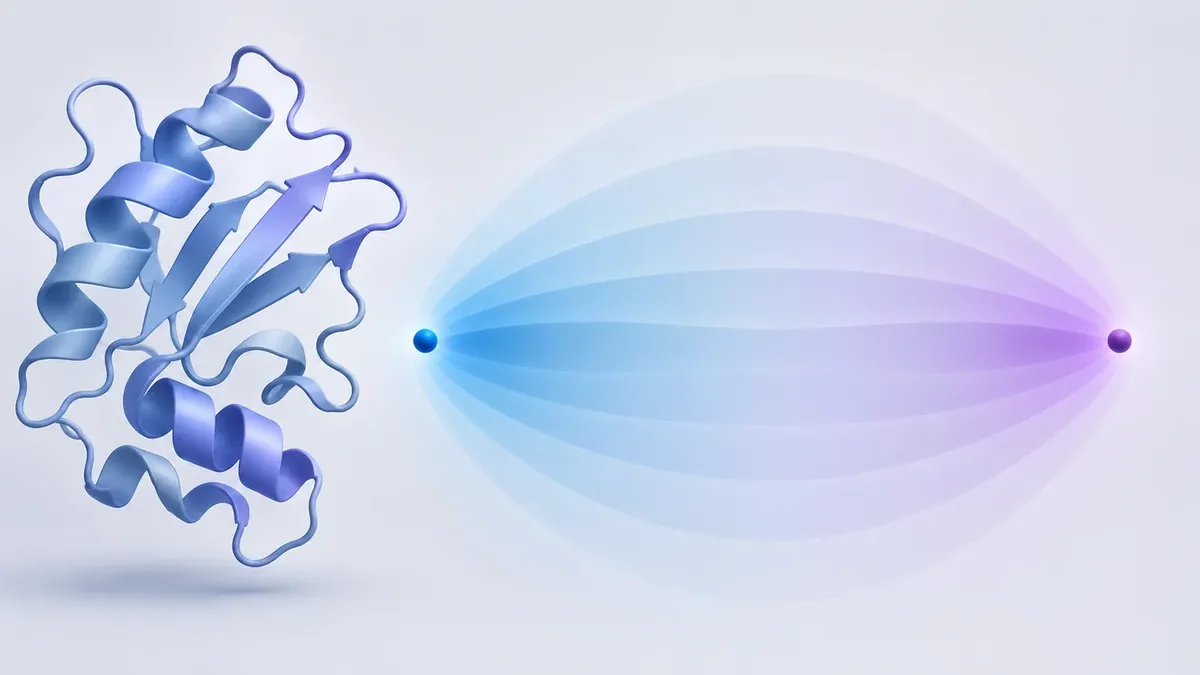
Could measurements of quantum information spreading help reveal distances within proteins? A computational study models out-of-time-order correlators, or OTOCs, in protein systems in settings relevant to nuclear magnetic resonance. Its reported patterns are promising, but this account is based on the paper’s abstract.
Out-of-time-order correlators (OTOCs) are quantities used to examine how operators spread through an interacting quantum system. Researchers have proposed using them to extract molecular structural information with nuclear magnetic resonance (NMR). A central challenge is predicting OTOC dynamics in complex protein environments while accounting for features relevant to experiments.
The paper Modeling quantum information scrambling in realistic protein NMR experiments presents a computational pipeline that connects molecular structures to OTOC dynamics in protein systems.
From protein structures to modeled correlators
The framework incorporates molecular motion through molecular-dynamics simulations and averages over orientations to represent powder samples. It also uses spin-network truncation and an experimentally realizable double-quantum effective Hamiltonian. These are elements of the approach as described in the abstract; the evidence available here does not allow a detailed assessment of their implementation or assumptions.
The authors apply the pipeline to more than 350 carbon–carbon spin pairs across 10 protein systems. The pairs span interspin distances of 5–17 ångströms. These figures describe the systems analyzed, not a set of experimental OTOC measurements.
Distance-related patterns
The authors report that OTOC arrival times scale approximately linearly with interspin distance. They interpret this pattern as showing operator-spreading velocities that vary between systems. The abstract also reports that correlations can propagate over extended distances within milliseconds, timescales the authors describe as compatible with solid-state NMR experiments.
A sensitivity analysis suggests that each individual OTOC predominantly constrains one structural parameter, primarily one associated with the distance between the spins. This points to a link between individual correlators and interspin distance; it does not establish that a single OTOC supplies a complete protein structure.
What the evidence can—and cannot—show
The abstract reports modeled dynamics and their relationship to distance. It does not describe an experimental demonstration of OTOCs extracting structural information from protein NMR measurements. A timescale described as compatible with an experiment is relevant to feasibility, but does not by itself establish that measurements will yield reliable structural information in practice.
The supplied evidence is the abstract, so details about modeling choices, uncertainty in predictions, and how results respond to changes in assumptions cannot be assessed here. Nor does the abstract establish what combination of measurements would be needed to infer broader structural features.
This is an arXiv preprint, and this account is based on its abstract rather than a full-paper assessment. Preprints may not have undergone peer review. The work presents a computational case for exploring OTOCs as distance-sensitive probes in protein NMR, while experimental performance and the strength of structural inferences remain open questions.
- protein NMR
- quantum information scrambling
- out-of-time-order correlators
- OTOCs
- molecular structure
- spin dynamics
Related reading
Automatically matched by shared topic keywords. These links do not imply that the sources agree or establish a consensus.