TRANSMISSION // 2611.23193v1
Could Rydberg atoms detect atmospheric signals at 4.7 THz?
Source published
A theoretical study assesses a room-temperature atomic receiver for sensing an upper-atmosphere oxygen line, and finds substantial performance and engineering hurdles.
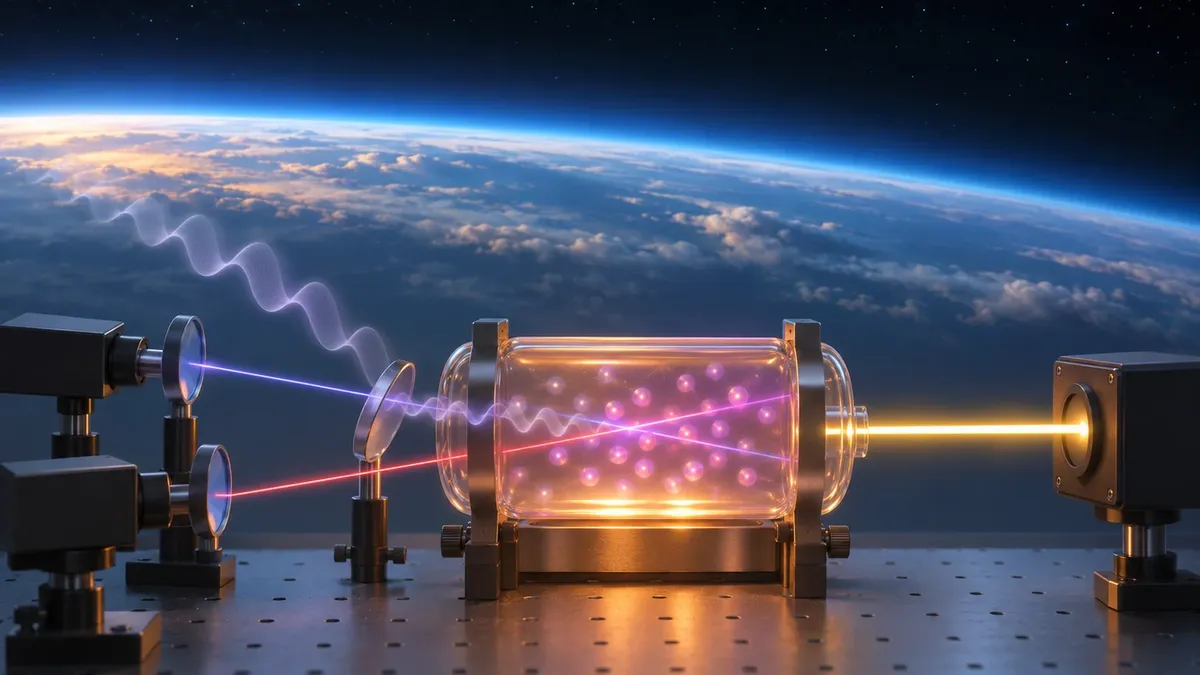
Could a cell of laser-prepared atoms offer another way to measure a faint terahertz signal from Earth’s upper atmosphere? A new study models a Rydberg-atom receiver for the 4.7 THz emission line of atomic oxygen. Its calculations outline a possible route to optical readout—but also show that the proposed design is far from a useful instrument.
The measurement challenge
The mesosphere and lower thermosphere are difficult to observe, and there is no global, long-term dataset for atomic oxygen, a key constituent of this region. One way to study it is through its terahertz emission. The paper focuses on the oxygen line at 4.7 terahertz (THz), where conventional receivers face challenges including cryogenic cooling and generating a stable local oscillator at the signal frequency.
Richard J. Murchie and colleagues assess an alternative: a receiver based on Rydberg atoms. These are atoms whose outer electrons have been excited to high energy levels, making them unusually responsive to electric fields. The proposed system would use that sensitivity to convert incoming THz radiation into light, which could then be measured with an optical detector.
The researchers ask whether such a converter could work as a radiometer for Earth observation—not whether an operational sensor has already been built.
How the study works
This is a theoretical performance analysis. The authors model a warm rubidium-87 vapor cell at 294.15 kelvin, with laser-driven atomic transitions arranged in a six-state loop. A static electric field shifts and mixes atomic energy levels so that a transition can interact with the 4.7 THz signal. Several control lasers support the conversion process, and the generated optical field carries information about the incoming radiation.
The model follows the atoms’ response and the propagation of the THz and optical fields through the cell. It includes effects such as Doppler broadening from moving atoms, spontaneous decay, blackbody-radiation-driven transitions, laser phase noise, collisions, and ionisation-related loss. The authors then calculate output photon statistics and use them to estimate noise-equivalent power, a measure of the input signal needed to rise above receiver noise.
For an atmospheric example, they use a previously simulated oxygen-line profile and estimate how much of that signal would reach the receiver. The example is not a measurement made by this proposed instrument.
What the calculations indicate
The model gives an intrinsic receiver noise-equivalent power of 15 picowatts per square root hertz under its stated assumptions, including a detector efficiency of 0.6. When translated into an idealised radiometric sensitivity for a one-second integration and a one-megahertz bandwidth, the estimate is about 772,000 kelvin. The authors compare this with a 25-kelvin sensitivity reported for a 4.7 THz radiometer benchmark and conclude that the proposed design would need major improvement to meet that benchmark.
For the atmospheric oxygen example, the calculated signal-to-noise ratio is about 0.0019. The weak result reflects both low conversion efficiency and a mismatch between the receiver’s frequency response and the shape of the oxygen emission line. The paper suggests that tuning the atomic response to better suit the target line could help, but does not demonstrate that this would achieve the required performance. Broadening the response could also reduce peak conversion or admit more noise.
The concept’s appeal is that it could operate at room temperature and may avoid a local oscillator at the incoming THz frequency. But room-temperature operation alone does not make a complete receiver practical. The proposed system also needs stable lasers, controlled electric and magnetic fields, temperature management, shielding, careful optical alignment and a calibration strategy.
What remains uncertain
The estimates are conditional on simplifying assumptions. The authors identify missing or incomplete treatments, including inhomogeneous electric fields caused by ionisation, a full non-collinear analysis of the beams, fluorescence at the detected optical frequency, laser-amplitude noise and gain drift. The noise model uses vacuum environmental noise as a lower bound; it does not fully account for atomic fluorescence and thermally driven noise. The atmospheric calculation also depends on a simulated line profile and assumptions about the scene and accepted radiation mode.
These omissions mean the quoted sensitivity should not be read as demonstrated instrument performance. The study is a preprint assessment of feasibility, not an experimental validation or a complete spacecraft design. Its results show a modeled concept with a large performance gap in the example considered, while identifying areas for future modelling and optimisation. Whether those changes can close the gap remains an open question.
- Rydberg atoms
- terahertz radiometry
- atomic oxygen
- Earth observation
- quantum sensing
- upper atmosphere
Reviewed cross-references
These connections were reviewed by a model, not independently fact-checked by a human. Similarity does not imply agreement; consult the original papers and the evidence below.
A laser-made charge source reduces stray fields around Rydberg atoms
Supporting evidence: Both papers identify electric-field control as an operational concern for Rydberg systems: Murchie et al. say their proposed radiometer requires a well-shielded, stable electric-field environment, while Deng et al. report reducing stray fields in a strontium tweezer-array experiment. The latter supports the bounded point that stray-field mitigation can matter in Rydberg experiments; it does not demonstrate mitigation in a warm-vapor THz radiometer.
Model review: · openai-codex/gpt-6-luna
Evidence and provenance
Selected excerpts, not complete papers. PDF extraction can omit figures or damage equations, tables and reading order; sources may be preprints.
2611.23193v1 — Original paper
Excerpt reference:
static/papers/2611.23193v1.md:1424-1464
Basis: Paper text
Source SHA-256:2a2f555f6c1b5fd5fed98b36e67664ed44147f289cd52a328efd7fedb2ceeb102607.08418v2 — Original paper
Excerpt reference:
static/papers/2607.08418v2.md:60-191
Basis: Paper text
Source SHA-256:fe8ada69e548c5364dd5473b88972f8ca793450ea0a2fba6b94f2df53452245b2607.08418v2 — Original paper
Excerpt reference:
static/papers/2607.08418v2.md:749-884
Basis: Paper text
Source SHA-256:fe8ada69e548c5364dd5473b88972f8ca793450ea0a2fba6b94f2df53452245b
Related reading
Automatically matched by shared topic keywords. These links do not imply that the sources agree or establish a consensus.
Cesium atoms turn a 10 MHz electric field into an optical signal
Source published
Shared keywords: rydberg atoms
Can a language model help protect spacecraft polymers from atomic oxygen?
Source published
Shared keywords: atomic oxygen
A laser-made charge source reduces stray fields around Rydberg atoms
Source published
Shared keywords: rydberg atoms
A two-stage reasoning system helps AI choose Earth-observation evidence
Source published
Shared keywords: earth observation
A promising quantum optimization strategy loses its edge when noise enters
Source published
Shared keywords: rydberg atoms