TRANSMISSION // 2611.23165v1
Teleporting a logical qubit by joining code patches
Source published
A 41-qubit superconducting device demonstrates logical-state teleportation using surface-code lattice surgery. Repeated error checks help restore fault tolerance, while streamlined circuits improve measured success probabilities.
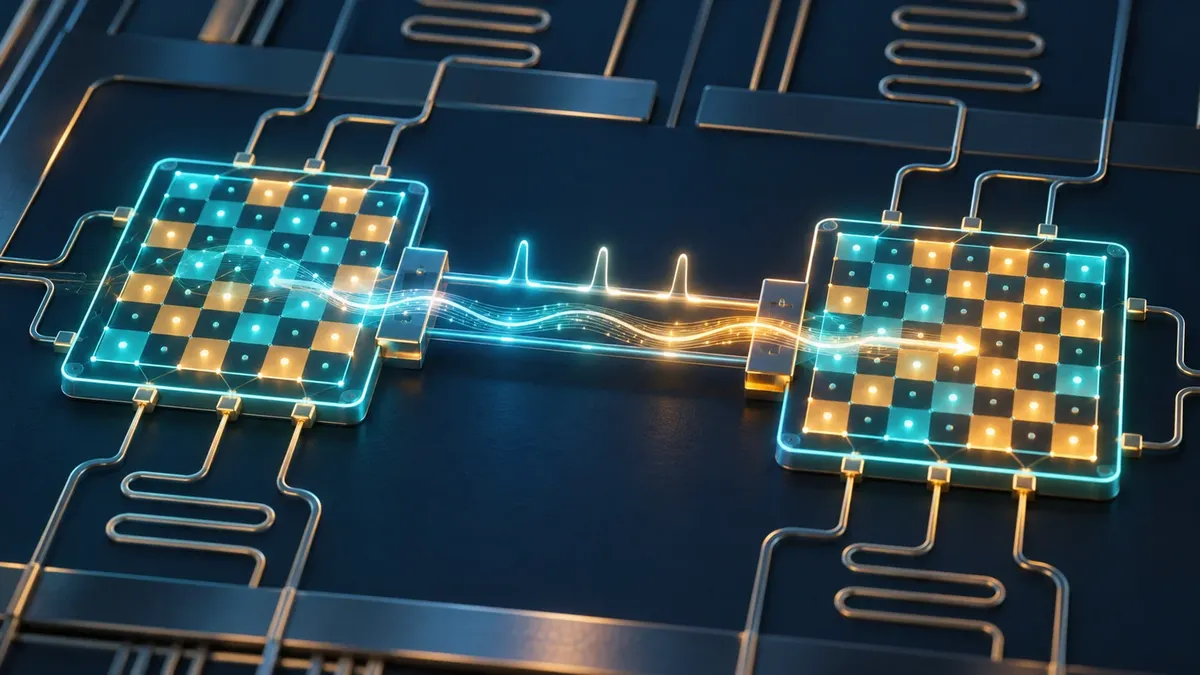
Quantum computers need ways to protect information while moving it between encoded qubits. In a superconducting-circuit experiment, researchers used lattice surgery—temporarily joining and separating surface-code patches—to teleport logical states, and tracked how error checks affected the process.
A qubit is fragile: small control errors or interactions with its environment can change its state. Quantum error correction tackles this by encoding one logical qubit across several physical qubits and repeatedly checking for signs of errors. But protecting stored information is not enough for a useful computer. Logical qubits must also be connected and manipulated without losing that protection.
The experiment reported by Luca Hofele and colleagues studies one route: lattice surgery. In this method, neighboring patches of a surface code are temporarily joined so that measurements across their boundary reveal a relationship between the encoded qubits. The patches can then be separated again. The researchers used this process to transfer a logical state from a source qubit to a target qubit.
The work was carried out on a superconducting device with 41 physical qubits. The team encoded two distance-three surface-code logical qubits. “Distance three” describes a relatively small code whose structure allows it to detect and correct certain errors, but whose protection is limited compared with larger codes. The researchers combined experimental measurements with decoding and stabilizer-circuit simulations to examine the protocol’s performance and follow logical observables—quantities that reveal information about the encoded state—at different steps.
The key question was not simply whether teleportation could be performed, but how errors changed during the operation. Joining two code patches temporarily changes which stabilizer checks are measured. Those checks act like consistency tests on the encoded information. The team found that the logical observable associated with the X basis was particularly affected by errors on the shared boundary during the merge. Repeating stabilizer measurements after the merge suppressed these errors and restored fault tolerance, meaning that the protocol could again handle the relevant faults without losing the intended logical operation.
In the fully modular version of the protocol, the reported teleportation success probabilities were 0.57 for states in the Z basis and 0.65 for states in the X basis. These are experimental results for the tested basis states, not a demonstration of teleporting arbitrary unknown quantum states with those same probabilities.
The researchers also tested streamlined circuits. Rather than keeping every component as a separate, fully fault-tolerant module, they combined parts of the procedure and removed some stabilizer-measurement rounds while retaining fault tolerance for the combined operation. The most optimized circuit achieved reported success probabilities of 0.65 in the Z basis and 0.73 in the X basis. In this experiment, reducing the number of measurements and shortening the sequence improved performance. That is a result for this device and protocol, not a general rule that fewer checks always make error correction better: the authors note that the best degree of optimization depends on the errors in the hardware.
The study also helps explain where improvements may come from. Tracking logical observables step by step exposed extra errors associated with the stabilizers at the merge boundary, beyond what the researchers attributed to errors on the data qubits alone. Their simulations reproduced broad features of the measurements, but used a simplified Pauli-noise model. The authors say it omitted effects including undetected leakage, residual interactions between qubits, and measurement-induced dephasing; those omissions may help explain remaining differences between simulation and experiment.
There are important limits to the result. The demonstration used distance-three logical qubits and reported teleportation of X- and Z-basis eigenstates, rather than full state tomography of arbitrary input states. The experiment also rejected runs in which leakage was detected, so the reported success probabilities do not describe every attempted run without that selection. The paper discusses larger code distances and improved error rates as future steps needed for more capable fault-tolerant computing; this experiment does not establish that such systems are ready for practical quantum advantage.
The source is an arXiv preprint, a research manuscript shared publicly before or outside formal journal review; its claims should therefore be read with that limitation in mind. The paper’s contribution is a detailed experimental look at logical teleportation in a small superconducting surface code: repeated checks can recover fault tolerance after merging, and carefully designed circuits can improve the measured outcome in this setting.
- quantum error correction
- lattice surgery
- logical qubits
- surface code
- superconducting circuits
- quantum teleportation
Reviewed cross-references
These connections were reviewed by a model, not independently fact-checked by a human. Similarity does not imply agreement; consult the original papers and the evidence below.
Extra qubits make quantum error checks agree
Shared method: Both use repeated stabilizer-check measurements to support fault-tolerant logical measurement: Hofele et al. experimentally report that repeated checks after merging surface-code patches restore fault tolerance, while Wang introduces globally commuting checks for gauging-based logical measurement and bounds fault propagation across rounds. The approaches and evidence differ: a distance-three superconducting-circuit experiment versus a theoretical construction with an explicit toric-code circuit.
Model review: · openai-codex/gpt-6-luna
Evidence and provenance
Selected excerpts, not complete papers. PDF extraction can omit figures or damage equations, tables and reading order; sources may be preprints.
2611.23165v1 — Original paper
Excerpt reference:
static/papers/2611.23165v1.md:57-173
Basis: Paper text
Source SHA-256:62ec94363400544fb800c4f40983dab0db9d1b20501fff9af142f4d1107fb9422611.23165v1 — Original paper
Excerpt reference:
static/papers/2611.23165v1.md:880-937
Basis: Paper text
Source SHA-256:62ec94363400544fb800c4f40983dab0db9d1b20501fff9af142f4d1107fb9422611.12236v1 — Original paper
Excerpt reference:
static/papers/2611.12236v1.md:12-64
Basis: Paper text
Source SHA-256:6aa1d95a51ca1cb3a47eaee3943fe8e164fd5b7f441f4c9cdf0d4638f8ef99282611.12236v1 — Original paper
Excerpt reference:
static/papers/2611.12236v1.md:65-127
Basis: Paper text
Source SHA-256:6aa1d95a51ca1cb3a47eaee3943fe8e164fd5b7f441f4c9cdf0d4638f8ef9928
Related reading
Automatically matched by shared topic keywords. These links do not imply that the sources agree or establish a consensus.
A quantum compiler that keeps error correction in view
Source published
Shared keywords: logical qubits, quantum error correction
How the shape of a quantum-code region determines what it reveals
Source published
Shared keywords: quantum error correction, surface code
Extra qubits make quantum error checks agree
Source published
Shared keywords: lattice surgery, quantum error correction
Quantum turbo codes reveal a trade-off between decoding rounds and computing cost
Source published
Shared keywords: logical qubits, quantum error correction
A quantum decoder that learns to adapt to changing noise
Source published
Shared keywords: quantum error correction, surface code