TRANSMISSION // 2611.23150v1
JWST Maps Omega Centauri’s Crowded Core
Source published
A new JWST catalog captures hundreds of thousands of stars in Omega Centauri, revealing detail in its stellar populations and enabling future motion studies.
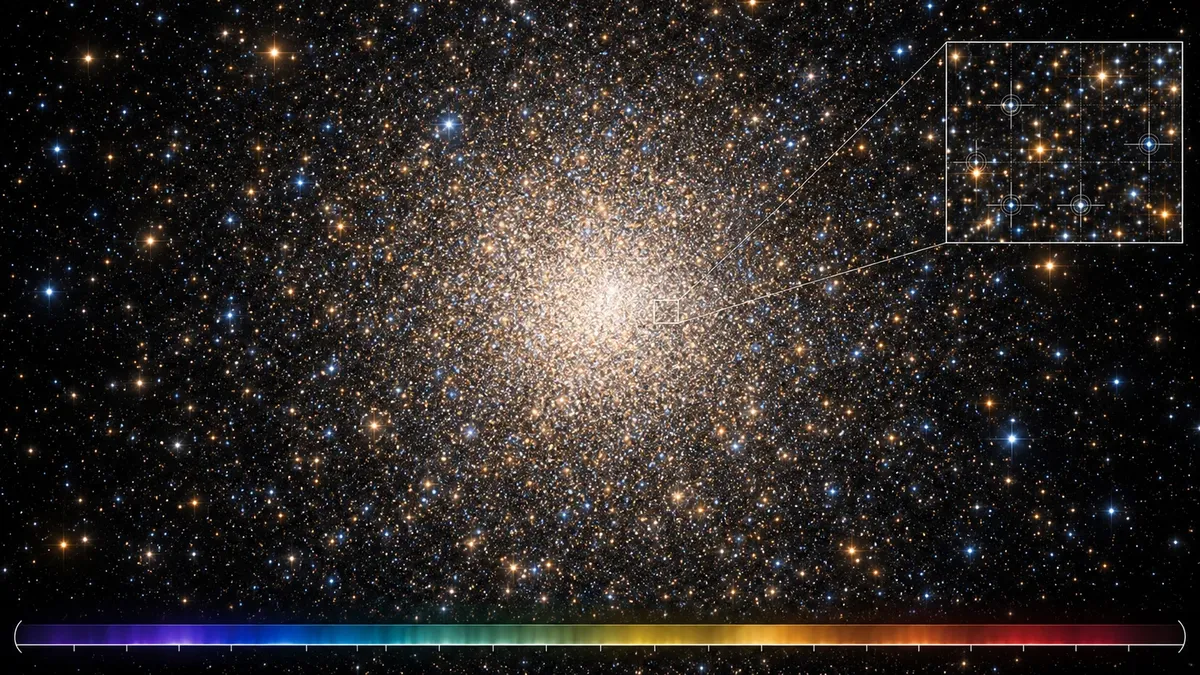
Omega Centauri’s packed core holds clues to the cluster’s history—and perhaps to an object at its center whose nature remains debated. A new catalog combines JWST’s infrared observations with earlier Hubble data to map stars and measure their positions.
Omega Centauri is the Milky Way’s most massive globular cluster. Astronomers consider it a possible remnant nucleus of a smaller galaxy absorbed by our own. Its stars include distinct populations with different chemical properties. Fast-moving stars near the cluster’s center have also been cited as evidence for an intermediate-mass black hole, but the black hole’s properties—and even the interpretation of the evidence—remain uncertain.
Tracking stars in this crowded region is difficult. Maximilian Häberle and colleagues present oMEGACat-JWST, a near-infrared catalog designed to improve measurements of stars’ brightness and positions, particularly for faint stars. It extends an earlier catalog based on Hubble Space Telescope observations and is intended to support studies of both the cluster’s populations and, with future observations, the motions of stars near its center.
Building a deeper catalog
The researchers reprocessed images from three JWST observing programs, using the NIRCam and NIRISS instruments. They measured stars’ positions and brightness with software that models each image’s point-spread function: the pattern of light produced by a point-like source. Modeling that pattern helps distinguish stars whose images overlap. The team also aligned the measurements with reference catalogs, including its earlier Hubble-based oMEGACat catalog.
The release contains about 677,000 sources across its observed fields, extending to roughly two half-light radii from the cluster center. A half-light radius is the distance from the center within which half the cluster’s light is emitted. In the region covered by both JWST and Hubble, the researchers compared which sources each catalog detected and how closely their position measurements agreed.
That comparison measures agreement between two catalogs, not the number of all stars that exist. Each catalog has its own sensitivity and limitations, and the authors say artificial-star tests are still needed to assess JWST’s absolute completeness for faint stars.
What the observations show
In the overlapping region, JWST recovered more than 90% of the sources in the Hubble catalog and added over 86,000 sources below Hubble’s detection limit. The comparison also shows that JWST misses some stars found by Hubble: the brightest can be saturated, and some faint stars lie near bright neighbors. Completeness therefore varies with brightness and location.
The team tested positional precision using repeated measurements and comparisons between observing epochs. For unsaturated stars in the most favorable brightness range, single-image precision reached about 0.5% of a NIRCam pixel, or roughly 150 microarcseconds. For stars at about magnitude 23 in the F115W filter, it was about 1 milliarcsecond. These figures describe measurement scatter under the study’s observing and analysis conditions; they do not mean every star has the same precision.
Color–magnitude diagrams—plots of stellar brightness against color—show a split in the cluster’s main sequence. The pattern is consistent with previously identified populations that differ in helium abundance. The sequence also broadens among faint stars. The authors suggest that differences in light-element abundances may contribute, because molecules in cooler stars affect their infrared colors. But the stellar models used in the paper do not reproduce the observed behavior below the main-sequence “knee,” so interpreting the faintest stars remains an open task.
Combining Hubble’s ultraviolet measurements with JWST’s infrared data creates diagrams spanning a wider range of wavelengths. Previously identified stellar subpopulations occupy distinct tracks in these diagrams. The results demonstrate how the combined data can help researchers examine population classifications and investigate the cluster’s history.
A catalog, not a black-hole verdict
This release does not determine whether Omega Centauri contains an intermediate-mass black hole. The authors say the first set of observations is not sufficient to search for the planned accelerations of the central fast-moving stars. Their monitoring campaign is expected to add observations in 2027 and 2028, which may help constrain changes in the stars’ motion. This paper reports the catalog and initial performance tests, not the result of that future investigation.
The source is an arXiv preprint whose manuscript states that it was submitted to Astronomy & Astrophysics in November 2026; the supplied material does not establish its publication or peer-review status. The paper’s main contribution is a data release and assessment of what the current observations can measure. Absolute faint-star completeness, improved models of the faint populations, and the nature of the cluster’s central object remain unsettled.
- Omega Centauri
- James Webb Space Telescope
- JWST
- star clusters
- astrometry
- stellar populations
- Hubble Space Telescope
Related reading
Automatically matched by shared topic keywords. These links do not imply that the sources agree or establish a consensus.
Why Astronomers Want a Bigger JWST Survey of the First Galaxies
Source published
Shared keywords: james webb space telescope
A nearby supernova may reveal how quickly white dwarfs can explode
Source published
Shared keywords: james webb space telescope, star clusters
How JWST Could Trace the Seeds of the First Massive Black Holes
Source published
Shared keywords: james webb space telescope
VENUS maps 60 galaxy clusters that magnify the distant universe
Source published
Shared keywords: james webb space telescope
Webb spots a faint oxygen line in a distant galaxy’s core
Source published
Shared keywords: james webb space telescope