TRANSMISSION // 2611.23110v1
When does a black hole’s ringdown mode sum converge?
Source published
A theoretical study connects convergence of Kerr black-hole mode sums to source and observer positions, with rotation adding directional effects.
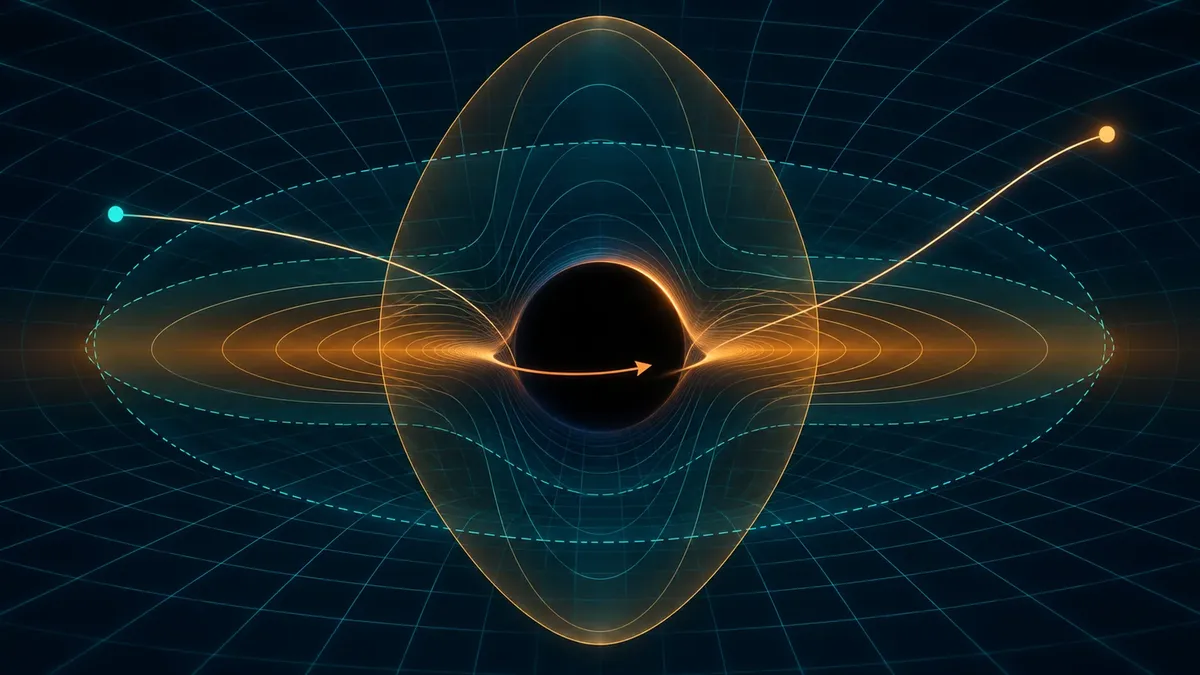
Quasinormal modes are damped oscillations used to describe a black hole’s ringdown. But adding more modes does not guarantee a better description: their amplitudes can grow even as they fade faster. A new preprint studies when these mode sums converge for a rotating Kerr black hole, using a geometric picture of bounce locations and surfaces.
When two black holes merge, the remnant emits a final gravitational-wave signal known as ringdown as it settles toward a stationary state. Physicists describe this signal with quasinormal modes: damped oscillations whose frequencies depend on the remnant’s mass and spin. Adding overtones—modes that fade more quickly—can help models reproduce a signal at earlier times. But when does their sum converge, so that it represents the black hole’s response rather than a divergent series?
Each mode’s contribution combines competing effects. Its time-dependent part decays, but its amplitude can grow with the amount of damping. A more strongly damped overtone is therefore not automatically less important in the sum. The balance depends on where an impulse begins and where its effect is observed.
Turning convergence into geometry
Davide Ciattaglia, Adrien Kuntz and Enrico Barausse investigate the retarded Green function of a Kerr black hole. It describes the response at an observer to a brief impulse at a source. The authors study gravitational perturbations using the Teukolsky equation, which describes such disturbances around a rotating black hole.
They separate the equations into radial and angular parts, then analyze amplitudes for highly damped modes. Their analytic estimates use the Wentzel–Kramers–Brillouin (WKB) approximation in the large-damping limit. They also calculate mode amplitudes numerically and compare their spatial variation with the estimates.
The analysis focuses on specified large-damping branches for gravitational perturbations with spin weight s = −2 and azimuthal index m = 2. Numerical tests use a black hole with spin-to-mass ratio a/M = 0.7. These results do not cover every Kerr mode or angular index.
For the mode sequences studied, the authors derive a position-dependent sufficient condition for absolute convergence: the elapsed time must exceed a threshold determined by source and observer locations. This is a mathematical condition for the mode sums, not a claim that every ringdown model is valid at those times.
Bounce radii—and a directional effect
For each of the two high-damping branches studied, the radial amplitude has a characteristic “bounce” radius where it is smallest. Moving away from that radius, the amplitude grows roughly exponentially with an optical distance—an effective travel-time measure in curved spacetime. Both the source and observer contribute to this growth.
Rotation adds an angular effect. The paper calls the branches prolate and oblate. In the prolate branch examined, the angular functions become concentrated around the equatorial direction in the large-damping limit. Its contribution to amplitude growth is reduced when the source or observer lies farther from the equatorial plane. For this branch, the geometry can be represented by angle-dependent “bounce surfaces.” The oblate branch has zero angular contribution to the exponential growth rate in the stated fixed-angle asymptotics, although its angular functions still vary. Its bounce surface is at constant radius. The authors caution that the oblate construction does not produce a real null front away from the rotation axis; the geometric picture should not be taken to mean both branches trace photon paths.
The combined threshold depends on both branches and on the endpoint positions. In the a/M = 0.7 case, the oblate branch sets the threshold when either endpoint is beyond the prolate bounce radius. The prolate branch can set it when both endpoints are close to the black hole and sufficiently near the equator. Angular suppression in one branch therefore does not by itself determine the convergence time for the combined sum.
Numerically calculated amplitudes reproduce the predicted spatial dependence to better than one percent in the reported tests. This supports the growth-rate estimates within the setup studied; it does not establish a start time for observed gravitational-wave ringdowns or demonstrate that a particular overtone has been detected.
What the result does—and does not—say
Convergence of a mode sum is not the same as arrival of a physical signal. At fixed angular indices, the paper finds that the pole sums can converge before the impulse’s signal reaches the observer. The complete Green function also includes contributions beyond these poles, including a prompt response and a branch-cut contribution associated with late-time tails. Those parts are not covered by the derived convergence condition.
The study treats an impulse at a point, with source and observer at finite radii. A physical source may extend across space and remain active over time, so applying the result to an actual waveform requires combining many responses. The authors say connecting their thresholds to waveforms measured far away, or to the start time of observational ringdown fits, requires further work. The analysis is a framework for understanding when these sums converge, not a direct prescription for choosing a fit start time.
This is an arXiv preprint; the supplied source does not establish that it has been peer reviewed. Its findings are theoretical and subject to further scrutiny. The authors also note independent work on Kerr bounce radii and radial convergence; this study’s stated scope includes angular dependence and numerical tests of amplitude growth rates.
- black hole ringdown
- Kerr black holes
- quasinormal modes
- gravitational waves
- mode convergence
- preprint
Related reading
Automatically matched by shared topic keywords. These links do not imply that the sources agree or establish a consensus.
Using a black hole’s ringdown to examine nonlinear gravity
Source published
Shared keywords: black hole ringdown, gravitational waves
How the early Universe’s changing particle soup could reshape gravitational waves
Source published
Shared keywords: gravitational waves
A New Search Strategy for Gravitational Waves from Eccentric Neutron-Star Binaries
Source published
Shared keywords: gravitational waves
Cosmic phase-transition simulations reveal a two-scale gravitational-wave signal
Source published
Shared keywords: gravitational waves
Blazar jets could create a background that complicates high-frequency gravitational-wave searches
Source published
Shared keywords: gravitational waves