TRANSMISSION // 2611.23104v1
Galaxy clusters test growth under a fixed cosmic model
Source published
A study of 85,818 DESI Legacy Imaging Survey clusters finds growth measurements consistent with general relativity, conditional on its cosmology and modelling choices.
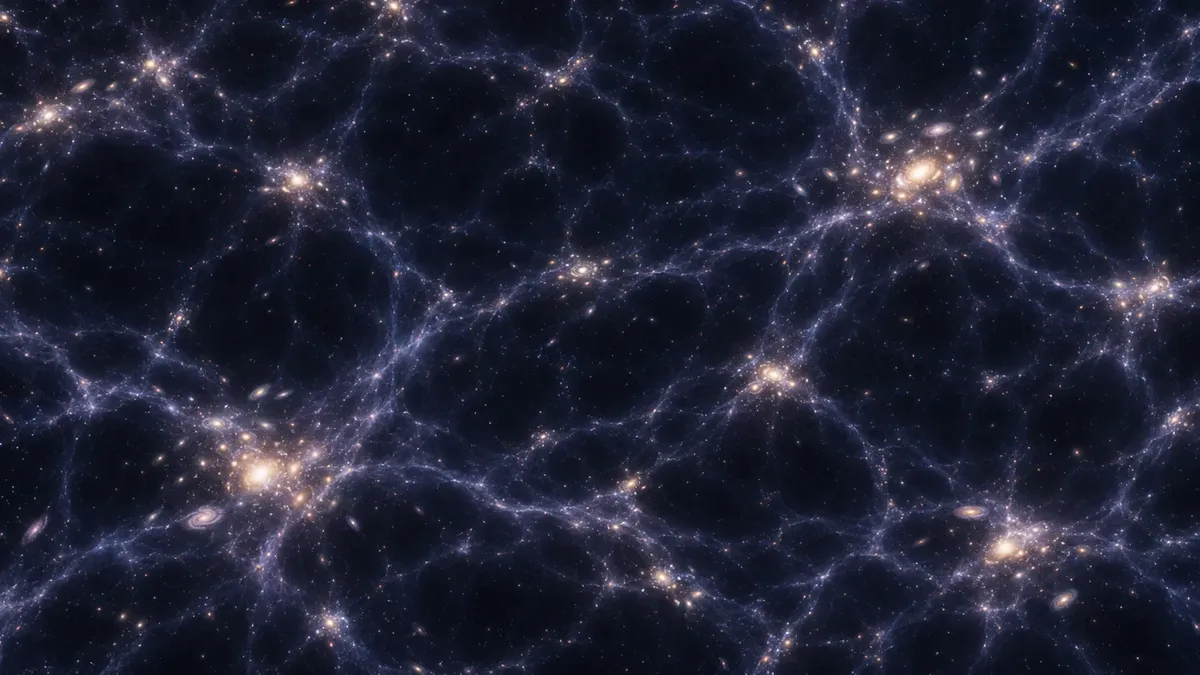
Can the way galaxy clusters are arranged across the universe reveal how cosmic structures grow? Researchers measured clustering in a spectroscopic cluster sample and compared the inferred growth with expectations from general relativity. The results are consistent with those expectations within a fiducial cosmology, but depend on assumptions about cosmic geometry, survey selection and clustering physics.
Galaxy clusters are among the largest structures bound by gravity. Their distribution across space carries information about how matter has gathered over cosmic time. In this study, researchers analysed clusters identified in the DESI Legacy Imaging Surveys to measure the growth of cosmic structure and assess whether it is consistent with general relativity (GR) under an adopted cosmological model.
The central quantity, fσ₈, combines the rate at which structure grows with the amplitude of matter fluctuations. The study does not measure gravity in isolation: its result depends on the cosmological template and modelling used to interpret the clusters.
From a cluster catalogue to a growth estimate
The researchers selected 85,818 clusters from the WH24 catalogue, which was constructed using optical and infrared imaging. The sample has spectroscopic redshifts between 0.1 and 0.4 and an effective redshift of about 0.28. Redshifts help infer distances and positions, but spectroscopic coverage is heterogeneous: whether a cluster has a spectroscopic redshift depends on its properties and location on the sky.
The team measured the redshift-space two-point correlation function, a statistic describing how often clusters appear in pairs at different separations. They analysed its monopole, which captures the average clustering pattern, and quadrupole, which captures directional variation relative to the line of sight. Motions along that line of sight affect the observed pattern, providing information about growth. Geometric distortions from converting redshifts into distances can also alter it, so the analysis fitted growth and geometry together using Alcock–Paczynski parameters.
The WH24 catalogue did not provide the selection-function information needed to build random catalogues for this analysis, including a detailed survey footprint and a quantitative model of spectroscopic selection. The researchers reconstructed the angular footprint and estimated the radial selection from the observed redshift distribution. They accounted for observed links between cluster density and foreground patterns such as Galactic extinction and stellar density. Their approach treats angular and radial selection as separable, without an explicit richness-dependent correction in the random catalogues. Simulations and other validation checks supported the method, but the reconstructed selection remains an important source of modelling dependence.
The team also used cluster counts across mass-proxy and redshift bins to estimate the sample’s effective halo bias: how strongly these clusters trace variations in matter density. That estimate informed the clustering fit. They used a one-loop perturbation-theory model, which includes some nonlinear effects, while fixing Ωₘ and σ₈—and therefore the matter power-spectrum shape—to values in a Planck-based fiducial cosmology.
Two estimates, different assumptions
With broad priors on geometric distortions, the inferred growth measure was fσ₈ = 0.45 ± 0.08 at an effective redshift of 0.28. The authors find it consistent with GR within the adopted fiducial cosmology.
With tight priors on the geometric parameters, the estimate was fσ₈ = 0.52 ± 0.03. The paper reports this result in its conclusion alongside an analysis excluding BAO scales; its detailed results also give the same value for a full-range fit with tight geometric priors. It should therefore not be read as a result uniquely produced by removing BAO scales. Tighter geometry priors reduce the growth–geometry degeneracy and yield a smaller uncertainty. Both estimates are conditional on their assumptions, not assumption-free tests.
The paper also identifies a coherent negative residual in the quadrupole. Across eight measurements at separations of roughly 40–140 h⁻¹ Mpc, the offset from the fiducial model was 2.7σ. That range was selected after inspecting the data, which can make an apparent feature seem more significant. After testing 12 possible starting scales and accounting for the choice, the authors estimate a two-sided probability of about 0.04. They describe the residual’s origin as unresolved; it does not establish a survey systematic or a modelling failure.
In a restricted analysis, the quadrupole was included only for separations r ≤ 33 h⁻¹ Mpc, while the full monopole range was retained. This gave fσ₈ = 0.26 +0.13/−0.14. The authors find the shift statistically compatible with fluctuations expected under their model, but note that the result has larger uncertainty and that part of the parameter sampling mixes slowly.
What the result can tell us
The main finding is consistency with GR within a specified cosmology and analysis—not proof that GR holds in every setting, or evidence of a departure. The clustering covariance assumes a constant-volume survey and Poisson shot noise, and omits survey-window mode coupling, connected non-Gaussian contributions and super-sample covariance. The study reports checks of selection and modelling choices, but these cannot eliminate every uncertainty in the catalogue, bias calibration or theoretical description.
The supplied source is an Astronomy & Astrophysics manuscript with proof-style text; the available evidence does not establish publication or peer-review status. The result should be read in that context. It demonstrates how cluster clustering can provide a probe of cosmic growth, while showing how its interpretation depends on the assumptions used to turn an observed pattern into a cosmological measurement.
- general relativity
- galaxy clusters
- DESI Legacy Imaging Surveys
- cosmic structure growth
- redshift-space clustering
- cosmology
Reviewed cross-references
These connections were reviewed by a model, not independently fact-checked by a human. Similarity does not imply agreement; consult the original papers and the evidence below.
Galaxy clusters reveal an ancient cosmic ruler
Shared method: Both studies use spectroscopic galaxy-cluster two-point correlation functions: Tsaprazi et al. fit redshift-space monopole and quadrupole measurements to constrain growth and geometry, while Shao et al. use the correlation function to measure isotropic BAO distances. This is a shared clustering statistic, not a shared analysis: the samples, fitting goals, and models differ.
Model review: · openai-codex/gpt-6-luna
Evidence and provenance
Selected excerpts, not complete papers. PDF extraction can omit figures or damage equations, tables and reading order; sources may be preprints.
2611.23104v1 — Original paper
Excerpt reference:
static/papers/2611.23104v1.md:1454-1531
Basis: Paper text
Source SHA-256:638a97962309506fe307d4ce9ac6cfb02e7ceb0c23dccf74e781a908bc00e8ed2611.11587v1 — Original paper
Excerpt reference:
static/papers/2611.11587v1.md:233-347
Basis: Paper text
Source SHA-256:dcca339e4fa4e0ff98e478eff4f01eea0ebb5b02a48270dd8815db3cb1a31646
Related reading
Automatically matched by shared topic keywords. These links do not imply that the sources agree or establish a consensus.
Galaxy clusters reveal an ancient cosmic ruler
Source published
Shared keywords: galaxy clusters
Galaxy Motions Help Untangle Models of Dynamical Dark Energy
Source published
Shared keywords: cosmic structure growth
VENUS maps 60 galaxy clusters that magnify the distant universe
Source published
Shared keywords: galaxy clusters
Neutron Star Tides Could Complicate Tests of Einstein’s Gravity
Source published
Shared keywords: general relativity
Using a black hole’s ringdown to examine nonlinear gravity
Source published
Shared keywords: general relativity