TRANSMISSION // 2611.23011v1
A fading X-ray pulsar reveals a two-hump spectrum
Source published
NuSTAR observations show how IGR J06074+2205’s X-ray spectrum changes as it fades, supporting—but not proving—a cold-disk accretion interpretation.
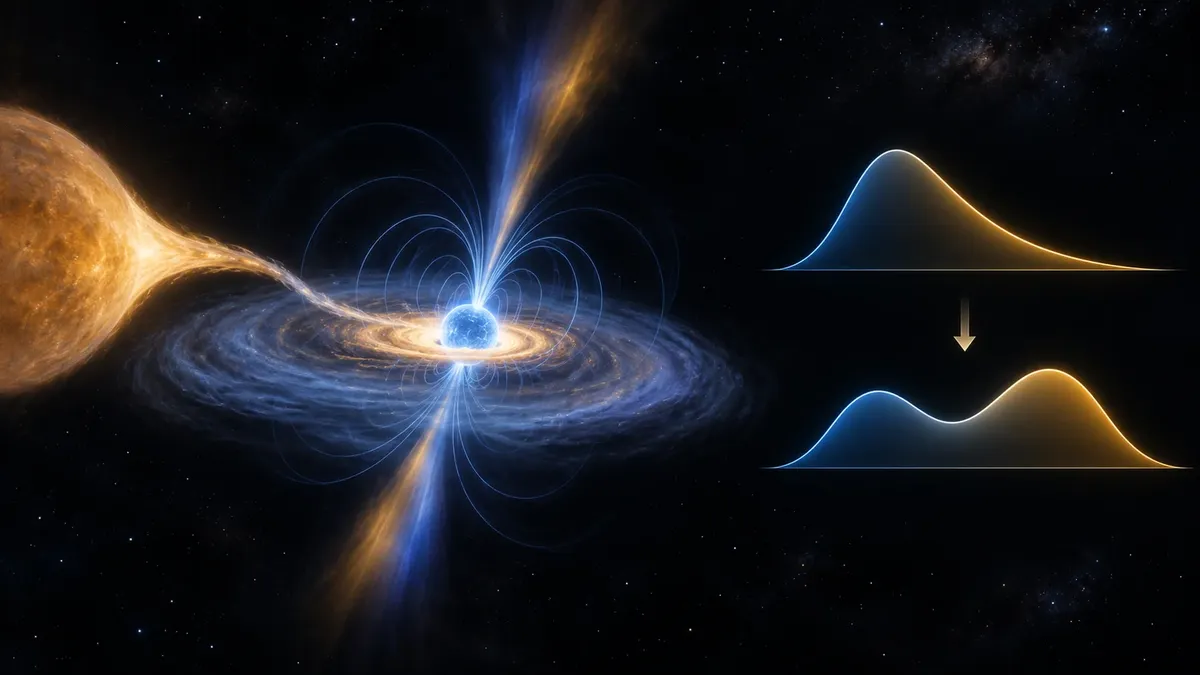
As an accreting neutron star dims, its X-ray spectrum can change shape as well as brightness. Three observations of IGR J06074+2205 trace a shift from a familiar single continuum to a two-hump pattern, offering clues about how matter reaches the star at low luminosity.
A pulsar’s changing X-ray light
IGR J06074+2205 is a Be/X-ray pulsar: a neutron star in a binary system, fed by material associated with a massive companion star. It spins approximately once every 373 seconds. As gas falls toward it, it releases energy in X-rays. The distribution of those X-rays across energy—the spectrum—can reveal how the inflowing material behaves near the neutron star’s powerful magnetic field.
A team led by Alexander Salganik studied what happens as this source fades. Their central question was whether its faintest observed state still involves matter accreting onto the neutron star, and what the spectrum can tell us about that process.
Comparing three brightness levels
The researchers analyzed three observations made with NASA’s NuSTAR X-ray telescope during outbursts in 2023 and 2025. The observations sampled a bright state, an intermediate state, and a faint state, with reported 3–79 kiloelectronvolt luminosities of about 5 × 10³⁶, 4 × 10³⁵, and 6 × 10³⁴ ergs per second, respectively. They also used monitoring data and supporting spectra from the Neil Gehrels Swift Observatory’s X-ray Telescope.
The team fitted models to the broadband spectra. At high brightness, a standard model—a power law that cuts off at high energies—described the data adequately. For the intermediate and faint states, that same model left systematic mismatches. The researchers instead used two thermal Comptonization components: a phenomenological model in which energetic electrons modify the energies of photons. Together, the components reproduced two broad humps in the spectra.
This fit describes the observed shape; it does not by itself identify exactly how each component is made. The paper discusses possible processes in the neutron star’s strongly magnetized atmosphere, including scattering and thermalization of radiation. But the authors say their data and phenomenological model cannot distinguish between proposed physical explanations.
A magnetic-field clue—and an instrumental limit
The pulsar has a cyclotron absorption feature, a spectral signature linked to the star’s magnetic field. In the bright observation, the feature was measured near 52 kiloelectronvolts. In the intermediate state, the fitted line was near 46 kiloelectronvolts and lay on top of the high-energy hump. That overlap matters: estimates of a line’s properties can depend on how the surrounding continuum is modeled.
The faintest NuSTAR observation was analyzed only up to 40 kiloelectronvolts because stray-light contamination and rising instrumental background limited the reliable energy range. The authors therefore did not report a cyclotron-line measurement in that state; the expected line energy was outside the analyzed range. Its absence from the reported fit is not evidence that the feature disappeared.
The researchers compared the faint-state two-hump spectrum’s intersection energy—the point where the two components contribute equally—with an empirical relation reported in earlier work. For the comparison, they used the cyclotron-line energy measured in the bright state, not a line measurement from the faint state. The resulting ratio was consistent with a relation based on four other sources. This does not directly measure the faint-state magnetic field or establish a particular radiation mechanism.
What the faint state may mean
Coherent pulsations have been detected at low luminosities, including in earlier observations of this source. Pulsations indicate that the emission varies with the neutron star’s rotation. Along with the two-hump spectrum, they support the authors’ interpretation that matter is still reaching the star’s magnetic poles, rather than being fully held back by the rotating magnetosphere in a “propeller” state.
The team proposes that the faint state represents stable accretion from a cold disk—a disk whose temperature falls below the hydrogen-ionization threshold while material continues inward. Their estimated transition luminosity is about 8 × 10³⁴ ergs per second, close to the faint observation’s reported luminosity. But the comparison is approximate: the theoretical estimate is bolometric, while the observed value covers a limited X-ray band. The estimate also depends on assumptions about the disk and its interaction with the magnetic field.
The result is a detailed snapshot of one pulsar across three brightness levels, not a universal account of how all such systems behave. The faint spectrum’s restricted energy coverage, the use of phenomenological fitting, and assumptions in the accretion estimate leave important questions open. The supplied document is labeled “A&A proofs” and gives an acceptance date, but this summary does not independently verify publication status.
- X-ray pulsars
- neutron stars
- NuSTAR
- accretion
- cyclotron line
- X-ray spectra
Related reading
Automatically matched by shared topic keywords. These links do not imply that the sources agree or establish a consensus.
How vacuum polarization may reshape X-rays from pulsars
Source published
Shared keywords: x ray pulsars
A pulsar’s gamma rays brighten when its X-rays fade
Source published
Shared keywords: neutron stars
The Crab pulsar may be less steady than astronomers thought
Source published
Shared keywords: neutron stars
Viewing Angle May Help Explain Black Hole Binaries’ X-Ray Spectral Turning Points
Source published
Shared keywords: x ray spectra
Testing Pulsar Evolution Before Simulating a Whole Star Cluster
Source published
Shared keywords: neutron stars