TRANSMISSION // 2611.22984v1
Estimating Long-Term Effects Across the Outcome Distribution
Source published
A proposed framework combines short-term experiments and long-term observational data to estimate treatment effects at different points in an outcome distribution.
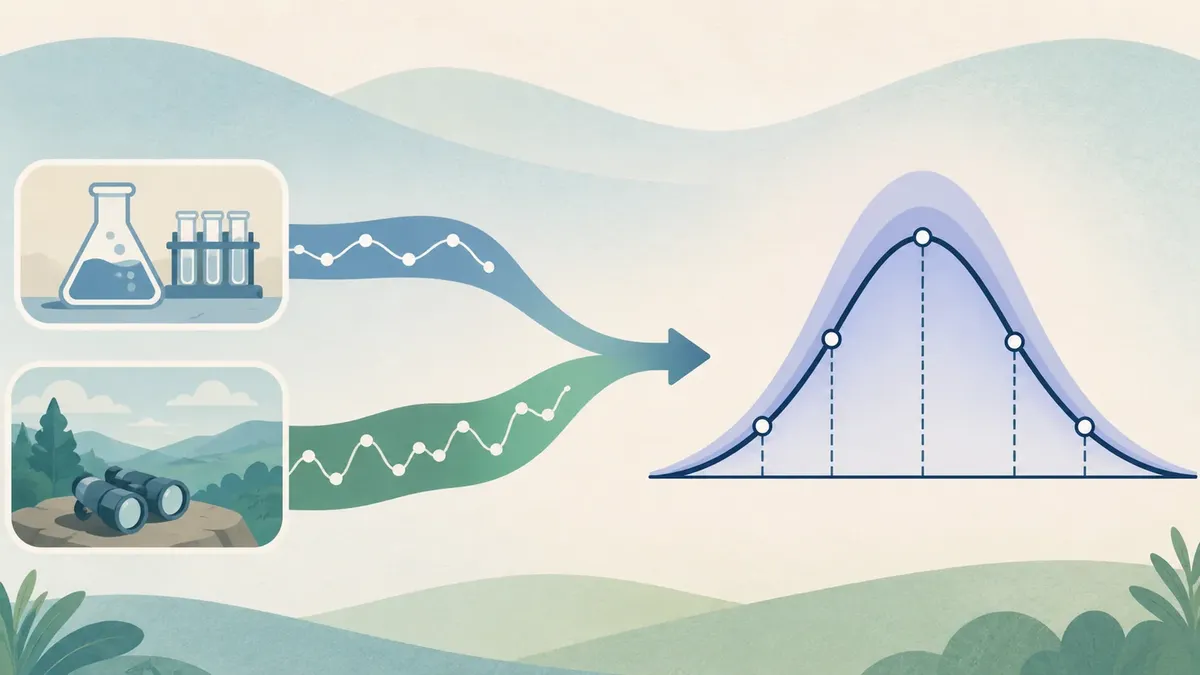
Experiments can offer a strong basis for causal comparisons, but their follow-up may be too short to reveal lasting effects. This paper develops statistical methods for using long-term observational data alongside short-term experimental data to estimate how a treatment affects different parts of an outcome distribution.
The question: what happens over the long run—and where in the distribution?
A treatment’s effects may vary across an outcome distribution. An average effect can conceal differences at different points: for example, the effect near one quantile may not match the effect near another. Long-term quantile treatment effects (LTQTEs) describe treatment effects across quantiles for outcomes measured over the long term.
The challenge is that experimental data may not include long-term follow-up, while observational data may cover a longer period. Nan Liu, Yanbo Liu, Yuya Sasaki and Yichong Zhang study how these sources can be combined to identify and estimate an LTQTE curve.
What the authors propose
The paper develops its results under a latent unconfoundedness framework. The abstract does not spell out the framework’s assumptions in detail, so their exact meaning and conditions require consulting the full paper.
The authors establish identification of the LTQTE curve and derive corresponding efficient influence functions. They then use these results to propose a semiparametrically efficient estimation procedure. For uncertainty assessment, they develop a multiplier bootstrap method intended to provide uniform inference across a continuum of quantile indices, yielding simultaneous confidence bands for the curve.
These are methodological contributions. The abstract does not report numerical estimates, an empirical application, or simulation results, so it does not show how the proposed method performs in a particular dataset or what long-term effects it estimates.
What remains uncertain
The abstract identifies latent unconfoundedness as the framework for the results but does not give enough detail to assess its assumptions or how they apply in practice. More broadly, combining experimental and observational data does not, by itself, establish that a particular long-term estimate is reliable; interpretation depends on the conditions under which the method identifies the effects. The abstract does not describe diagnostics or evidence for those conditions.
This account is based on the abstract, not a full-text assessment. The source is arXiv version 1, a preprint; the supplied information does not establish whether it has undergone peer review. Readers interested in applying the method should consult the full paper for its assumptions, technical conditions, and any supporting analyses.
- quantile treatment effects
- causal inference
- long-term outcomes
- experimental and observational data
- statistical inference
Reviewed cross-references
These connections were reviewed by a model, not independently fact-checked by a human. Similarity does not imply agreement; consult the original papers and the evidence below.
Can statistical ‘digital twins’ help evaluate job training?
Shared method: Both papers use semiparametric methods with machine-learning nuisance estimation: the origin paper describes Neyman orthogonality and cross-fitting for long-term quantile effects, while Chetty et al. use a double/debiased machine-learning estimator for earnings effects. This is a methodological connection, not evidence that either approach validates the other; their estimands, data, and identification settings differ.
Model review: · openai-codex/gpt-6-luna
Evidence and provenance
Selected excerpts, not complete papers. PDF extraction can omit figures or damage equations, tables and reading order; sources may be preprints.
2611.22984v1 — Original paper
Excerpt reference:
static/papers/2611.22984v1.md:5019-5061
Basis: Paper text
Source SHA-256:e4dade2fdffe4077ff6fc0c2b5f225107ce37d6b62436f6ec22a8a3f68b4c5c22611.03938v1 — Original paper
Excerpt reference:
static/papers/2611.03938v1.md:182-282
Basis: Paper text
Source SHA-256:aec729c2d95a90c33925c41bbaf9e9504bce2e3fc4532cce45861b4a7e8137af
Related reading
Automatically matched by shared topic keywords. These links do not imply that the sources agree or establish a consensus.
When a Few Large Groups Distort Statistical Inference
Source published
Shared keywords: statistical inference
A regression method for extreme-value patterns
Source published
Shared keywords: statistical inference
Modeling Hidden Factors in Complex Time Series
Source published
Shared keywords: statistical inference
Finding the economic estimate that local searches can miss
Source published
Shared keywords: statistical inference
Correcting economic models when the measurements are wrong
Source published
Shared keywords: statistical inference