TRANSMISSION // 2611.22675v1
When can approximate likelihoods stand in for exact ones?
Source published
A theoretical study derives conditions under which exact and approximate maximum-likelihood estimates converge for sampled multivariate diffusions.
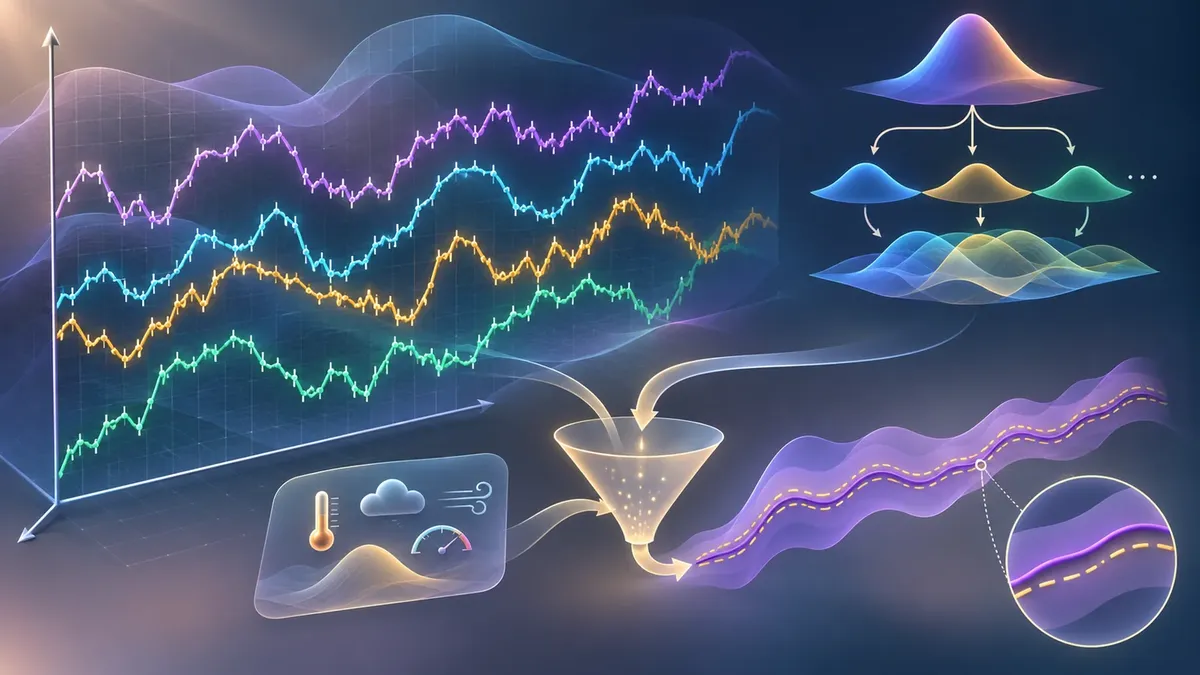
How reliably can researchers estimate a changing system from observations taken at discrete times? Duy Nguyen’s theoretical paper studies exact maximum-likelihood estimation for multivariate diffusions and asks when a likelihood built from a density approximation gives an asymptotically equivalent estimate.
A diffusion is a mathematical model of continuous change with random fluctuations. When such a system is observed at discrete times, statistical methods can use the observations to estimate its parameters. This paper examines maximum-likelihood estimation (MLE)—choosing parameter values that make the observed data most probable—for multivariate, ergodic diffusions sampled at increasingly short intervals over an increasingly long total period.
The abstract specifies conditions on the model: the drift may grow linearly, while volatility stays bounded away from zero and is either bounded or grows in proportion to one plus the state’s size. These are mathematical assumptions, not claims that a particular real-world system meets them.
The paper establishes asymptotic results for the exact MLE. With a polynomially shrinking sampling interval, the estimator is consistent, asymptotically normal and efficient. In broad terms, consistency means estimates approach the true parameter as the data grow; asymptotic normality describes their limiting distribution. The abstract reports efficiency but does not specify a framework for explaining or interpreting that property further. The convergence rates are √(nΔₙ) for drift parameters and √n for diffusion parameters, where n is the number of observations and Δₙ is the sampling interval.
The proof does not analyze the exact likelihood directly. Instead, it uses a closed-form expansion of the transition density and shows that, at every observed transition, the expansion is uniformly accurate in relative terms at sufficiently high order. This implies that the exact and expanded log-likelihoods differ by a quantity that vanishes in probability, uniformly over the parameter values considered. The same argument yields conditions under which an estimator based on an approximate likelihood is asymptotically equivalent to the exact MLE. In particular, the abstract reports that the approximate MLE of Yang, Chen and Wan converges to the true parameter under the relevant conditions.
The paper also studies the leading bias of a delta-expansion estimator of fixed order K ≥ 1. It finds that, when the bias constant is nonzero, the condition nΔₙ^(K+1) → 0 cannot be weakened. The bias falls on drift parameters for even K and diffusion parameters for odd K. Monte Carlo experiments are reported to confirm the predicted biases; the abstract gives no design details or numerical results. It also states that, with an additional condition on ergodic averages and polynomial growth of the total observation span, moments of the exact MLE converge.
These are conditional mathematical conclusions, not guarantees for every model or sampling plan. The evidence available here is the arXiv abstract for version 1, rather than the full paper. The abstract does not provide the detailed assumptions, proofs or simulation setup, and the supplied record does not establish whether the preprint has been peer reviewed. Assessing the results or applying them to a particular system requires consulting the full paper and its publication status.
- diffusion models
- maximum likelihood estimation
- high-frequency sampling
- asymptotic theory
- statistical bias
Related reading
Automatically matched by shared topic keywords. These links do not imply that the sources agree or establish a consensus.
UniRGBA adds transparency to a pretrained video generator—with trade-offs
Source published
Shared keywords: diffusion models
Making diffusion-teacher gradients cheaper to estimate
Source published
Shared keywords: diffusion models
A learned clock helps diffusion models spend sampling steps more wisely
Source published
Shared keywords: diffusion models
How separate image generators can make coordinated outputs
Source published
Shared keywords: diffusion models
Teaching molecular AI chemistry rules in stages improves 3D generation
Source published
Shared keywords: diffusion models