TRANSMISSION // 2611.22643v2
A hidden phase in quantum dynamics
Source published
A proposed measurement method reveals interference information that standard quantum correlations can miss.
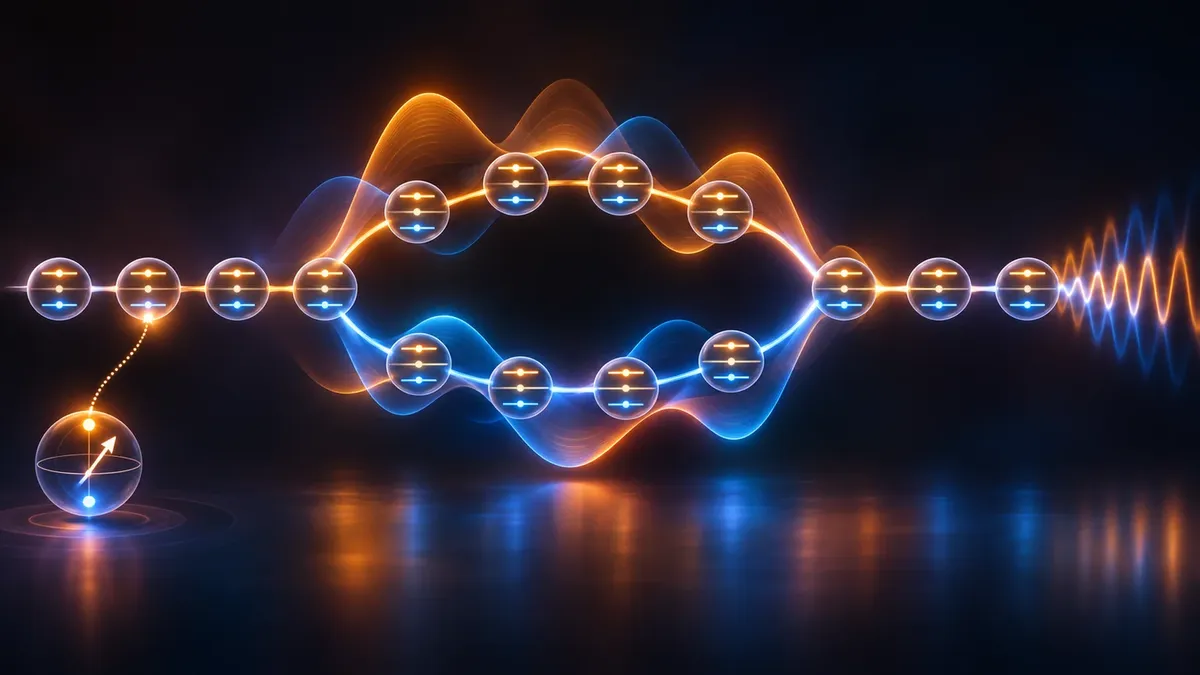
Out-of-time-order correlators are useful probes of how quantum information spreads, but they do not capture every feature of a system’s dynamics. A new theoretical study examines whether a richer quantity—the extended Kirkwood–Dirac quasiprobability—can reveal some of what those correlators leave out, and how to measure it without reversing the system’s evolution.
A quantum system can follow several possible paths through time, and those paths can interfere. Some familiar measures of quantum dynamics capture only part of that interference. In a preprint, Wenzheng Dong, Alexander Yosifov and Jinzhao Sun propose a way to access an additional part: the imaginary component of an extended Kirkwood–Dirac (KD) quasiprobability.
The question matters because out-of-time-order correlators, or OTOCs, are widely used to study how information spreads through interacting quantum systems. They track changes in the relationship between observables measured at different places and times. But at infinite temperature, the usual OTOCs made from two repeated Hermitian observables contain only weighted sums of the real part of the extended KD quasiprobability. Its imaginary part can therefore hold dynamical information those OTOCs do not show.
Interference between echo paths
The authors interpret the KD quantity as a set of overlaps between alternative “echo” paths. In this picture, a system evolves forward, is described through a sequence of measurement outcomes, and is compared with another possible sequence. The overlap between two paths has a real and an imaginary component—like two complementary coordinates describing an interference signal. Negative or complex values are why the quantity is called a quasiprobability: unlike an ordinary probability distribution, it need not be nonnegative or even real.
The paper proves a key condition for seeing an imaginary component. At infinite temperature, it vanishes for every unitary evolution if either of the two projective measurements has only two outcomes. If both measurements have at least three outcomes, complex values occur for generic unitary dynamics, though particular systems can still have a zero signal. A spin-1 site, with three resolved levels, is one example of a system that can support the effect. This is a statement about the number of measurement outcomes, not simply about whether a system is “classical” or “quantum.”
Reading the signal with a probe
The proposed reconstruction method uses a local qubit probe coupled to the many-body system at two times. The system evolves forward only; the protocol does not require reversing its dynamics or reading out the system itself. Instead, researchers would prepare repeated copies of randomized initial states, measure the probe’s response, and calculate covariances—how signals vary together across those preparations. The paper derives how these covariances can recover the real and imaginary parts of the KD quantity.
The method has practical requirements. It depends on global randomized-state preparation, repeatable experiments, calibrated probe couplings and enough measurements to control statistical noise. The authors’ analysis also identifies a trade-off: finite probe coupling introduces bias, while reducing sampling uncertainty requires more random states and measurement shots. The proposed protocol is therefore a measurement strategy, not a claim that the signal is effortless to obtain in current experiments.
A spin-1 test case—and its boundaries
The authors apply the idea to a simulated spin-1 chain, using exact diagonalization for chains of up to seven sites and numerical simulations of the probe measurements. In this model, they report that the imaginary signal changes sign when the Hamiltonian is reversed from H to −H, even though the corresponding Hermitian OTOCs are identical. They also find that, at short times, the signal has opposite signs on opposite sides of a pair-conversion resonance, while dipolar and quadrupolar OTOCs remain nearly unchanged. The authors interpret this as an additional constraint that could help distinguish candidate dynamics when inferring a Hamiltonian.
These examples show what the measure can add in the studied setting; they do not establish that it will distinguish every pair of systems or make Hamiltonian inference generally reliable. The resonance indicator is a short-time result in a particular model, and at longer times higher-order effects can shift where the signal crosses zero. The paper also notes that extending the probe method to thermal initial states remains open: state coherences can produce imaginary values even with two-outcome measurements, complicating their interpretation.
The work is a theoretical and numerical study, not a report of an experimental demonstration. Its conclusions depend on the stated measurement and temperature assumptions, and its proposed implementation needs further experimental evaluation. As a preprint, it may not yet have undergone peer review. For now, the result is best read as a promising framework for asking a sharper question of quantum dynamics: not only how large an observable’s correlations become, but also what phase information is hidden between alternative histories.
- quantum dynamics
- Kirkwood–Dirac quasiprobability
- out-of-time-order correlators
- quantum interference
- spin-1 systems
- Hamiltonian inference
Reviewed cross-references
These connections were reviewed by a model, not independently fact-checked by a human. Similarity does not imply agreement; consult the original papers and the evidence below.
One Extra Qubit, Many More Ways to Observe Quantum Dynamics
Shared method: Both papers use a coherently controlled qubit probe to access dynamical information through interference: Dong et al. reconstruct a Kirkwood–Dirac quasiprobability from probe-signal covariances across randomized initial states, while Du et al. use a coherent ancilla to interfere dynamical trajectories and estimate multi-time correlators. The protocols and target quantities differ, so this is a shared broad interferometric approach, not the same algorithm.
Model review: · openai-codex/gpt-6-luna
Evidence and provenance
Selected excerpts, not complete papers. PDF extraction can omit figures or damage equations, tables and reading order; sources may be preprints.
2611.22643v2 — Original paper
Excerpt reference:
static/papers/2611.22643v2.md:68-272
Basis: Paper text
Source SHA-256:bcf7d6736f4a1d5c605dfd97afb3e4eaffc2d5f91862b6bd3970e864ec758c1f2611.30876v1 — Original paper
Excerpt reference:
static/papers/2611.30876v1.md:55-95
Basis: Paper text
Source SHA-256:9cb049760dea0af260f0cb4d418a2d4f5a5e94b199cdd929d71a044f57e974cb2611.30876v1 — Original paper
Excerpt reference:
static/papers/2611.30876v1.md:337-386
Basis: Paper text
Source SHA-256:9cb049760dea0af260f0cb4d418a2d4f5a5e94b199cdd929d71a044f57e974cb
Related reading
Automatically matched by shared topic keywords. These links do not imply that the sources agree or establish a consensus.
A middle state gives spin-1 quantum annealing another route
Source published
Shared keywords: spin 1 systems
Can NMR Track Quantum Information Spreading Through Proteins?
Source published
Shared keywords: out of time order correlators
A neutron ‘transistor’ controls spin through quantum interference
Source published
Shared keywords: quantum interference
How selecting quantum outcomes could make a clock appear to run ahead
Source published
Shared keywords: quantum interference
How unequal cavity losses could steady single-photon emission
Source published
Shared keywords: quantum interference