TRANSMISSION // 2611.22543v2
A graph-based approach to robot world-model drift
Source published
JointGV pairs visual predictions with a separately predicted scene graph to reduce accumulated errors in tested robot-model rollouts.
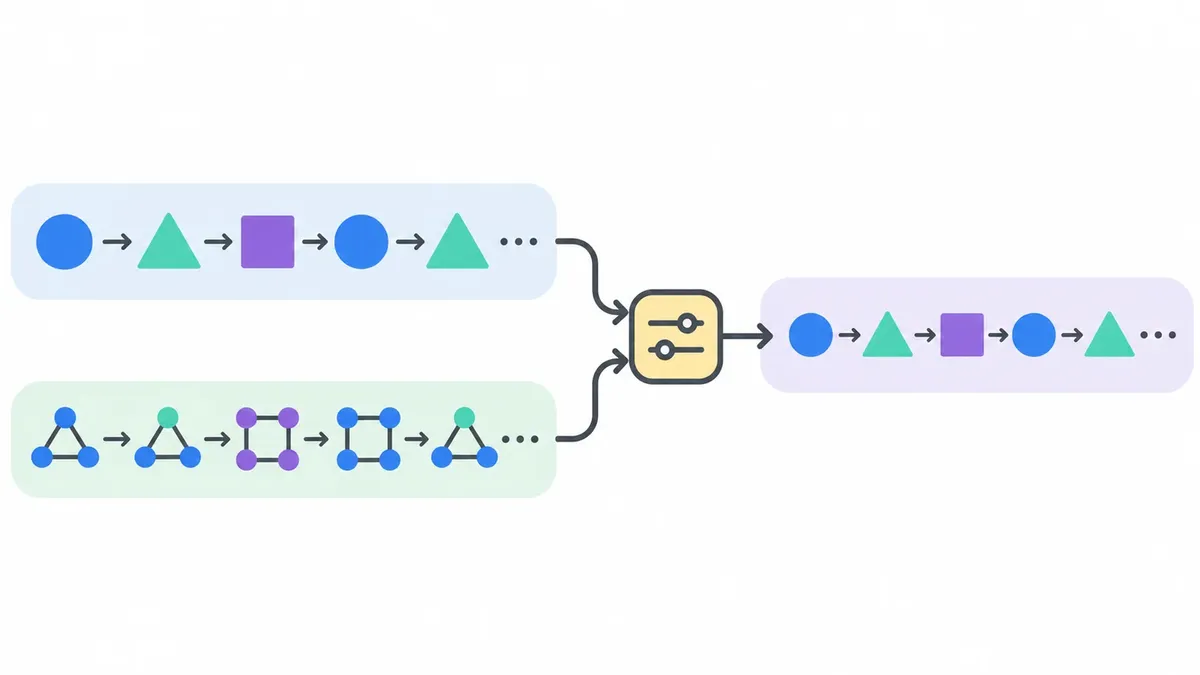
When a robot’s AI imagines what will happen after a sequence of actions, small prediction errors can build up. A new plug-in called JointGV tests whether a separate, graph-based account of scene changes can help reduce that drift.
A robot that plans ahead needs a useful model of how its body and surroundings will change. Visual world models make predictions from images and proposed actions. But when each imagined state becomes the starting point for the next, mistakes in positions and spatial relationships can accumulate, and the predicted future may diverge from what happens.
In an arXiv preprint, Tian Lyu and colleagues ask whether a separate representation of objects and their relationships can help correct this drift without rebuilding the visual model itself. Their approach, Joint Graph–Visual Dynamics Correction (JointGV), runs a scene graph alongside an existing visual world model.
Two views of the same movement
A scene graph represents task-relevant entities as nodes, with information about their positions and relationships. In JointGV, node roles are defined for the task and supervised during training; the method does not automatically discover what every object or robot part should represent. At inference, it constructs the graph from images rather than receiving simulator states.
JointGV predicts how graph nodes change under an action, while the original world model predicts changes in its visual representation. The two systems do not share matching components or a common feature space. JointGV’s central hypothesis is that their changes nevertheless describe the same physical transition. It learns to relate those changes, then combines that motion information with the graph’s predicted node positions to produce a bounded adjustment to the visual prediction. The graph and correction losses do not update the original visual model’s encoder or dynamics.
The researchers attach JointGV to DINO-WM, which predicts spatial visual tokens, and DreamerV3, which uses a global latent state. They test the systems on simulated running and walking tasks, and on a contact-rich simulated task in which a robot finger turns a spinner. They also assess predictions from recordings of a physical inverted pendulum. Most tests use open-loop rollouts: models predict multiple steps from recorded actions without receiving future images along the way.
Better predictions in the tested rollouts
Across the main 32-step simulated locomotion comparisons, JointGV reduced measured joint-position error by 11–28%, depending on the model and task. The authors also report improvements in visual-prediction measures. On the finger-and-spinner task, the DINO-WM version had lower 32-step joint-position and RGB prediction errors than its uncorrected counterpart.
On recordings of the physical inverted pendulum, JointGV reduced DINO-WM’s average 32-step pole-angle error from 12.56 degrees to 6.69 degrees. The paper also reports improvements for DreamerV3 and LeWorldModel on those recordings. These are open-loop prediction results, not evidence that the method has solved physical robot control.
The team tested whether corrected imagined rollouts could help train a policy. In a MuJoCo simulation of the pendulum, a policy trained using JointGV-corrected DINO-WM predictions completed 46 of 50 six-second episodes; one trained using the original predictions completed none. This comparison is in simulation. On hardware, a selected representative trial showed the corrected-rollout policy keeping the pole near upright at 1.27 seconds, while the original-rollout policy’s pole had fallen. But all seven paired preliminary hardware trials ended at the angle-triggered stop, and the authors report that reliable six-second physical balancing has not been achieved.
What remains uncertain
Several comparisons support the proposed role of graph information in the tested settings. In a Cheetah Run ablation, graph-conditioned corrections improved on visual-only residual corrections, including a control given the same node annotations but not predicted graph states. For spatial tokens, learned matching of graph changes to visual changes reduced error compared with broadcasting the same mean graph motion to every token in the reported comparison. The extra benefit was concentrated in cases where non-adjacent parts came close together in the image. These results do not establish that the same advantages will hold across other robots or environments.
JointGV adds computation, uses task-defined node roles, and depends on the quality of graph observations and predictions. The authors report weaker performance when graph initialization is severely corrupted and identify inaccurate predicted positions, including in cases of limb overlap, as a remaining failure mode. Broader testing and dependable physical closed-loop control remain open challenges.
This work is presented as an arXiv preprint, not a settled result established through peer review. Its experiments cover specified simulated tasks and robot recordings; they do not show that the approach generalizes to arbitrary robots or settings. The findings support further testing of graph-based corrections for visual predictions, while leaving clear limits on what can be concluded about real-world control.
- robotics
- world models
- scene graphs
- robot learning
- visual prediction
- simulation
Reviewed cross-references
These connections were reviewed by a model, not independently fact-checked by a human. Similarity does not imply agreement; consult the original papers and the evidence below.
Teaching robot video models to focus on what moves
Supporting evidence: In separate evaluations, JointGV reports improved visual-prediction accuracy when a predicted scene graph corrects rollouts, while MoReWorld reports stronger simulator-faithfulness scores when a predicted motion region guides video generation. These findings support the bounded idea that auxiliary structure can improve action-conditioned visual prediction in the evaluated settings; the tasks and metrics differ, so they do not establish comparable effect sizes or broad generalization.
Model review: · openai-codex/gpt-6-luna
Evidence and provenance
Selected excerpts, not complete papers. PDF extraction can omit figures or damage equations, tables and reading order; sources may be preprints.
2611.22543v2 — Original paper
Excerpt reference:
static/papers/2611.22543v2.md:13-83
Basis: Paper text
Source SHA-256:d99c8e922a2b110268bbccfaecb71f1bb874a95b0fa0917ffb197d1cb816b6692611.27344v1 — Original paper
Excerpt reference:
static/papers/2611.27344v1.md:13-77
Basis: Paper text
Source SHA-256:15519900f5bbf63f29419fea3708e0d6a4212b324271c72091d55f5a3b021b43
Related reading
Automatically matched by shared topic keywords. These links do not imply that the sources agree or establish a consensus.
How a Robot Can Predict a Moving Target
Source published
Shared keywords: robot learning, world models
A smoother way for robot AI to imagine what actions do
Source published
Shared keywords: world models
Teaching a robot model to predict what its actions will change
Source published
Shared keywords: robot learning
A food-picking robot learns what its scoop may leave behind
Source published
Shared keywords: robot learning, world models
WorldFlow predicts motion in both pixels and 3D
Source published
Shared keywords: world models