TRANSMISSION // 2611.22374v2
A compact driving model, tested against the limits of open-loop evidence
Source published
AutoE2E combines camera views, map and route information to predict vehicle motion. Its KITScenes results are promising, but they do not establish safe autonomous driving.
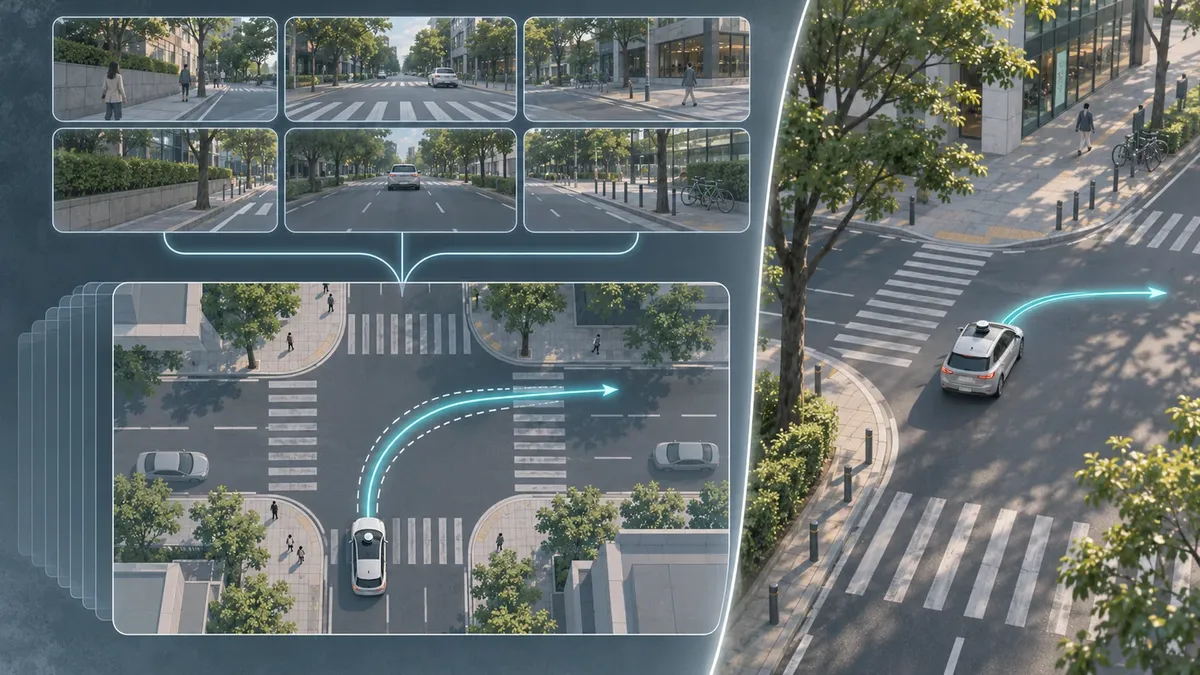
A driving model can predict where a car should go without proving it can safely drive there. AutoE2E is an open-source system that uses camera images, an HD map and a route to predict motion. Its authors report low trajectory errors on a driving-data benchmark, while emphasizing that the release has not demonstrated validated closed-loop autonomous driving.
A trajectory is not a driving test
Self-driving systems must turn observations into actions, but research often evaluates a simpler question: given a recorded scene, how closely does a model’s predicted path match the human driver’s path? This is called open-loop evaluation. It can measure prediction accuracy on logged data, but the model does not control a moving car in response to what happens next.
AutoE2E, an open-source research release from the Autoware Foundation Robotaxi Working Group, focuses on that prediction task. The paper describes it as a compact, deterministic “reactive” model: it produces one trajectory for each input rather than generating multiple candidate paths. The project’s title refers to a design that does not use a language model; the evaluated system predicts motion directly, without a natural-language reasoning trace.
Cameras, maps and a planned route
The model processes six camera views over time, alongside a high-definition map, a selected route and a history of the vehicle’s own motion. It converts camera information into a bird’s-eye-view representation—a top-down feature map that helps relate objects and road layout to the vehicle. Map and route features are then fused with that representation. A recurrent planner predicts acceleration and curvature over time, which are integrated into a path.
The evaluated configuration has about 79.9 million parameters, but only about 1.45 million are trainable: most of the camera-based backbone is kept frozen from pretrained weights. The v1.0 release includes checkpoints, training and evaluation code, and DataModelConsole, a dashboard for inspecting experiments and predicted trajectories.
The team trained a baseline using nuPlan data, then fine-tuned it on KITScenes, a European driving dataset with high-definition maps. Its main evaluation used KITScenes’ validation split, where map and route inputs were available. The authors also report a camera-only test track, but it uses a different set of scenes. Those two evaluations therefore cannot show what the map and route themselves contributed: that would require comparing inputs on the same scenes.
What the benchmark shows
On the KITScenes validation set, the fine-tuned checkpoint had an average displacement error of about 0.745 metres and a final displacement error of about 2.020 metres at a three-second horizon. Average displacement error measures the mean gap between predicted and recorded positions across the horizon; final displacement error measures the gap at its endpoint. These are measures of agreement with logged driving, not direct measures of safety or successful navigation.
The paper also compares several models on a smaller, shared set of 202 keyframes. The authors caution that model inputs, camera setups and training differ, so this is not a controlled comparison of overall capability. They report that AutoE2E’s fine-tuned checkpoint had the lowest errors at some horizons, while another model had lower errors at others. Such results are best read as benchmark-specific observations, not a general ranking of systems.
The paper includes selected real-world driving scenes and preliminary work with the Technical University of Munich’s EDGAR vehicle platform. These demonstrations are qualitative, not a representative statistical test. The authors also describe an initial closed-loop simulation experiment: the baseline completed five scenes without collision, but left the road in four. They traced this behavior to feedback from the model’s own motion history and describe further testing as future work.
What remains unknown
The central limitation is the gap between predicting a recorded path and controlling a vehicle. AutoE2E v1.0 has not demonstrated validated closed-loop autonomous driving or been evaluated with closed-loop safety and intervention metrics. The benchmark covers five seconds of future motion, while the model predicts 6.4 seconds; some predicted output is therefore not assessed. The route supplied in KITScenes is also reconstructed retrospectively from the lane sequence the human driver took, so the study does not establish robustness to route errors.
This is an early research release, not evidence that the system is ready for deployment. Its code and visualizations may make the work easier to inspect and build upon, but open access does not replace independent validation. The article is based on an arXiv preprint; preprint findings may not have undergone peer review, and the paper itself identifies evaluation gaps and checkpoint quality gates that were not passed. Its numbers support a limited claim: the released model can match recorded trajectories on specified datasets. Whether it can drive safely when its own actions change the scene remains an open question.
- autonomous driving
- trajectory prediction
- bird’s-eye view
- open-loop evaluation
- KITScenes
- Autoware
- robotaxis
Related reading
Automatically matched by shared topic keywords. These links do not imply that the sources agree or establish a consensus.
A Driving AI That Weighs What Might Happen Next
Source published
Shared keywords: autonomous driving, trajectory prediction
A driving planner that looks where each route leads
Source published
Shared keywords: autonomous driving
How AXE Selects Driving Paths in Simulation
Source published
Shared keywords: autonomous driving
DriveFoundry links driving-data corrections with selective AI reasoning
Source published
Shared keywords: autonomous driving
Instant NuRec: A One-Pass Route to 3D Driving Scenes
Source published
Shared keywords: autonomous driving